

Beyond Basics: How Advanced Accounting Courses Help You Master Financial Statements


Most people start learning accounting in the same traditional way. Debit here. Credit there. Record transactions. Prepare a balance sheet. Maybe a profit and loss statement. At first, it feels mechanical. Almost like following a recipe. But somewhere along the way something changes. You realise accounting isn’t really about recording numbers. It’s about understanding what those numbers are trying to say about a business. That shift usually happens when someone moves beyond the basics. And that is exactly where Advanced Accounting Courses begin to matter. Because once you reach that stage, the real challenge isn’t preparing financial statements anymore. It is learning how to read them properly. And sometimes that takes practice. A lot of it.
30-Second Summary
Still treating accounting as simple debit-credit entries? That’s no longer enough.
In today’s business environment, you need more than bookkeeping, you need financial clarity and control.
This blog shows you how advanced accounting courses help you move beyond basic entries to real financial insight. You’ll learn how to interpret balance sheets, profit & loss statements, and cash flows together, so you can identify risks, track performance, and make confident decisions.
In short, this is how you transition from recording numbers to becoming a decision-maker who is accurate, audit-ready, and in control.
The moment accounting stops being just bookkeeping
If you have studied basic accounting, you already know the three core financial statements.
1) The balance sheet
2) The profit and loss statement
3) The cash flow statement
Most introductory courses teach you how financial statements are prepared. That part is important. But advanced accounting starts by asking different questions. Have you ever looked at a financial statement and wondered, what do these numbers actually mean?
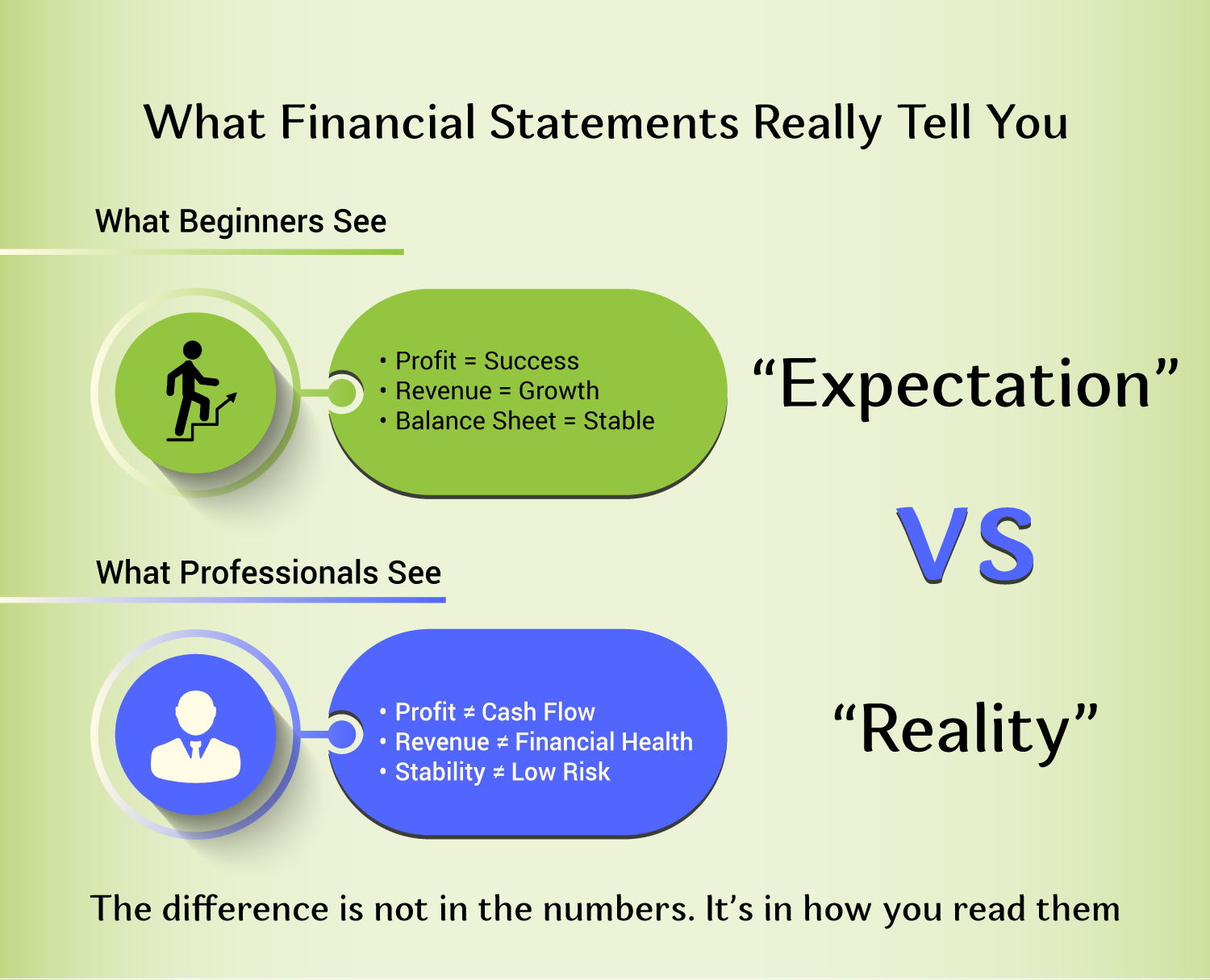
How can a company show strong profits on paper yet constantly struggle with cash flow?
And how do two companies with the same revenue end up with completely different balance sheets?
These are not beginner-level doubts. These are the questions real professionals deal with every day. That’s exactly what an advanced financial training course prepares you for.
You don’t just read financial statements, but you start analysing them. You learn to evaluate profitability, liquidity, and solvency with clarity and confidence.
Financial statements tell stories
Once, looking at the annual report of a mid-sized manufacturing company, things looked great on the surface. Revenue had grown. Profits had grown. Everything seemed healthy. But when someone examined the cash flow statement closely, a different picture appeared. Most of the profit existed only on paper. Cash inflow was weak. The company had aggressive credit sales. That one detail changed how investors interpreted the entire business. This is exactly why advanced accounting training focuses heavily on financial statement analysis. It teaches professionals how to interpret income statements, balance sheets, and cash flows together instead of looking at them individually. Because businesses rarely hide problems in obvious places. You have to read between the lines.
Where advanced accounting skills really help
Basic accounting teaches how to record transactions. Advanced accounting teaches how to think about them. Students in advanced accounting courses start working with situations that feel closer to real business environments. Complex transactions. Adjustments. Consolidations. Foreign currency operations. They also learn how financial statements interact with each other.
For example, when assets change, the balance sheet changes. It will exhibit the classic cascading effect on the depreciation expenses, tax calculations, and eventually profit figures as well. But what happens next? An advanced course takes you deeper. Instead of just knowing what is recorded, you begin to understand why it behaves the way it does.
You explore how assets are managed, how liabilities impact decisions, how shareholder equity evolves, and how cash actually moves through a business. Have you noticed how some businesses look profitable but still run out of cash? Or how small changes in liabilities can completely shift financial stability? At this stage, accounting stops being about memorising rules. It becomes about understanding systems.
The role of accounting software in modern finance
Now think about how businesses operate today. Do companies still maintain books manually? Not really. Today, most companies rely on accounting software. Entries flow automatically, reports are generated instantly, and financial data updates in real time.
So, the real question is, ‘Are you prepared to work in that environment?’ That’s why many advanced learners choose to pursue a professional Tally course after completing their basic accounting studies. Because understanding concepts is one thing and applying them in real-time systems is another. Working with accounting software changes how people experience finance. Instead of isolated journal entries, you start seeing complete business workflows. Sales transactions feed into ledgers. Payroll updates expense records. Inventory changes cost structures. It all connects.
A Tally professional course helps learners understand how these financial processes operate inside real businesses. And honestly, that exposure can make financial statements feel far less abstract. They start looking like the output of a living system.
When financial statements become decision tools
Here is something interesting. Most people assume financial statements exist only for accountants. But we all need it, and businesses revolve around it. Managers rely on them to plan budgets. Investors use them to evaluate companies. Banks review them before approving loans. Even government authorities depend on financial statements for regulatory compliance. An advanced accounting training focuses heavily on interpretation of these statements.
And what do you actually learn through this? You learn to analyse profitability in practical scenarios. You evaluate liquidity to understand whether a business can survive short-term pressures. You assess financial risk before it becomes a problem.
You also explore tools like:
- Ratio analysis to break down performance
- Budgeting to plan ahead
- Forecasting to reduce uncertainty
- Cost management to control expenses
But here’s the real shift. Have you ever felt that financial statements are just static reports? Once you understand how these tools work, that feeling disappears. You start seeing movement, patterns, and signals. Financial statements stop being documents.
They become stories you can read, question, and act on. They become decision-making instruments.
Why advanced accounting skills matter for career growth
Many accounting professionals begin their careers with basic bookkeeping responsibilities. Recording transactions. Maintaining ledgers. Assisting with documentation. They are just the foundations of the profession. Of course, they are important, but career growth often comes when professionals develop deeper financial insight. When they can analyse business performance. When they can explain why profit margins are changing. When they can identify financial risks before they become problems.
This is where advanced accounting courses help bridge the gap between operational accounting and financial expertise. They train professionals to move from recording numbers to interpreting them. That transition changes how employers view an accountant.
Learning accounting the way businesses actually use it
One of the biggest differences between beginner training and advanced training is realism. At the beginner level, examples are usually simplified. At the advanced level, scenarios become messy. Realistic. You may encounter incomplete financial data. Complex ownership structures. Multi-branch accounting. Foreign currency transactions. Courses that combine theory with software training help learners experience how these complexities appear in real financial systems.
This is why many professionals pursue structured programs like a Tally professional course, where advanced accounting concepts are applied using practical business tools.
You can explore the course here if you want to see how it works in practice:
https://tallyeducation.com/tepl/offline-courses/tally-professional/
Sometimes seeing the system in action is the moment everything finally clicks.
So, what really changes when you move beyond the basics?
At the beginning of an accounting career, most people focus on accuracy. Entering the right numbers. Making sure the ledgers match. Later, the focus shifts. The question becomes different. What are these numbers telling us about the business? That shift is subtle. But it changes everything.
A Professional tally course or other advanced accounting training does not simply teach more technical rules. It teaches how to think like a financial professional. And once you start looking at financial statements that way, they stop feeling like reports. They start feeling like stories about how a business actually works.
Frequently Asked Questions
Question 1: What are Advanced Accounting Courses?
Answer: Advanced Accounting Courses go beyond basic bookkeeping and financial recording. They focus on complex accounting topics such as financial statement analysis, consolidation, asset valuation, taxation adjustments, and financial reporting.
Question 2: Who should take a Professional tally course?
Answer: A Professional tally course is usually suitable for students who already understand basic accounting and want to develop practical accounting software skills used in real businesses.
Question 3: What skills are taught in a Tally Professional course?
Answer: A Tally Professional course typically includes financial reporting, GST compliance, payroll management, inventory accounting, and advanced business accounting workflows.
Question 4: Why is financial statement analysis important?
Answer: Financial statement analysis helps professionals understand the financial health of a business by evaluating profitability, liquidity, efficiency, and risk.
Question 5: Do advanced accounting courses improve career opportunities?
Answer: Yes. Professionals who understand advanced accounting concepts and financial statement analysis often qualify for higher-level accounting roles because they can support financial decision-making within organisations.

Tally Education
Tally Education empowers learners with industry-relevant skills in accounting, finance, taxation, and business management through practical learning and certifications. Our blogs are created and reviewed by subject matter experts to deliver accurate, practical, and up-to-date insights on accounting, GST, taxation, finance, and TallyPrime.