

Business Accounting Course vs Financial Accounting: Key Differences Explained


If you’ve spent any time looking into accounting careers, you’ve probably noticed something a little confusing. Financial accounting and business accounting. They look almost identical. Many students assume they mean the same thing. Then you talk to people working in accounts departments, and you realise the difference is actually quite big. And if you’re planning to take a Business Accounting Course, this distinction matters more than you might expect. Because one teaches you the theory of accounting. The other teaches you how accounting actually happens inside a business.
Let us discuss that a little deeper in this blog. Just the practical difference. Ready? Dive in.
30-Second Summary
Financial accounting is mainly about reporting financial information to external stakeholders. Investors, regulators, and auditors. Whereas, business accounting focuses on managing everyday financial activity within the company.
One explains the numbers. The other works with the numbers every single day.
| Aspect | Business Accounting | Financial Accounting |
|---|---|---|
| Focus | Daily financial transactions | Financial reporting |
| Purpose | Manage internal business operations | Present financial performance |
| Users | Business owners, accountants | Investors, regulators |
| Learning style | Practical and application-based | Conceptual and theory-heavy |
| Career impact | Job-ready accounting roles | Finance and audit roles |
If you’re looking for an accounting course for beginners, this difference helps you decide which path actually prepares you for real world work.
What Is Financial Accounting?
Financial accounting is the structured process of recording, summarising, and presenting financial information about a business. It is the branch of accounting that focuses on financial statements that help people outside the organisation understand the company’s financial health.
Think of it like the official report card of a business. Financial accounting usually involves preparing documents such as:
- Balance sheets
- Profit and loss statements
- Cash flow statements
- Annual financial reports.
Regular academic programs like B.Com and M.Com provide substantial knowledge of financial accounting. And some of you might be interested in taking up professional finance courses. However, the focus in academic programs is often on accounting principles, reporting frameworks, and financial statement preparation. You study principles, frameworks, and reporting formats. You understand how transactions should be classified and how financial statements are prepared.
And all of that knowledge is useful. But here’s the thing many students realise later. Knowing how financial statements are structured does not always mean you know how businesses record their daily transactions. That’s where the next part comes in.
What Is Business Accounting?
Business accounting focuses on the operational side of accounting. The daily work that keeps a company’s financial records organised and accurate. It’s practical. It’s ongoing. And sometimes, it’s a bit messy. Real businesses rarely move in perfectly structured steps.
A business accounting course typically trains students to handle real accounting tasks that happen inside companies every day.
That might include:
- Recording sales and purchase transactions
- Managing invoices and bills
- Tracking payments from customers
- Monitoring expenses
- Handling GST calculations and returns
- Maintaining inventory records
These tasks form the backbone of business financial management. And they require more than theoretical knowledge. They require Practical Accounting Training where students actually work through accounting scenarios and learn how transactions flow through a business.
You start seeing how the pieces connect. Sales affect receivables. Purchases affect inventory. Taxes affect reporting. Once that picture becomes clear, accounting starts feeling far less abstract.
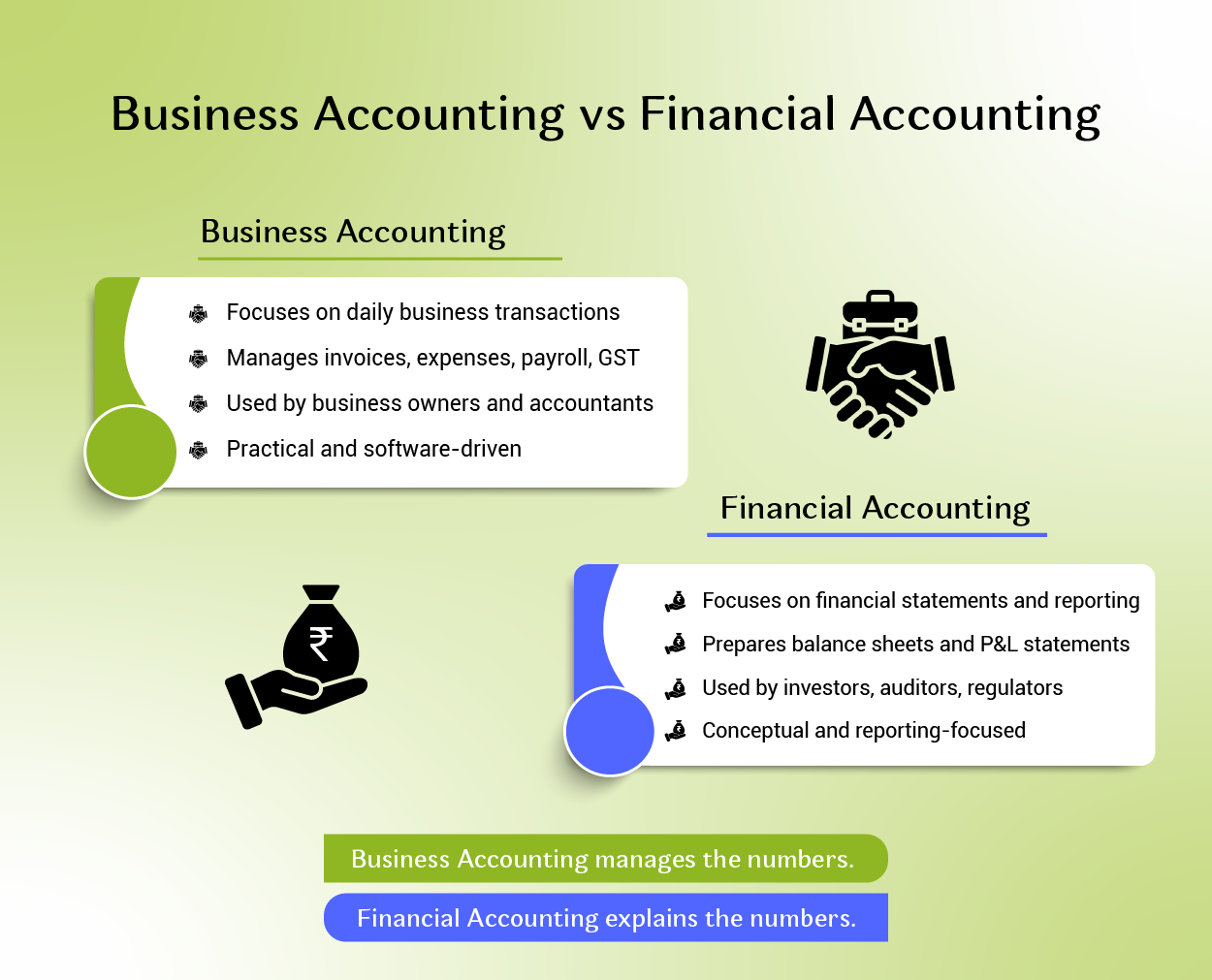
Major Differences Between Business Accounting and Financial Accounting
Both fields deal with financial information, but their purpose and approach are quite different. Let me explain.
- Purpose
Financial accounting focuses on communicating financial information to external stakeholders. Business accounting focuses on managing financial activities inside the organisation. One reports the outcome. The other manages the process.
- Learning Approach
Financial accounting is usually taught through textbooks, case studies and theoretical frameworks. A business accounting course focuses heavily on practical accounting training, where learners work with real transaction examples and accounting systems. You don’t just read about accounting. You actually perform accounting tasks.
- Tools Used
Financial accounting primarily involves preparing structured reports. Business accounting relies on accounting systems and software to manage daily transactions. Modern accounting roles require professionals to be comfortable using digital accounting tools such as Tally.
- Career Application
Financial accounting knowledge is often used in roles related to auditing, financial reporting or corporate finance. Business accounting skills are used in operational roles such as accounts executive, accountant or finance assistant. These professionals handle the financial records that businesses depend on every day.
- Job Readiness
Students who only study theoretical accounting sometimes struggle when they enter their first job. That’s why accounting training is increasingly valued by employers. It helps candidates transition smoothly into real accounting work environments.
Why Beginners Should Start with a Business Accounting Course
For many students, starting with a business accounting course can make learning accounting feel far more approachable. Especially if they are searching for an accounting course for beginners.
Why? Because practical learning removes a lot of the confusion that comes with purely theoretical study, accounting starts making more sense to beginners when they see how transactions work in real business scenarios.
- Beginner-Friendly Learning
A good accounting course for beginners introduces concepts gradually. Students begin with basic accounting principles and slowly move into more practical tasks such as recording transactions and generating reports. That’s steady progress and smoother learning imparting confidence to the beginners. - Hands-On Learning
Practical accounting training plays a big role here. Students get to practice real tasks like entering invoices, recording payments and preparing financial summaries instead of just reading about the processes. In the beginning, it might feel like a big task, but you must believe that confidence builds with repetition.
- Faster Job Readiness
Students who complete an accounting course often feel much more prepared when they step into their first accounting role. Because they’ve already seen how accounting systems work and they’ve already practiced handling transactions.
What You Learn in Practical Accounting Training
A structured program focused on practical accounting training usually covers the key financial activities businesses deal with every day.
Learners typically explore areas such as:
- Accounting fundamentals and principles
- Recording and managing financial transactions
- GST basics and compliance procedures
- Inventory and stock management
- Payroll accounting
- Preparing financial reports
- Working with accounting software
By learning these, you are not just gaining some skills, but you are understanding how accounting systems function in real organisations. And accounting stops feeling complicated, and it becomes a structured way of tracking business activity.
Career Opportunities After a Business Accounting Course
Completing a business accounting course can open the door to several entry-level roles in finance and accounting.
Some common career options include:
- Accountant
- Accounts executive
- GST assistant
- Payroll executive
- Finance executive
Businesses of all sizes need professionals who can maintain accurate financial records. With strong accounting training, learners can build a solid foundation and gradually grow into more advanced finance roles.
Who Should Take an Accounting Course for Beginners?
An Accounting Course For Beginners is suitable for commerce students who wish to build job skills. Graduates sometimes use it to strengthen their accounting knowledge before entering the workforce.
Working professionals may join to improve their financial understanding or transition into accounting roles. You also see entrepreneurs enrolling in such programs because they want a clearer understanding of their own business’ finances. And when you understand the numbers, running your business becomes much less stressful.
How to Choose the Right Accounting Course
Not all programs focus on real-world job skills. So, when selecting a business accounting course, it helps to look for a few important elements. Courses that emphasise practical accounting training tend to provide stronger career preparation.
Hands-on exercises and real transaction examples make learning far more effective. A structured curriculum also helps beginners progress step by step without feeling overwhelmed. If the course is designed well, learners finish with both conceptual understanding and practical confidence. Which, if you think about it, is exactly what employers look for.
Conclusion
Financial accounting and business accounting both play important roles in the world of finance. Financial accounting focuses on structured reporting and financial statements. Business accounting focuses on the daily financial activities that keep businesses running smoothly.
For students who want to build real-world accounting skills, a business accounting course combined with strong practical accounting training can be a valuable starting point. And for anyone exploring an accounting course for beginners, learning the practical side of accounting often makes the entire subject easier to understand.
Once you start seeing how real transactions flow through a business, the theory begins to click. At that point, accounting stops feeling like a difficult subject. It just starts feeling logical.
Frequently Asked Questions about Accounting Course
Question 1: Is financial accounting enough to get an accounting job?
Answer: Financial accounting provides important theoretical knowledge. However, many employers prefer candidates with practical accounting training because it prepares them for real business tasks.
Question 2: Who should take a business accounting course?
Answer: A business accounting course is ideal for:
- Commerce students
- Job seekers entering finance roles
- Entrepreneurs managing business finances
- Professionals switching to accounting careers
Question 3: Is an accounting course for beginners difficult?
Answer: No. A structured accounting course for beginners breaks down accounting concepts into simple steps. With practical examples and software training, learning becomes easier and more intuitive.
Question 4: Does practical accounting training include GST?
Answer: Yes. Most practical accounting training programs include GST invoicing, return filing, and compliance procedures, which are essential for modern businesses.