


Cash Flow Statement: Meaning, Components, Importance and Format Explained


30-Second Summary
A business may be profitable on paper, but does it have cash to pay its expenses and meet its financial obligations? That’s where a Cash Flow Statement comes in. It shows the movement of cash and cash equivalents into and out of a business over a period of time and helps to assess its liquidity and financial health. In this blog, we will understand what a Cash Flow Statement is, why it is important, its three main activities such as operating, investing and financing and how it helps businesses make better financial decisions.
Introduction
If a business is profitable and doesn’t have enough cash available, it can have difficulty paying its suppliers, employees or lenders. So, profit alone does not tell the whole story of a company’s financial health. The answer is the Cash Flow Statement. It describes the sources and uses of cash and cash equivalents during an accounting period and shows the flow of cash and cash equivalents.
In this blog, we will learn about Cash Flow Statement, Importance of Cash Flow Statement, Main Components and Classification of Cash Flows.
What Is a Statement of Cash Flows?
The Cash Flow Statement is a financial statement which provides information on all cash inflows and cash outflows of a business in a given accounting period.
In simple terms, it answers three fundamental questions:
• How much cash did the business produce?
• Source of cash?
• Where did the money go?
For example, a company might receive cash from customers, pay its suppliers, buy machinery, pay off a loan or raise money by issuing shares. Those transactions impact the cash position of the company. They are reflected in the cash flow statement as per their nature. This statement classifies cash flows into operating, investing and financing activities in a broad sense.
Why Is a Cash Flow Statement Useful?
A cash flow statement shows the real movement of cash in and out of a business, a core concept covered in our Accounting Course that every finance professional should master. Here’s why it matters:
- Supports Liquidity Assessment:
It tells you if a company has enough cash to pay off its short-term debts, like payments to suppliers, employees and others.
- Shows Cash Sources and Uses:
The statement explains the sources and uses of the company’s cash during the accounting period.
- Assists in Financial Planning:
Cash flow information can be used by management to plan for future expenses, investments, borrowings and other financial activities.
- Helps in Investment Decisions:
Investors can evaluate if the company is consistently generating cash flow from its core business operations.
- Helps the Lenders to Assess Repayment Capacity:
Cash flow information can be used by banks and other lenders to see if a business has enough cash to repay loans and interest.
What Are the Three Parts of a Cash Flow Statement?
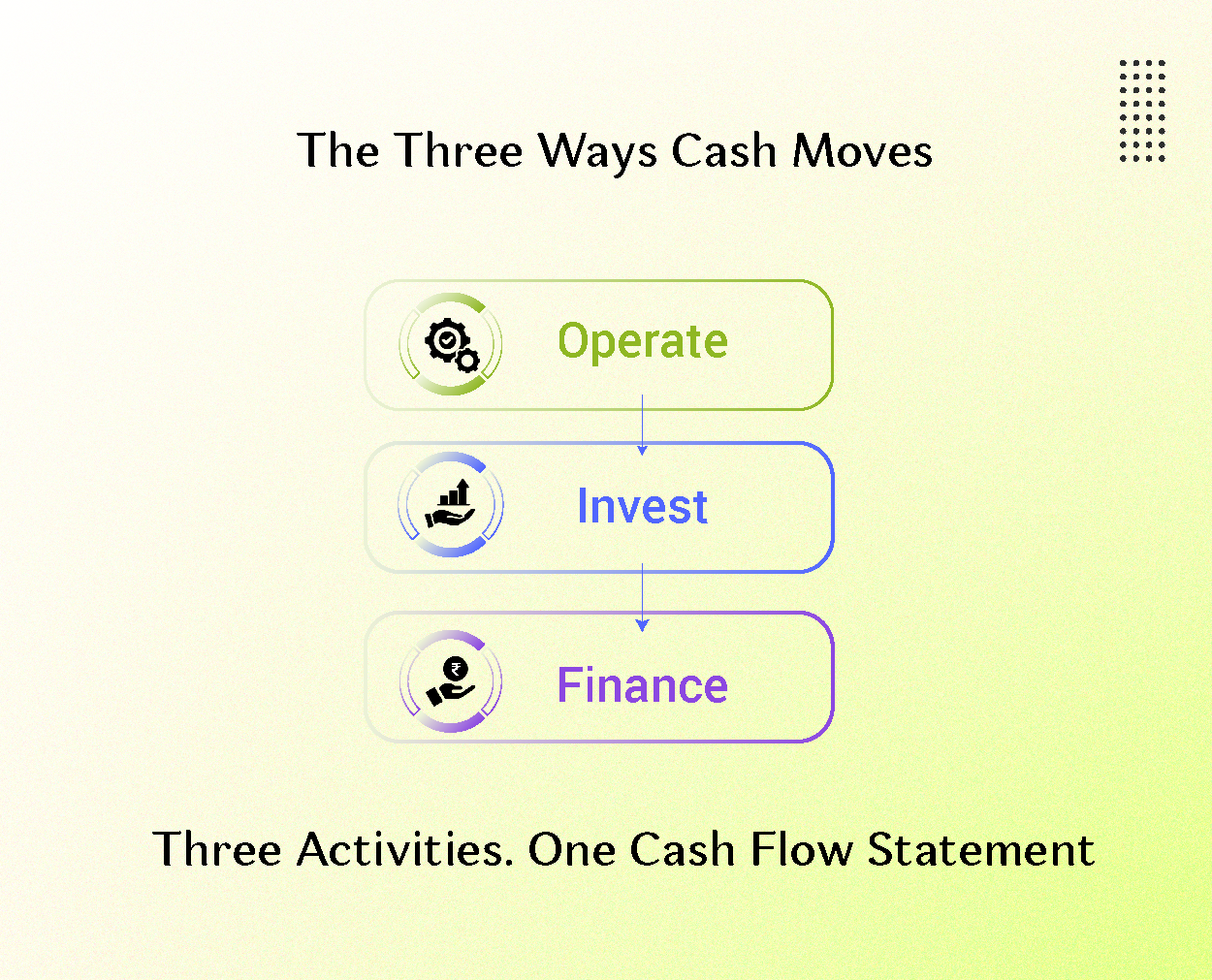
The cash flow statement is broadly divided into three sections.
1. Cash Flow from Operating Activities
2. Investing Activities Cash Flows
3. Cash flows from financing activities
Let us understand each one.
Operating Activities Cash Flows
Operating activities are the main revenue generating activities of the entity. These activities produce cash flows from the company’s ongoing business operations.
Some examples are:
• Cash received from customers
•Cash paid to suppliers
• Payments to employees
• Cash paid for operating expenses
• Cash Payments for Taxes, subject to relevant classification requirements
For example, if a company earns ₹10 lakh by selling goods and receives the amount in cash from the customers, then the cash received from the sale is an operating cash inflow. Similarly, if the company pays ₹4 lakh to suppliers for goods bought, it is an operating cash outflow.
A consistently positive cash flow from operating activities is typically a good sign as it shows the core business is generating cash.
Cash Flows from Investing Activities
Investing activities represent the purchase and sale of long-term assets and other investments not included in cash equivalents.
Here are some examples:
• Acquisition of machinery
• Property, plant and equipment disposal
• Investment in long-term assets
• Sales of investments
• Loans provided to other parties
• Recovery of loans and advances as per the applicable classification
For example, if a manufacturing company purchases machinery for ₹20 lakh, it is an outflow of cash from investing activities. Similarly, if the company later sells an old machine for ₹5 lakh, the cash received would normally be recorded as an investing cash inflow.
Investing cash flows help the users of the financial statements to know how the company is using its cash to acquire or dispose of long-term resources.
Cash Flows from Financing Activities
Financing activities are related to changes in the capital structure of the company and borrowings. They are about how a business gets money and how it pays that money back to investors or lenders.
For example:
• Issue of equity shares
• Problem of debt
• Proceeds from borrowings
• Payment of loans
• Repurchase of preference shares or debt
• Dividends payable, if applicable under the relevant accounting framework
For example, if a company takes bank loan of Rs 50 lakh, then the amount received is usually a financing cash inflow. And the repayment of ₹10 lakh of the loan is a financing cash outflow.
Cash Flow Statement Example
The simplified cash flow statement can be illustrated as follows:
| Details | Amount (₹) |
|---|---|
| Cash Flow from Operating Activities | XXX |
| Cash Flow from Investing Activities | XXX |
| Cash Flow from Financing Activities | XXX |
| Increase / (Decrease) in Cash and Cash Equivalents | XXX |
| Add: Opening Cash and Cash Equivalents | XXX |
| Cash and Cash Equivalents at the End of the Period | XXX |
The closing cash and cash equivalents should be reconciled with the respective cash and cash equivalent balance reported in the financial statements, subject to the relevant accounting requirements.
Cash Flow from Operating Activities (Direct & Indirect Methods of Preparation)
Cash flows from operating activities may generally be presented using the direct method or the indirect method, depending on the applicable accounting framework.
Direct approach: Direct method reports major categories of gross cash receipts and gross cash payments.
For instance:
• Customer payments
• Payments in cash by vendor
• Money paid to employees
• Cash payments from operations, other
Indirect Technique: With the indirect method you start with the profit or loss. You then make adjustments for non-cash items and changes in working capital to arrive at cash generated from operating activities. Depreciation, for example, is a non-cash expense. Therefore, under the indirect method, it is adjusted while determining cash flows from operating activities.
Cash Flow Statement vs Income Statement
Both statements serve different purposes.
| Cash Flow Statement | Statement of Income |
|---|---|
| Shows cash and cash equivalents movement | Shows income, expense and profit and loss |
| Highlights cash receipts and cash payments | Comprises cash and non-cash items |
| Classified into operating, investing and financing activities. | Income and expense classification |
| Helps evaluate liquidity | Helps evaluate profitability |
Therefore, a profitable business does not necessarily mean that it has strong cash flows.
Key Takeaways
Cash Flow Statement Cash flow statement is a financial statement that reports the cash and cash equivalents that have moved into and out of a business over a specific accounting period. It divides cash flows into operating, investing and financing activities, which helps stakeholders understand how a company generates and uses its cash. Good for business owners to manage liquidity and plan for future financial needs. It is a key tool for lenders and investors to evaluate the company’s ability to generate cash and pay its debts. The cash flow statement, the Balance Sheet and the Profit and Loss Statement together give a more complete picture of a company’s financial performance and financial position.
FAQs (Frequently Asked Questions)
Question 1: What is the cash flow statement?
Answer: A Cash Flow Statement is a financial statement that reports the cash and cash equivalents that have entered and left a business during a specific accounting period.
Question 2: What are the three types of cash flow?
Answer: There are three types. They are cash flow from operations, investing activities and financing activities.
Question 3: Why is Cash Flow Statement Important?
Answer: The Cash Flow Statement is a useful tool for assessing a company’s liquidity, cash generation ability, financial planning and ability to meet short-term and long-term financial obligations.
Question 4: Define cash flow from operating activities?
Answer: Operating activities are cash that is generated or used in the core business activities of the company. For example, cash received from customers and cash paid to suppliers and employees.
Question 5: What are cash flows from investing activities?
Answer: The net cash provided by or used in investing activities consists of the purchase and sale of long-term assets and investments. Examples include buying machinery, selling property & buying/selling investments.
Question 6: What is the cash flow from financing activities?
Answer: Cash flow from financing activities includes all transactions that affect the capital and borrowings of the firm. For example issuing of shares, taking loans, repaying borrowings and other financing transactions.
Question 7: What is the difference between profit and cash flow?
Answer: Profit is the excess of income over expenses for an accounting period while cash flow is a record of the actual movement of cash and cash equivalents. A company can be profitable but cash-poor because it is selling on credit, paying back a loan, or buying assets.

Nita R
Nita is a content writer specialising in Accounting, Finance, GST, and Taxation. She creates easy-to-understand, research-driven content that simplifies complex financial and tax concepts for learners, professionals, and businesses. Her expertise lies in translating technical accounting and GST topics into practical insights, helping readers stay informed about tax compliance, financial processes, and industry best practices. Through her content, she aims to make accounting and taxation accessible, accurate, and relevant for today's evolving business environment.