

E-Invoicing Under GST: Rules, Eligibility & Process Explained


30-Second Summary
E-invoicing is hassle free and a smarter way to create and manage invoices digitally. It is mandatory for businesses with turnover above ₹5 crore. This applies mainly to B2B and export transactions. The invoices are generated, validated, and authenticated through the Invoice Registration Portal (IRP). The e-invoice consists of a unique IRN and QR code. It also updates your GST returns. In simple terms, e-invoicing helps the business in staying fully compliant, avoiding errors and working more efficiently.
What Is an E-Invoice?
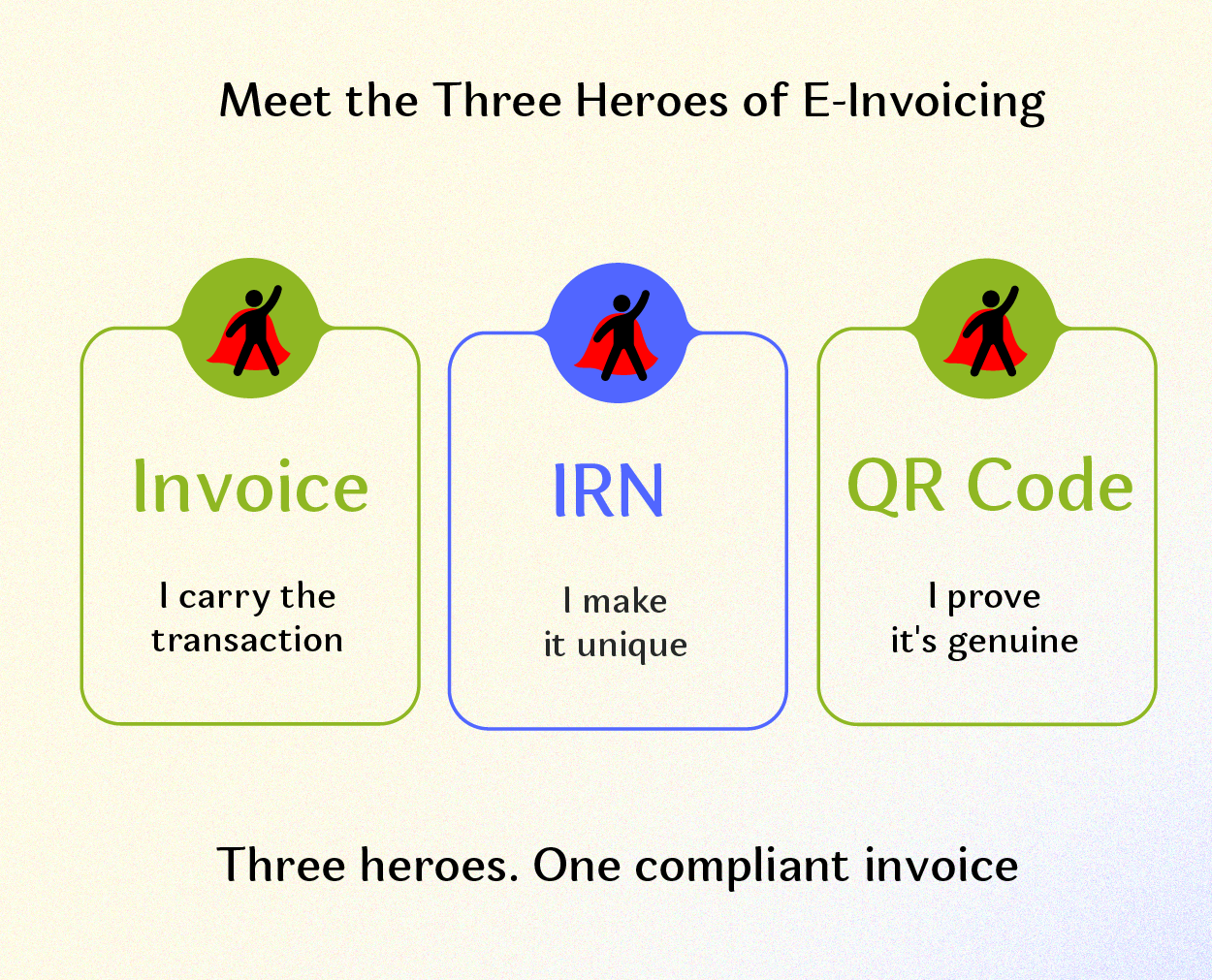
An invoice which is electronically generated, authenticated, and reported through a designated government portal before it is issued to the buyer. E-invoicing is implemented to ensure transparency, reduce tax evasion, and streamline compliance. Once an invoice is generated, it is uploaded to the Invoice Registration Portal (IRP). Here, a unique Invoice Reference Number (IRN) and a QR code will be assigned to those invoices.
It is mandatory to generate e-invoice for businesses with turnover exceeding ₹5 crores (as of Aug 2023). E-invoice is to be generated for all the B2B and export invoices.
Note: An Invoice Reference Number (IRN) is a unique 64-character alphanumeric string generated by the government’s Invoice Registration Portal (IRP) for electronic invoices (e-invoices) under GST.
Features of E-Invoicing
1. Standardised Format:
It uses a uniform structure (JSON format) as prescribed by the government. This ensures consistency across businesses. It also simplifies data exchange between the systems.
2. Real-Time Validation:
The errors are reduced as the invoices are validated instantly through the IRP.
3. Unique Invoice Reference Number (IRN):
IRN acts as an identity to each, and every invoice generated through the IRP. This helps in prevention of duplication.
4. QR Code Integration:
A quick verification is enabled through the generation of QR code along with IRN. This QR code consists of details such as supplier information, invoice value, and IRN.
5. Auto-Population of GST Returns:
As and when the e-invoices are generated for the invoices, it gets auto populated into the GST returns. This reduces the manual entry and improves the accuracy.
6. Reduced Compliance Burden:
The time consumed on compliance tasks are reduced as the invoicing process is automated through e-invoice.
Eligibility Criteria for E-Invoicing
1. Turnover Threshold:
The businesses must mandatorily generate e-invoices if their aggregate turnover exceeds ₹5 crore applicable from 1st of August 2023.
History of e-invoicing in terms of the threshold limits:
| Effective Date | Turnover Limit (Aggregate) |
|---|---|
| 1 Oct 2020 | ₹500 crore and above |
| 1 Jan 2021 | ₹100 crore and above |
| 1 Apr 2021 | ₹50 crore and above |
| 1 Apr 2022 | ₹20 crore and above |
| 1 Oct 2022 | ₹10 crore and above |
| 1 Aug 2023 | ₹5 crore and above |
2. Applies to Specific Transactions:
E-invoices must be generated mandatorily for the following transactions:
- B2B (Business-to-Business) invoices: E-invoice must be generated when the nature of sales takes place between the two GST registered entities.
- B2G (Business-to-Government) invoices: E-invoice to be generated when the seller is a registered entity and the buyer is the government entity.
- Export invoices: When the invoices are raised for the export related transactions, e-invoices are to be generated mandatorily.
- Credit Notes: Invoices related to sales return which are tagged with the sales made to registered dealers.
- Debit notes: Debit notes which are raised for the price escalation or de-escalation for the sales related nature of transactions.
- RCM invoices: When sales are done for the Reverse Charge Mechanism enabled goods or services. It is mandatory to generate e-invoice though the GST would not get calculated in the invoices.
Exempted Entities
Following are the entities which are exempted from generating e-invoice:
- Small businesses below the turnover threshold.
- SEZ units
- Banks, financial institutions, and NBFC’s.
- Goods transport agencies (GTAs) and Passenger transportation services.
- Insurance Sector
- Entertainment Sector
Step-by-Step Registration Process for E-Invoicing
Following are the steps to be followed for registering under the GST:
- GST Registration:
A business must be registered under GST and have a valid GST Identification Number (GSTIN).
- Access the E-Invoice Portal:
Visit the official e-invoice portal managed by the government. This portal is used for generating and managing e-invoices.
- Login Using GST Credentials:
Users can log in using their GSTIN and password. If the user is new, they may need to create login credentials.
- Register on the Invoice Registration Portal (IRP):
- Select the registration option.
- Enter GSTIN and captcha code.
- Verify details through OTP (sent to the registered mobile number/email).
- Create User Credentials:
After verification, create a username and password for accessing the IRP.
- Integrate with Accounting Software:
Businesses can integrate their ERP or accounting software with the IRP using APIs. Alternatively, they can upload invoices manually in JSON format.
- Generate E-Invoices:
- Prepare the invoice in the standard format.
- Upload the invoice to the IRP.
- Receive the IRN and QR code.
- Share the validated invoice with the buyer.
Final Thoughts
E-invoicing is a major step taken by the GST towards making India’s tax system digital, transparent, and efficient. The features like real-time validation, standardised formats, and automation of the invoices in the GST return, helps in reducing the errors.
The gradual lowering of the turnover threshold limit shows the efforts put forward by the government to bring more businesses into the structured system. E-invoicing helps the businesses in saving time, improving accuracy and better management of their finances.
Frequently Asked Questions about E - Invoicing
Question 1: What is e-invoicing under GST?
Answer: E-invoicing under GST is a system where invoices are generated electronically and it is authenticated through the Invoice Registration Portal (IRP). Each invoice receives a unique Invoice Reference Number (IRN) and QR code for validation.
Question 2: Who is required to generate e-invoices under GST?
Answer: Businesses with aggregate turnover exceeding ₹5 crore are required to generate e-invoices.
Question 3: What is an Invoice Reference Number (IRN) in e-invoicing?
Answer: An Invoice Reference Number (IRN) is a unique 64-character alphanumeric number generated by the Invoice Registration Portal (IRP) for every valid e-invoice under GST.
Question 4: What are the benefits of e-invoicing for businesses?
Answer: E-invoicing benefits the businesses by reducing manual errors, improving GST compliance, automating return filing, enabling real-time invoice validation, and simplifying invoice management.
Question 5: Which transactions require mandatory e-invoicing under GST?
Answer: E-invoicing is mandatory for B2B invoices, export invoices, B2G transactions, debit notes when raised for price escalation post sales, credit notes, and certain Reverse Charge Mechanism (RCM) transactions.
Question 6: Which businesses are exempt from e-invoicing under GST?
Answer: SEZ units, banks, NBFCs, insurance companies, goods transport agencies, passenger transport services, and businesses below the prescribed turnover limit are exempt from e-invoicing.
Question 7: How does the e-invoicing process work under GST?
Answer: Businesses generate invoices in a prescribed format and upload them to the Invoice Registration Portal (IRP). The IRP validates the invoice and generates an IRN and QR code before the invoice is shared with the buyer.

Nita R
Nita is a content writer specialising in Accounting, Finance, GST, and Taxation. She creates easy-to-understand, research-driven content that simplifies complex financial and tax concepts for learners, professionals, and businesses. Her expertise lies in translating technical accounting and GST topics into practical insights, helping readers stay informed about tax compliance, financial processes, and industry best practices. Through her content, she aims to make accounting and taxation accessible, accurate, and relevant for today's evolving business environment.