

From Invoice to Payment: Mastering AR & AP Workflows in TallyPrime


Two candidates walk into an interview for an accounts executive role. Same degree. Same subjects studied. Same marks on paper. The interviewer asks one question: walk me through how you would handle an outstanding receivable that has crossed 60 days.
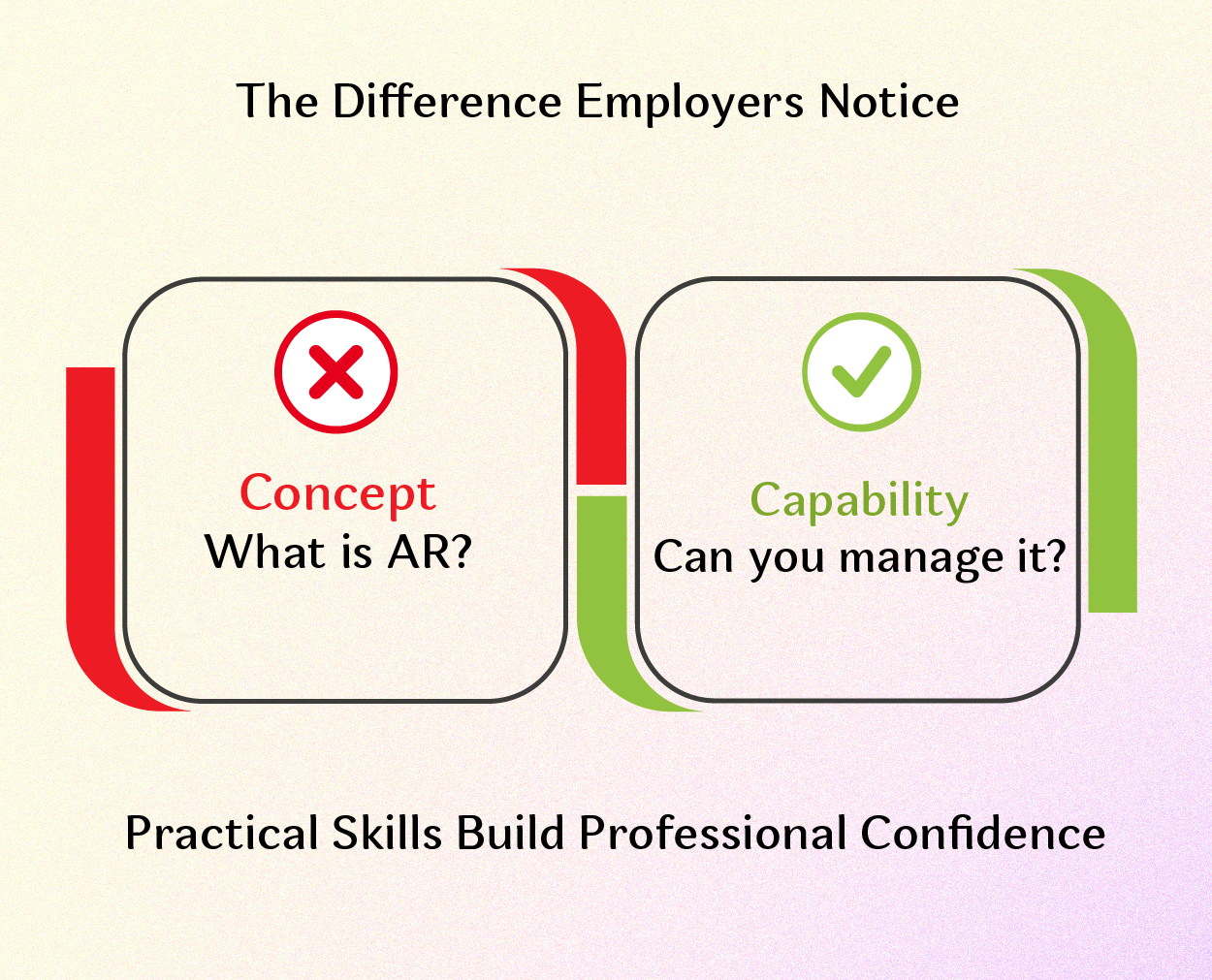
One candidate talks about the concept. The other describes exactly what they would open in TallyPrime, which report they would pull, and what action they would take next.
Same education. Very different outcomes. The difference is not intelligence or effort. It is practical familiarity with how Accounts Receivables and Payables actually work inside a live business system.
30-Second Summary
Most accounting students learn what receivables and payables are. Far fewer understand how they actually flow through a live business environment. That practical knowledge often makes the difference between getting hired and being overlooked. Tally Education’s AR and AP course provides hands-on training in TallyPrime on Cloud, covering the complete Order-to-Cash (O2C) and Procure-to-Pay (P2P) cycles, helping you build the real-world skills employers value.
What the Classroom Does Not Show You
Academic accounting teaches you what. What a receivable is. What a payable represents. What the journal entry looks like. All of that is correct and necessary.
But a working business does not run on journal entries in isolation. It runs on workflows. On a Tuesday morning, the accounts team is not thinking in theory. They are raising invoices, tracking which customers have paid and which have not, checking which vendor payments are due this week, and making sure the ITC entries from last month’s purchases have been reconciled before the GST Filing deadline arrives.
That is what Accounts Receivables and Payables management looks like in practice. And until you have worked through that flow end to end, inside the system a real business uses, the knowledge stays theoretical.
Why TallyPrime Is the Right Place to Learn This
Across small businesses, trading firms, manufacturers, and service companies throughout India, one software handles the day-to-day accounting work: TallyPrime. Which means that when you join an accounts team, TallyPrime is very likely the first screen you will sit in front of.
Learning AR and AP workflows in TallyPrime is not about mastering a software tool for its own sake. It is about understanding how transactions actually behave inside a system that thousands of businesses depend on every day.
When you raise a sales invoice in TallyPrime, the receivable is created automatically. When a payment comes in and you record it against the correct invoice, the outstanding report updates in real time. You can immediately see who owes how much, from which invoice, and since when. No manual calculation. No hunting through entries. The system does the tracking; your job is to read it correctly and act on it.
The AR Workflow: What It Actually Involves
On the receivables side, the work begins the moment a sale happens. The invoice goes out with the correct party details, applicable GST, and payment terms. TallyPrime links that invoice to the customer’s account and starts tracking the outstanding balance from that point forward.
When the payment arrives, you record it and match it to the specific invoice it settles. The ageing analysis then shows you, clearly and without any manual effort, which dues are within 30 days, which have crossed 60, and which need immediate attention.
Bill-wise tracking means every transaction is tied to a specific document. Partial payments, advance receipts, and credit notes all sit against the right entry. When a manager asks for the complete receivables position before a review, the report is ready in under a minute.
Also Check out : How Does Tally Help with Accounts Payable and Receivable?
The AP Workflow: Keeping Your Obligations in Order
Payables follow the same logic from the vendor’s direction. A purchase invoice arrives. You record it with the supplier details, GST breakup, and due date. The liability is created. Where Input Tax Credit applies, it flows into the ITC tracker automatically, ready to be matched against GSTR-2B at reconciliation time.
The payables ageing report shows what is due and when. Payments approaching their deadlines appear before they become overdue obligations. When you process a payment and link it to the invoice, the supplier ledger clears instantly. No ambiguity about whether a vendor has been paid. No awkward calls because a due date slipped through.
Well-managed Accounts Receivables and Payables protect two things simultaneously: your cash flow and your business relationships. Both matter more than most people realise until something goes wrong with one of them.
The Shift That Makes You Valuable in Any Finance Role
There is a specific moment that finance professionals often describe when they talk about building confidence in their work. It is the moment when the system stops feeling like a black box and starts feeling logical. When you understand not just what to enter, but why the entry behaves the way it does, what report it feeds, and what decision it supports.
That moment comes from structured, hands-on practice, not from reading about it. And it is exactly what separates the candidate who talks about concepts from the one who describes workflows with the quiet confidence of someone who has actually done the work.
The Accounts Receivables and Payables Simplified with TallyPrime course from Tally Education takes you through the Order to Cash (O2C) and Procure to Pay (P2P) cycles, bill-wise tracking, credit limit management, ageing analysis, and MIS reporting. With access to TallyPrime on Cloud, the practice is hands-on from the very first session.
One Question Worth Answering Honestly
If you were asked right now to pull an ageing report for all outstanding customer dues and explain what it means, could you do it confidently? If the honest answer is not quite, that is worth paying attention to.
Because in an interview room, and in an actual accounts role, Accounts Receivables and Payables management is not a supporting skill. It is a core one. The professionals who handle it with accuracy and speed are always the ones employers want to keep.
Frequently Asked Questions
Question 1: What is the difference between Accounts Receivables and Accounts Payables?
Answer: Accounts Receivables (AR) tracks money that customers owe your business after a sale. Accounts Payables (AP) tracks what your business owes vendors after a purchase. In TallyPrime, both are managed through bill-wise tracking, which links every payment or receipt to a specific invoice, so your outstanding position is always clear and current.
Question 2: Why do I need to learn AR and AP in TallyPrime specifically?
Answer: TallyPrime is the accounting system most small businesses, trading firms, and manufacturers in India rely on daily. Learning AR and AP workflows inside TallyPrime means you are practising in the same environment you will likely work in from day one of your job, which makes the transition from learner to professional significantly smoother.
Question 3: Do I need prior accounting knowledge to take this course?
Answer: A basic understanding of accounting concepts is helpful, but the course is structured to take you through workflows step by step, making it accessible even if your practical experience is limited.
Question 4: What kind of roles does this skill prepare me for?
Answer: Accounts Executive, AR/AP Executive, Finance Assistant, and Tax Consultant roles essentially any position where managing invoices, payments, and reconciliation is part of the daily job.

Tally Education
Tally Education empowers learners with industry-relevant skills in accounting, finance, taxation, and business management through practical learning and certifications. Our blogs are created and reviewed by subject matter experts to deliver accurate, practical, and up-to-date insights on accounting, GST, taxation, finance, and TallyPrime.