

GST Return Filing Process in India: A Step-by-Step Guide


Here’s the truth about GST return filing. Most people don’t struggle with the concept. They struggle with the process. Which form goes first? What happens if figures don’t match? When exactly is the deadline? This article answers all of that in practical, clear terms so you can file with confidence every single time.
30-Second Summary
Miss a deadline. File a mismatch. Ignore a notice. GST errors have a way of snowballing fast. This guide cuts through the confusion with a clear, step-by-step walkthrough of return filing in India, so whether you’re a business owner, an accountant, or someone building real GST skills, you know exactly what to do and when.
What Is a GST Return and Who Needs to File It?
A GST return is a document that a registered taxpayer files with the government, declaring their sales, purchases, tax collected, and tax paid during a specific period. It is not optional. Every business registered under GST is required to file returns, whether or not there were any transactions in a given period.
The two returns most businesses deal with regularly are:
| Return | What It Covers | Frequency |
|---|---|---|
| GSTR-1 | Outward supplies (sales) | Monthly or Quarterly |
| GSTR-3B | Summary of sales, ITC, and tax payment | Monthly |
| GSTR-9 | Annual return | Yearly |
If you are just getting started or want to build a stronger foundation, enrolling in a structured GST Return Filing Course is one of the smartest investments you can make before handling real filings independently.
Step-by-Step GST Return Filing Process in India
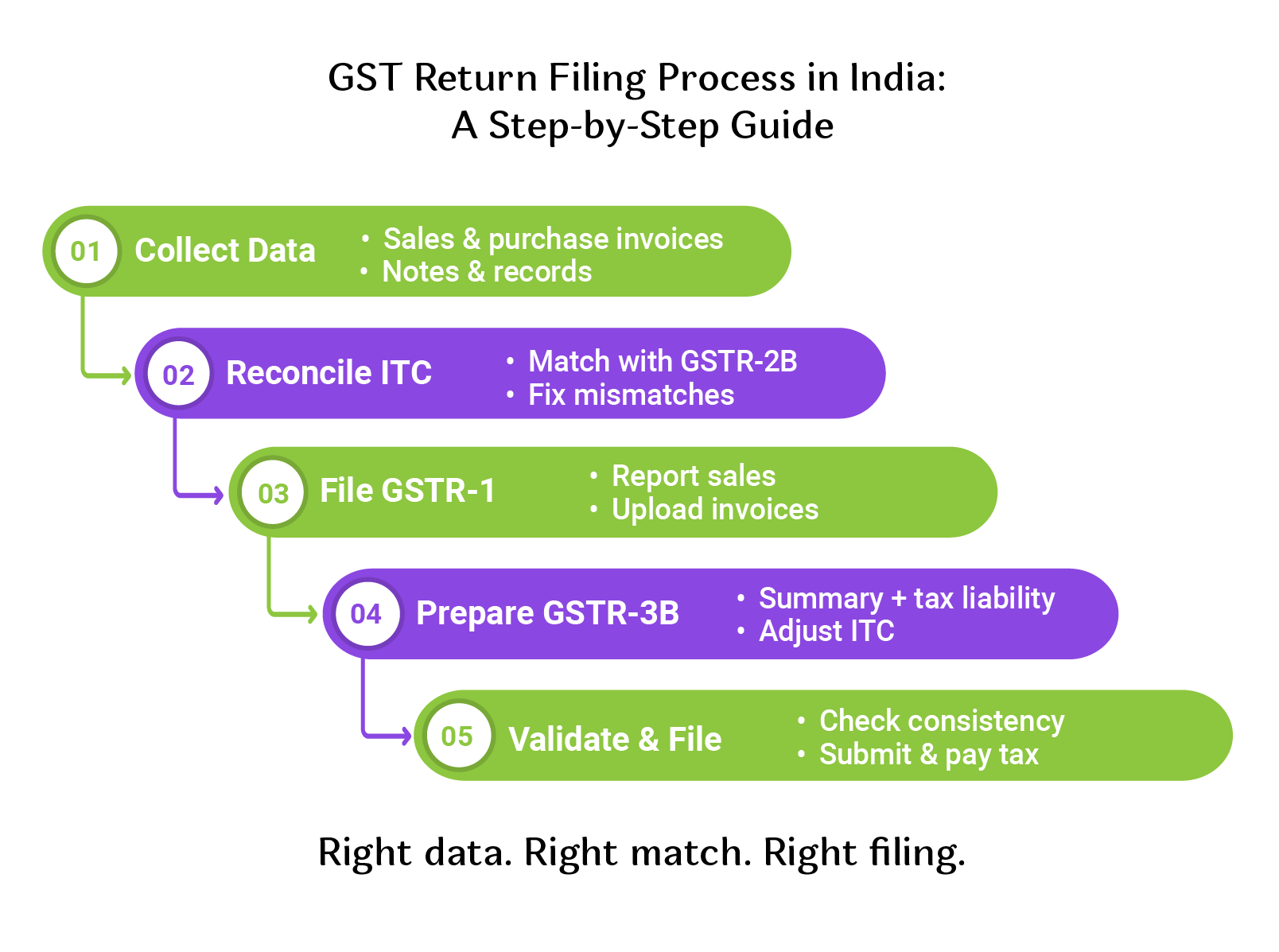
Step 1: Collect and Organise Your Data
Before you touch the GST portal, get everything in one place: sales invoices, purchase invoices, credit and debit notes, and details of any advances. GST filing is a reporting exercise at its core. If the data going into the system is incomplete, the return coming out will be inaccurate. And correcting a filed return costs time, effort, and sometimes penalties. Getting the data right at the start is the most important step.
Step 2: Reconcile Your Purchases with GSTR-2A and GSTR-2B
Here is a question worth asking honestly: do you verify whether your suppliers have actually filed their returns before claiming Input Tax Credit? If not, you could be claiming ITC the government will later reject, and that rejection comes with interest.
Reconciling your purchase register with GSTR-2B helps you confirm which supplier invoices are reflected in the system, spot missing or duplicate entries, and ensure every ITC claim is valid before you file. This step is the backbone of clean GST compliance. Skip it and you are essentially filing blind.
Step 3: Prepare and File GSTR-1
GSTR-1 captures everything you sold during the month: to whom, at what rate, and under which category. You will classify invoices as B2B or B2C, report credit and debit notes, and validate all tax amounts. What makes this return especially important is that the moment you file it, your buyers can see those invoices in their GSTR-2A. Your accuracy directly affects their ITC. GSTR-1 is typically due by the 11th of the following month for monthly filers.
Step 4: Prepare GSTR-3B
GSTR-3B is your monthly summary return. It declares total outward supplies, the ITC you are claiming, your net tax liability after adjusting credits, and the tax payment made for the period. One critical thing to remember: GSTR-3B figures must be consistent with GSTR-1. A mismatch between the two is one of the most common triggers for scrutiny notices. Always reconcile both before you file. GSTR-3B is due by the 20th of the following month.
Step 5: Validate, File, and Save Your Acknowledgement
Before submitting, run a final check. Do the output tax figures in GSTR-3B match GSTR-1? Is the ITC claimed consistent with your reconciled purchase data? Are HSN codes and tax rates accurate? This takes 15 to 30 extra minutes but can save weeks of back-and-forth if something is caught only after filing.
Once everything is in order, log in to the GST portal, submit the return using your DSC or EVC, pay any outstanding tax liability, and download the acknowledgement number as proof of filing.
How GST Filing with TallyPrime Makes This Easier
How much of this process are you currently handling manually? If the answer is most of it, you are spending more time and taking more risk than necessary. This is exactly the problem GST Filing with TallyPrime is built to solve.
TallyPrime connects your accounting directly with GST compliance, so everything works from one place instead of being scattered across spreadsheets and separate tools. Invoices flow automatically from your books into return preparation, eliminating manual re-entry and the errors that come with it. GSTR-2A and GSTR-2B reconciliation happens automatically, flagging mismatches before you file rather than after. GSTR-1 and GSTR-3B are prepared side by side within the software, with built-in validation checks that catch common errors before they become compliance problems.
For businesses that want to move from reactive, last-minute filing to proactive, controlled compliance, GST Filing with TallyPrime is one of the most practical tools available.
Want to Build Real GST Filing Skills?
Knowing the process is one thing. Executing it confidently across different business scenarios, handling exceptions, and troubleshooting mismatches is a different level of skill entirely. A well-designed GST Filing Course gives you the hands-on practice that reading alone cannot provide.
The right GST Return Filing Course covers real-world scenarios, reconciliation exercises, actual portal workflows, and practical use of tools like TallyPrime, so you are not just learning theory but building capability you can use immediately. Whether you are an accounts professional looking to upskill or a student preparing for a career in finance and compliance, a structured course is the fastest path to genuine confidence.
Explore a practical, job-oriented GST Filing Course here: GST Filing with TallyPrime.
Conclusion: Stop Dreading Deadlines. Start Owning Them.
Your GST Returns Should Work For You, Not Against You.
Filing returns is not just a regulatory checkbox. It is a window into your business’s financial health. When you file accurately and on time, you have clarity on your tax liability, your ITC position, and your cash flow, all at once.
The process is not complicated when broken into clear steps. Collect your data. Reconcile your purchases. Prepare GSTR-1 and GSTR-3B. Validate everything. File with confidence. If you want to make that process faster and more reliable, GST Filing with TallyPrime removes the friction that slows most businesses down. And if you want the skills to handle it independently, a dedicated GST Return Filing Course is the most direct path to getting there.
Start here: GST Filing with TallyPrime Course
Frequently Asked Questions
Question 1: What are the main GST returns a business needs to file?
Answer: Most regular taxpayers file GSTR-1 for outward supplies and GSTR-3B as a monthly summary return. Annual filers also submit GSTR-9. The specific returns required depend on your registration type and annual turnover.
Question 2: What happens if I miss a GST filing deadline?
Answer: Late filing attracts a fee of Rs. 50 per day (Rs. 20 per day for nil returns) subject to prescribed maximum caps based on turnover. Plus interest at 18% per annum on any outstanding tax liability. Repeated late filings can also draw compliance scrutiny by tax authorities.
Question 3: Can I file GST returns without accounting software?
Answer: Yes, the GST portal allows direct filing. However, manual preparation increases the risk of errors during reconciliation and return preparation. Using GST Filing with TallyPrime significantly reduces that risk and cuts down the time required for each filing cycle.
Question 4: Is a GST Filing Course worth it?
Answer: Absolutely, especially if you handle GST for a business or are building a career in accounting and finance. A structured GST Return Filing Course gives you practical skills, real-world filing experience, and the confidence to handle compliance without relying on external help for every return.

Tally Education
Tally Education empowers learners with industry-relevant skills in accounting, finance, taxation, and business management through practical learning and certifications. Our blogs are created and reviewed by subject matter experts to deliver accurate, practical, and up-to-date insights on accounting, GST, taxation, finance, and TallyPrime.