

Is a Business Accounting Course Worth It in 2026?


If you’re thinking about a career in accounting and finance, you’ve probably run into the same question again. Is a business accounting course actually worth doing anymore? People keep talking about AI. Automation. Software is doing everything. Someone is saying that accounting will disappear in a few years. But when you look at how businesses actually run, a different picture emerges. Every company still needs someone who understands money. Someone who keeps track of what’s coming in, what’s going out, what the government needs, and what the business actually earns at the end of the month.
Numbers don’t organise themselves. Someone still has to make sense of them. That’s where practical accounting training comes in. And for someone starting out, an Accounting Course for Beginners often becomes the first step into that world. But before making a decision, let’s understand the real career demand, industry expectations, and return on investment (ROI) that accounting education offers today.
30-Second Summary
Yes, a business accounting course can still be very valuable in 2026. Businesses still depend on people who understand their finances. Not just in theory, but in real day-to-day operations. Billing. Tax filings. Payroll. Financial records. All of that. Employers tend to prefer candidates with some practical accounting training. Someone who understands how accounting works inside a real company. For many students, an ‘accounting course for beginners’ becomes a way to step into finance without spending years in study first. Simple as that. But the real picture is a bit more layered. Read on to find out.
Businesses Still Run on Numbers
Think about any company you know. A shop down the street. A manufacturing unit. A startup someone launched from a co-working space. Every one of them has to keep track of money. Revenue. Expenses. Taxes. Salaries. Compliance. I once spoke to a small business owner who tried to manage everything on his own in the beginning. Sales were going well. Orders were coming in. Things looked fine on the surface.
Then tax season arrived. Let’s just say it wasn’t easy. That’s when he realised something obvious. Running a business and managing the financial records of that business are two completely different skills.
Most companies eventually reach that point. And that’s why trained accounting professionals keep showing up in job listings year after year. A Business Accounting Course teaches the basics of how this system works. Not just theory, but the logic behind the numbers. Once you understand that, businesses start to make more sense.
The Real Shift Happening in Accounting
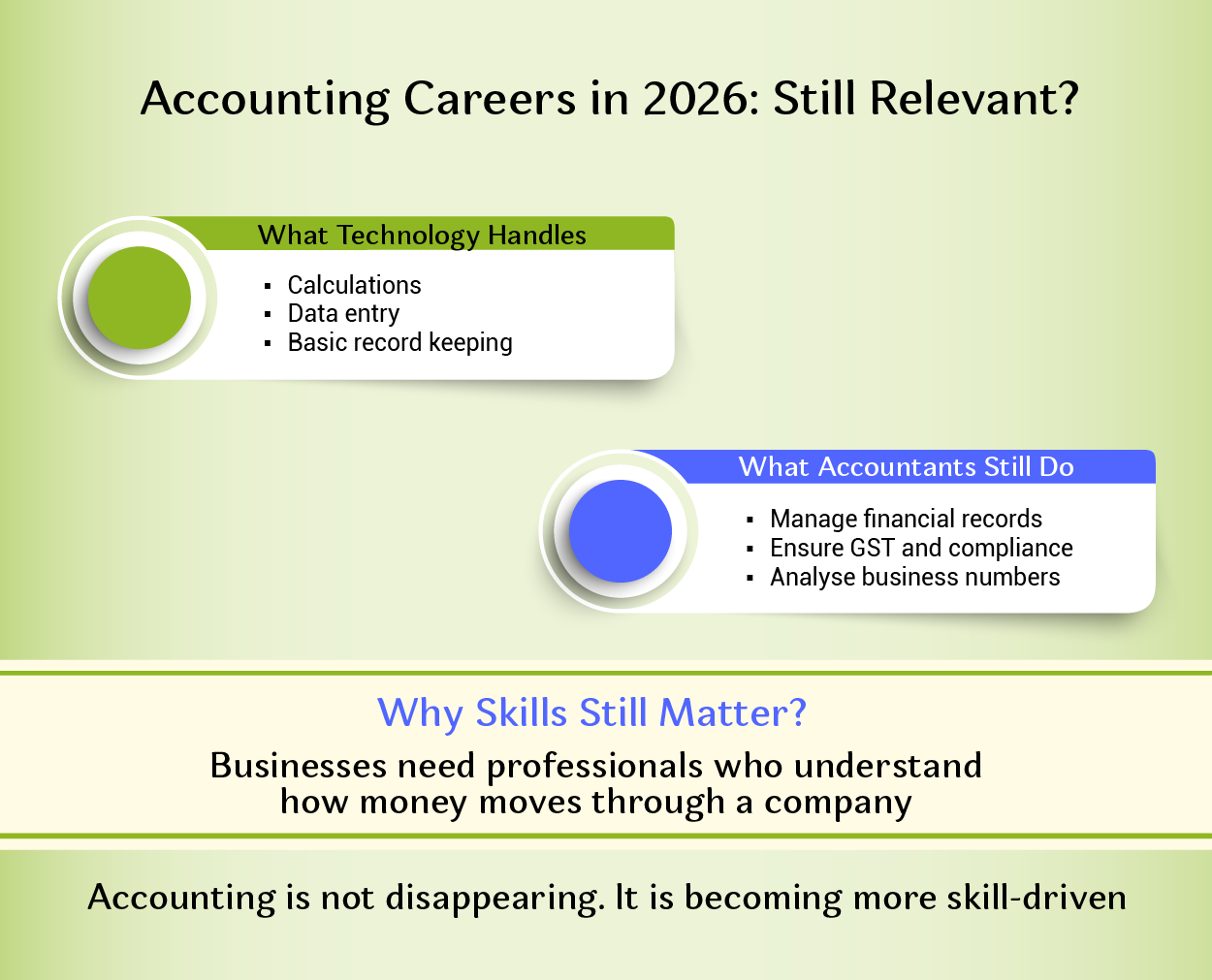
Now here’s the interesting part. Accounting hasn’t stayed the same. The work has changed quite a bit. Earlier, people spent hours doing manual calculations, updating ledgers, and entering records line by line. A lot of that work happens through software now. Which sounds like bad news for accountants. But it actually changed the role rather than removing it. Today, companies want people who understand the systems. People who know how financial records flow through a business. People who can spot problems before they become expensive mistakes.
That’s why practical accounting training matters so much now. Employers don’t only want someone who can explain accounting concepts. They want someone who can walk into a finance department and understand what’s happening. Invoices. GST entries. Payroll. Financial reports. Those things don’t feel abstract anymore once you’ve seen them in action. An accounting course for beginners prepares you for that.
Where The Jobs Actually Are
You might assume accounting jobs mostly exist inside banks or large corporations. Not really. Most opportunities appear in regular businesses. Small companies. Medium-sized firms. Growing startups. Local enterprises. They all need financial records maintained properly. Manufacturing companies need it. Retail businesses need it. Logistics companies need it. Even the small clinic near your house probably has someone handling accounting. It’s not glamorous work every day. Let’s be honest. But it’s steady work. And steady careers are sometimes underrated. Completing a business accounting course opens doors in many of these environments because the underlying financial processes look surprisingly similar. Money comes in. Money goes out. Records need to match reality.
The Return on Investment Question
Students usually ask the same thing. Will this course actually help me get a job? Fair question. A business accounting course tends to offer a relatively quick path into the workforce. Many ‘accounting courses for beginners’ focus on skills that employers expect from entry-level staff.
So, instead of spending years studying theory, students start working sooner. That early experience matters more than people realise. Someone who spends their first year inside a finance department learns things that textbooks rarely explain. How invoices pile up. How deadlines creep in. How a tiny data entry mistake suddenly becomes a big reconciliation issue.
You learn fast when real money is involved. And over time, those early roles can grow into something bigger. Senior accounting roles. Finance management. Tax consultancy. The path isn’t identical for everyone, as they say, “careers rarely follow neat lines”.
Technology Didn’t Kill Accounting
People often talk about technology replacing accountants. I’m not completely convinced. Software handles repetitive work much faster now. That part is true. But businesses still need people who understand what the numbers mean.
Software can produce reports. It can’t always explain why expenses suddenly spiked or why cash flow looks strange this quarter. Someone still has to ask questions. Someone still has to check whether everything makes sense. That’s where Practical Accounting Training becomes useful again. It helps learners understand the system behind the software. Without that understanding, accounting tools are just screens full of numbers.
Who Benefits from an Accounting Course
Commerce students often explore accounting courses first. It feels like a natural extension of what they already studied. But they’re not the only ones. Graduates from other fields sometimes take an accounting course for beginners because they want job-ready skills. Something practical. Then there are small business owners. I’ve seen quite a few of them learn accounting basics just to understand their own finances better. Which honestly makes sense. Running a business without understanding your numbers is like driving a car without looking at the dashboard.
Choosing the Right Place to Learn
Not every course teaches accounting the same way. Some programs still stay very theoretical. You memorise concepts but rarely see how they play out in a real business. Courses that include practical accounting training tend to feel different. Students work through realistic scenarios. Financial entries. Reports. Workflows that look like what companies actually deal with.
That kind of exposure helps people feel less lost when they step into their first accounting role. If you’re exploring structured training options, the Tally Essential program is one place where students begin learning how business accounting works in practice.
You can explore the course here if you’re curious
https://tallyeducation.com/tepl/offline-courses/tally-essential/
Is it Worth it?
Honestly, it depends on what you want from your career. If you enjoy working with numbers, understanding how businesses operate, and keeping systems organised, accounting can be a steady and rewarding path. A business accounting course won’t magically solve everything. No course does that. But it can give you a foundation. A way into the finance world. From there, careers tend to grow in directions people rarely predict.
And that’s roughly where things stand right now. Accounting isn’t disappearing. It’s just changing shape a little. Maybe the better question isn’t whether the field will exist. Maybe it’s whether you enjoy understanding how money moves through a business. If that idea feels interesting, then a business accounting course might be worth exploring. If not, that’s okay too. Careers have a funny way of unfolding in unexpected directions anyway.
Frequently Asked Questions
Question 1: Can beginners really join an accounting course without prior knowledge?
Answer: Yes. Most accounting courses for beginners start with the fundamentals. Basic financial concepts, simple records, how transactions flow through a business. From there, the learning becomes more practical.
Question 2: What jobs usually come after a business accounting course?
Answer: Many learners begin in roles that support finance departments. Accounts assistants, billing executives, junior accountants. The titles vary, but the work usually involves maintaining records and helping manage financial documentation.
Question 3: Why does practical accounting training matter so much?
Answer: Because businesses run on real processes, not textbook examples. When students experience realistic accounting workflows during training, the workplace feels far less intimidating later.
Question 4: How long does an accounting course usually take?
Answer: Many accounting courses run for a few months. Enough time to learn the basics and practice real accounting tasks before entering the job market.