

Tally Accounting Course After Graduation: Is It Worth It in 2026?


30-Second Summary
Graduated and holding a commerce degree that somehow didn’t come with a “how to actually do accounting” manual? You’re not alone, and it’s not your fault. This article looks at whether a Tally accounting course after graduation is genuinely worth it in 2026, what the TallyEssential course covers, and why an accounting course built around real software might matter more to employers than another line on your degree certificate.
Why Accounting Knowledge Alone Isn’t Enough After Graduation
For most fresh commerce graduates, yes – a structured Tally accounting course like TallyEssential is worth it in 2026. Degrees teach accounting theory, but employers hire for software fluency, especially in TallyPrime, which most Indian businesses use to run their books. A beginner-friendly course closes that gap in a few structured weeks rather than your first three months on the job.
Let’s be honest for a second. You spent three years studying accounting theory. You know what a trial balance is. You can define “matching concepts” in your sleep. And then you sit across an interviewer who asks, “So, have you worked with TallyPrime?” and your brain quietly short-circuits.
This isn’t a personal failing. It’s a curriculum blind spot that shows up in almost every commerce classroom in the country. Degrees teach you the language of accounting. They rarely teach you the tools businesses actually run on. And in 2026, that difference decides who gets hired and who gets a very polite “we’ll keep your resume on file.”
So the real question isn’t whether you know accounting. It’s whether you can prove it, on software, under pressure, the way an employer will actually test you. That’s exactly where an Accounting Course built around practical application comes in, and it’s worth understanding why before you write it off as “just another certificate.”
The Problem Nobody Warns You About in College
Here’s what typically happens. You graduate. You apply for accounts executive or GST assistant roles. And somewhere in round one or two, someone hands you a laptop and says “show us how you’d record this transaction.”
If your entire accounting experience so far has been on paper or in theory, that moment gets uncomfortable fast. Not because you don’t understand accounting, but because you’ve never actually touched the tool that turns understanding into output.
Employers aren’t being unreasonable here. Most Indian businesses, big and small, run their books on Tally. If you can’t navigate it confidently, you’re effectively applying for a driving job without ever having sat in the driver’s sea
Why Does 2026 Make Practical Tally Skills More Important?
A few things have converged to make practical accounting skills less “nice to have” and more “non-negotiable”:
- GST compliance has become tighter and more automated, meaning errors get flagged faster, and hiring managers are wary of candidates who need hand-holding on basics
- E-invoicing thresholds keep pulling more businesses into digital-first compliance, so even smaller firms now expect software fluency from day one
- The job market for freshers is more competitive than ever, which means a degree alone simply doesn’t differentiate you the way it used to
In short, “I studied accounting” is table stakes. “I can operate accounting software and generate a clean GST return without supervision” is what actually gets you shortlisted.
What Does a Structured Tally Essential Course Actually Cover?
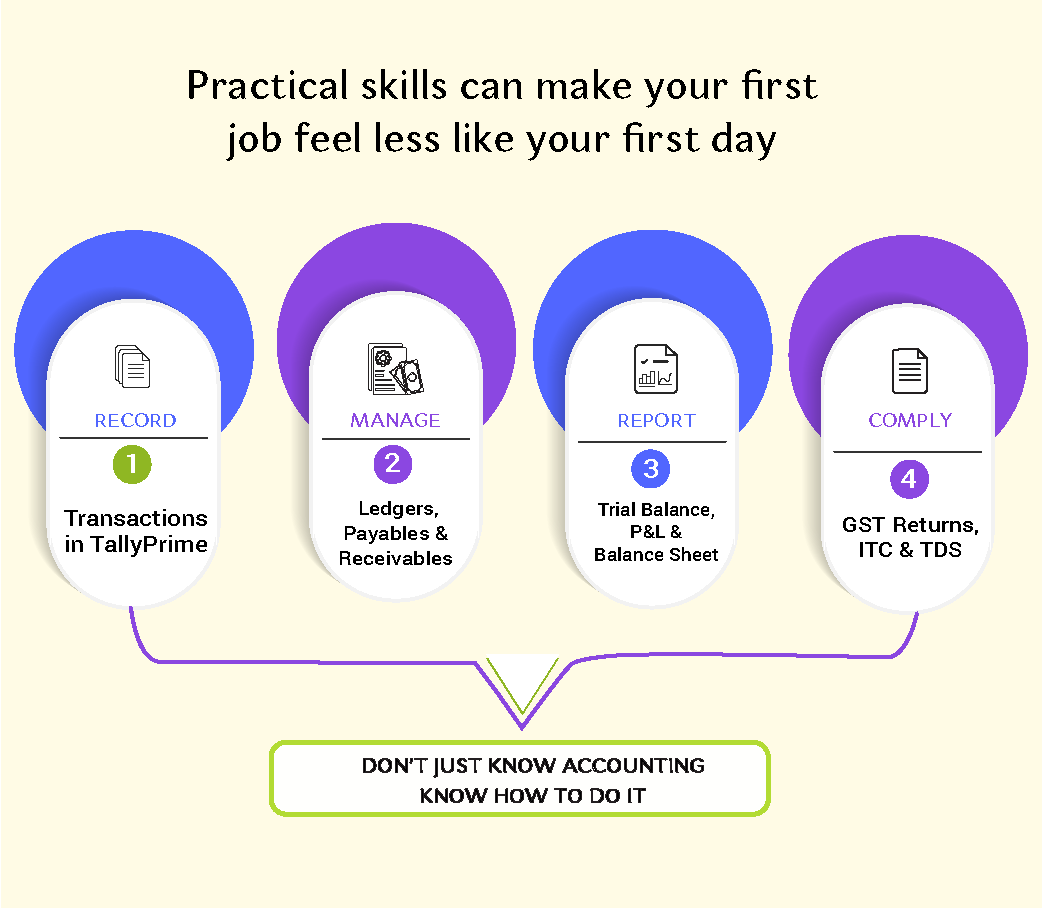
This is where a course like TallyEssential earns its keep. It isn’t a crash course in clicking buttons, it’s structured to take you from foundational accounting concepts through to real, employable skill, across three progressive levels.
Level 1: Recording and Reporting:
You start with the fundamentals, accounting terminology, the double-entry system, and the Golden Rules, before moving into TallyPrime itself. You’ll learn to create a company, maintain a chart of accounts, record vouchers (receipts, payments, sales, purchases, journal entries), handle basic banking functions, and generate financial statements like the trial balance, balance sheet, and profit and loss account. GST fundamentals are introduced here too, so you’re not learning compliance and software as two separate worlds.
Level 2: Accounts Payable and Receivable:
This level goes deeper into real business operations, inventory classification, managing outstanding bills and credit limits, handling purchase and sales orders, tracking additional costs, managing cost and profit centres, and working with budgets. You also build on your GST skills, including e-way bills and input tax credit handling.
Level 3: Taxation and Compliance:
The final level is where things get genuinely practical. You’ll work through GST returns including GSTR-1 and GSTR-3B, composition dealer transactions, exports, Tax Deducted at Source (TDS) configuration and payments, business data management, and moving company data across financial years.
Add to that a GST simulation module for hands-on return-filing practice, access to TallyPrime on cloud, and a Tally Job Portal that connects certified learners directly with employers, and you start to see why this isn’t just “another course.” It’s a structured path from theory to workplace-ready execution.
Related Read: From GSTR-1 to GSTR-3B: Filing Made Effortless with TallyPrime
Is a Tally Course Actually Worth It?
Fair question. Here’s the honest breakdown.
It’s worth it if:
- You’ve completed 12th or graduation and want a practical accounting course for beginners that doesn’t assume prior software experience
- You’re tired of interviews stalling out the moment software comes up
- You want a credential that employers in accounting, finance, taxation, and even banking sectors actually recognise
- You’d rather spend a few structured weeks now than spend your first three months on the job feeling like you’re constantly catching up
If you’re still weighing your options, here’s how to choose the right Tally course for beginners near you.
It’s probably not worth it if:
- You’re already confidently handling GST filing, ledgers, and reports in TallyPrime through work experience, in which case, you likely need a more advanced certification, not a beginner one
- You’re looking for a shortcut without putting in the practice hours, no course, however good, replaces actually doing the work
For most fresh graduates though, this sits squarely in the “worth it” category, not because a certificate is magic, but because the practical exposure it forces you to get is exactly what your degree skipped.
The Real Return on Investment
Think about it this way. A degree tells an employer you studied accounting. A Tally Essential Course tells them you can do accounting, on the exact software most Indian businesses use, from day one. That’s not a small distinction, it’s often the entire difference between a callback and silence.
And the career paths this opens up aren’t hypothetical. Roles like Accounts Executive, Taxation Assistant, Commercial Assistant, Finance Coordinator, and Internal Auditor all specifically list practical Tally proficiency as a baseline expectation, not a bonus skill.
Conclusion: Stop Studying Accounting, Start Doing It
Here’s the honest truth. Your degree got you in the door of the accounting world. It didn’t hand you the keys. If 2026 has taught the job market anything, it’s that practical, software-ready skills are what actually move candidates from “maybe” to “hired.”
If you’re a graduate wondering how to close that distance between what you know and what you can actually do, this is your sign to stop wondering and start practising.
Begin your journey with the Tally Essential course and take your first confident step from classroom accounting to workplace-ready accounting.
Frequently Asked Questions
Question 1: Who should take the TallyEssential course?
Answer: It’s designed for anyone who has completed 12th or a pre-university course in any stream and wants to build a career in accounts, finance, taxation, administration, banking, or entrepreneurship. No prior software experience is required.
Question 2: Do I need an accounting background before enrolling?
Answer: No. The course is structured as an accounting course for beginners, starting from fundamental concepts and building up progressively through Levels 1, 2, and 3, so learners with zero prior exposure to TallyPrime can follow along comfortably.
Question 3: Will this course actually teach me GST filing, not just accounting basics?
Answer: Yes. GST is woven through all three levels, from basic GST-compliant transactions in Level 1, to e-way bills and input tax credit in Level 2, right through to generating GSTR-1 and GSTR-3B returns in Level 3. There’s also a dedicated GST simulation module for hands-on practice.
Question 4: What do I get at the end of the course?
Answer: On successful completion of the assessment, you receive a digital, verifiable certificate. You’ll also get access to the Tally Job Portal, which connects certified learners with employers actively hiring for accounting and finance roles.

Tally Education
Tally Education empowers learners with industry-relevant skills in accounting, finance, taxation, and business management through practical learning and certifications. Our blogs are created and reviewed by subject matter experts to deliver accurate, practical, and up-to-date insights on accounting, GST, taxation, finance, and TallyPrime.