

Understanding GST (Goods and Services Tax) in India


30-Second Summary
Goods and Services Tax (GST) is a unified, destination-based indirect tax system that has replaced multiple taxes with a single tax structure. By introducing Input Tax Credit (ITC), GST eliminates double taxation and ensures tax is applied only on value added. The tax rates and compliance systems have been further reformed with the introduction of GST 2.0 in 2025. Currently GST is more technology-driven, transparent, and business-friendly. Understanding GST from its registration rules to current tax rates (0%, 5%, 18%, and 40%), is essential for businesses and consumers alike.
Want to learn these in-depth? GST with TallyPrime is one such course that provides step by step knowledge with practical examples.
What is GST?
GST (Goods and Services Tax) is an indirect tax applied on the supply of goods and services in India. It is a destination-based tax, which means tax revenue goes to the place where the service or goods are consumed. One of its key advantages is that it eliminates the cascading effect, so businesses are not taxed repeatedly on the same value.
Through Input Tax Credit (ITC), businesses can claim credit for GST already paid on their purchases. This ensures tax is applied only on the actual value added at each stage.
However, GST is not just about charging tax. It is a compliance-driven, technology-enabled system. Businesses must correctly classify their services, determine the right place of supply, issue timely invoices, and file regular returns. Proper documentation and accurate reporting are essential to stay compliant and avoid penalties.
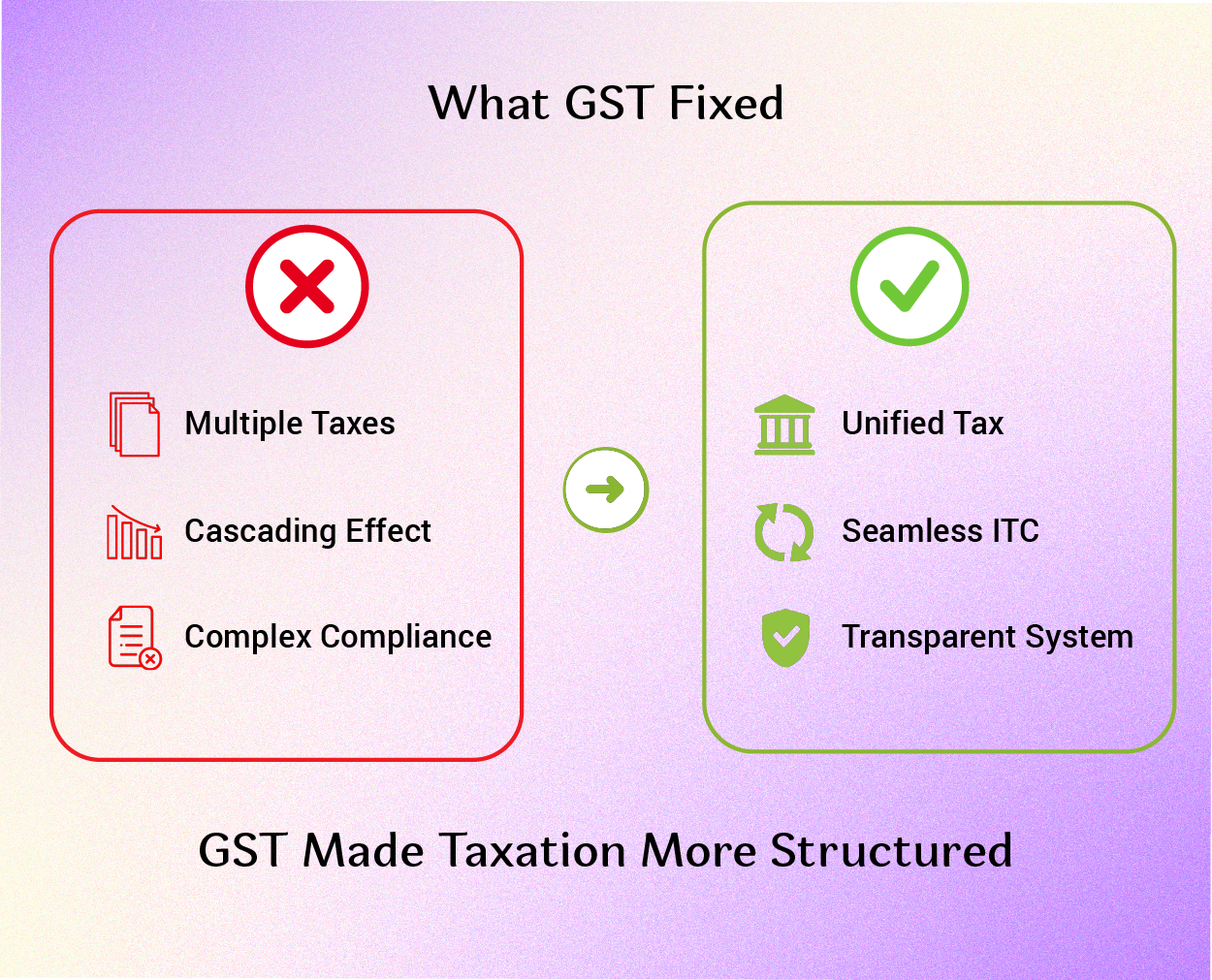
How GST Works: Key Benefits Over the Old Tax System
| Aspect | Before GST | After GST |
|---|---|---|
| Multiple Taxes | Yes | No |
| Input Tax Credit | Partial | Full |
| Price Transparency | Low | High |
| Cost to Consumer | High | Lower |
5 Main Objectives of GST in India
1. To Create a Unified National Market:
The notion “One Nation, One Tax” says that multiple indirect taxes are replaced with one tax. This ensures the same tax is collected for goods and services across India.
2. To Remove the Cascading Effect of Taxes:
GST has removed the cascading effect by introducing input tax credit. This can be claimed at every stage of supply which ensures that tax is charged only on the value added and not on tax already paid.
3. To Simplify the Indirect Tax Structure:
GST has replaced multiple taxes such as VAT, excise duty and service tax with a single unified tax system. This in turn makes compliance easier and reduces the confusion for end users.
4. To Increase Transparency and Curb Tax Evasion:
GST is technology‑driven which means that every invoice is recorded online. This digital tracking improves accuracy, prevents fraud, and boosts government revenue.
5. To Promote Economic Growth:
The tax barriers are reduced, and the business costs are lowered as there is uniformity in the tax structure. This encourages smooth movement of goods and services
Who needs to register under GST in India?
Any person or business engaged in taxable supply of goods or services exceeding the mentioned turnover limit of ₹40 lakhs in terms of goods (₹20 lakh in special category states) and ₹20 lakhs in terms of services (₹10 lakh in special category states) are required to register under GST. Compulsory registration applies regardless of turnover for inter-state suppliers, e-commerce sellers, and those under reverse charge. Once you are registered under GST you will be given a GSTIN which consists of 15 digits.
4 Types of GST: CGST, SGST, UTGST, and IGST
There are 4 types of GST such as:
- CGST (Central Goods and services tax) which is collected by the central government on the intra state sales.
- SGST (State Goods and Services Tax) which is collected by the State on the intra state sales.
- UTGST (Union Territory Goods and Services Tax) which is collected by Union Territory on the intra state sales.
- IGST (Integrated Goods and Services Tax) which is collected by the Central Government on interstate sales. Here the tax is being distributed to the respective destination state based on the place of supply.
Current GST Tax Rates in India: GST 2.0 Structure
GST was introduced on 1st July 2017 with tax rates of 0%, 5%, 12%, 18%, and 28%. Currently, GST 2.0 has come into effect on 22nd September 2025. It has brought major changes in tax rates. The 12% and 28% slabs have been merged into a new 40% slab. The current GST rates are 0%, 5%, 18%, and 40%.
| Aspect | Earlier GST 2.0 | After GST 2.0 |
|---|---|---|
| Compliance | Heavy & Manual | Simplified & Automated |
| ITC System | Misuse-Prone | Strict & Data-Linked |
| Returns | Complex | Auto-Generated |
| Technology | Basic | AI & Analytics-Driven |
| Business Impact | Mixed | More Business-Friendly |
- Nil (0%): Essential daily needs such as fresh fruits, vegetables, milk, and unbranded food items.
- 5%: Packaged food, fruit juices, tea, spices, edible oils, and other necessities.
- 18% (Standard Rate): Most consumer goods such as air conditioners, televisions, refrigerators, electronics, personal care items, and most services.
- 40% (Luxury/Sin Goods): High-end cars, premium motorcycles (>350cc), tobacco products, aerated drinks, casinos, and gambling activities.
HSN Codes and SAC Codes Under GST: What's the Difference?
HSN (Harmonized System of Nomenclature) codes
The codes which are used to classify goods under GST are known as HSN codes. These are the unique codes which range from 4-to-8 digits based on the turnover. Example: 1006 – Rice, 85171211 – Mobile Phones.
| Aggregate Turnover in the Preceding Financial Year | Number of Digits |
|---|---|
| Up to ₹ 5 Crore | 4 Digits |
| Above ₹ 5 Crore | 6 Digits |
| Imports and Exports | 8 Digits |
SAC (Service Accounting Codes)
The codes which are used to classify the services under GST are known as SAC. These are the unique codes which range from 4-to-6 digits, and it starts with 99. Example: 998222- Accounting and Bookkeeping Services, 998221- Financial Auditing Services.
Wrapping Up
Goods and Services Tax (GST) brought a major shift to India’s taxation system as it has replaced multiple earlier taxes with a single, unified structure. It is a destination-based tax. GST ensures that revenue is collected in the state where goods or services are consumed.
One of its most important features is Input Tax Credit (ITC), which prevents double taxation by allowing businesses to claim credit for the tax already paid on purchases. This means tax is applied only to the value added at each stage of the supply chain.
With its technology-driven compliance system, GST has improved transparency, strengthened tax administration, and simplified many processes for businesses.
Frequently Asked Questions about GST in India
Question 1: What is GST and why was it introduced in India?
Answer: GST (Goods and Services Tax) is an indirect tax which was introduced to replace multiple taxes with a single unified tax structure. Introduction of GST has simplified the process of taxation, removed the cascading effect, and improved the transparency.
Question 2: How does Input Tax Credit (ITC) work under GST?
Answer: Input Tax Credit (ITC) allows businesses to claim credit for the GST already paid on purchases and expenses. This helps in avoiding double taxation and ensures that the tax is charged only on the value added at each stage.
Question 3: Who is required to register under GST in India?
Answer: Businesses supplying taxable goods or services whose turnover is crossed beyond the prescribed limit must register under GST. Regardless of turnover, a compulsory GST registration is required for certain businesses such as inter-state suppliers, e-commerce sellers, and reverse charge taxpayers.
Question 4: What are the different types of GST in India?
Answer: The four types of GST in India are:
- CGST (Central Goods and Services Tax)
- SGST (State Goods and Services Tax)
- UTGST (Union Territory Goods and Services Tax)
- IGST (Integrated Goods and Services Tax)
Question 5: What are the current GST tax rates in India?
Answer: The current GST tax slabs in India based on the category of goods and services are 0%, 5%, 18%, and 40%.
Question 6: What is the difference between HSN code and SAC code under GST?
Answer: HSN (Harmonized System of Nomenclature) codes are used for classifying goods under GST, while SAC (Service Accounting Code) codes are used for classifying services.
Question 7: How has GST simplified the taxation system in India?
Answer: GST has replaced multiple indirect taxes with a single unified structure. This has resulted in improved tax transparency, streamlined compliance, enabled seamless ITC, and made business operations more efficient.

Nita R
Nita is a content writer specialising in Accounting, Finance, GST, and Taxation. She creates easy-to-understand, research-driven content that simplifies complex financial and tax concepts for learners, professionals, and businesses. Her expertise lies in translating technical accounting and GST topics into practical insights, helping readers stay informed about tax compliance, financial processes, and industry best practices. Through her content, she aims to make accounting and taxation accessible, accurate, and relevant for today's evolving business environment.