


Course Overview

Professional Financial Accounting with GST using TallyPrime is designed to help you build practical accounting, compliance, and digital finance skills required in today’s business environment.
Aligned with the NEP 2020 outcome-based education framework, this course combines conceptual learning with hands-on application to help you develop industry-relevant skills that can strengthen your employability.
You will be introduced to core accounting concepts, including International Accounting Standards (IAS) and International Financial Reporting Standards (IFRS), along with practical business accounting using TallyPrime.
The course covers company creation, chart of accounts setup, recording business transactions, and working with real-time dashboards and reports.
You will also gain practical exposure to accounts receivable and payable management, cost centre accounting, financial reporting, and MIS reporting to support better business decision-making.
Additionally, the course covers office automation tools, role-based security controls, data backup practices, and GST fundamentals, including compliance requirements and statutory reporting.
Why Choose This Course

Gain hands-on exposure to accounting workflows, GST compliance processes, and digital finance practices relevant to today’s business environment.
Build industry-relevant skills that can support your job readiness for accounting, finance, and business operations roles.
Develop practical understanding through real-world accounting scenarios, tool-based learning, and applied business workflows.
Learn to work with financial statements, MIS reports, receivables and payables management, cost centre accounting, and business performance analysis.
Build practical knowledge of GST fundamentals, invoicing, tax calculations, statutory reporting, and compliance workflows.
Understand role-based access control, data backup practices, office automation tools, and workflow management for efficient business operations.

Skills You Will Gain
Learning Outcomes
By the end of this course, you will be able to:
- Understand the structure, features, and role of TallyPrime in business accounting.
- Create companies, ledgers, vouchers, and perform complete bookkeeping operations.
- Record, analyse, and manage financial transactions accurately, including identifying and rectifying accounting errors.
- Manage accounts receivable and payable processes, including credit terms and outstanding tracking.
- Understand cash flow management and optimise collections and payment processes.
- Apply cost centre accounting concepts to track and analyse business performance.
- Generate and interpret financial statements and MIS reports to support business decision-making.
- Understand data privacy principles and apply secure data handling, access control, and backup practices.
- Create GST invoices and perform GSTR return filing while analysing compliance reports for accuracy.

Course Syllabus

Explore the key modules covered in this credit course, from accounting fundamentals to GST compliance and financial reporting using TallyPrime.
| Module Name | Topic Name | Module-wise Training Hours | ||
|---|---|---|---|---|
| Theory | Practical | Total | ||
| Introduction to IAS & IFRS Accounting | Fundamentals of Accounting | 5 | 1 | 6 |
| Accounting Principles and Double Entry System | ||||
| Books of Accounts: Journal, Ledger and Trial Balance | ||||
| Module Name | Topic Name | Module-wise Training Hours | ||
|---|---|---|---|---|
| Theory | Practical | Total | ||
| Introduction to TallyPrime for Business Operations | Company Creation and Configuration | 1 | 3 | 4 |
| Module Name | Topic Name | Module-wise Training Hours | ||
|---|---|---|---|---|
| Theory | Practical | Total | ||
| Designing Chart of Accounts (CoA) for Businesses in TallyPrime | Capital and Financial Structure Concepts | 2 | 3 | 5 |
| Setting up the Chart of Accounts in Tally | ||||
| Configuring Opening Balances and Balancing Structure | ||||
| Module Name | Topic Name | Module-wise Training Hours | ||
|---|---|---|---|---|
| Theory | Practical | Total | ||
| Recording Business Transactions and Impact on Book of Accounting using Business Dashboard | Voucher Types and Their Usage | 3 | 7 | 10 |
| Recording Financial Transactions in TallyPrime | ||||
| Maintaining Books of Accounts and Generating Reports | ||||
| Module Name | Topic Name | Module-wise Training Hours | ||
|---|---|---|---|---|
| Theory | Practical | Total | ||
| Accounts Receivables and Payables (AR/AP) Management | Understanding Receivables and Payables | 2 | 4 | 6 |
| Maintaining Party Ledgers and Credit Terms | ||||
| Managing Receipts, Payments and Reconciliation | ||||
| Module Name | Topic Name | Module-wise Training Hours | ||
|---|---|---|---|---|
| Theory | Practical | Total | ||
| Cost Centre Accounting and Performance Analysis | Introduction to Cost Centres and Cost Categories | 1 | 4 | 5 |
| Allocating Costs to Cost Centres | ||||
| Cost Centre Reporting and Analysis | ||||
| Module Name | Topic Name | Module-wise Training Hours | ||
|---|---|---|---|---|
| Theory | Practical | Total | ||
| Financial Reporting and Management Information System (MIS) | Understanding Financial Statements | 1 | 4 | 5 |
| Customizing and Interpreting MIS Reports | ||||
| Module Name | Topic Name | Module-wise Training Hours | ||
|---|---|---|---|---|
| Theory | Practical | Total | ||
| Streamlined Accounting with Office Automation | Introduction to Office Automation in Accounting | 2 | 3 | 5 |
| Data Import, Export and Document Management | ||||
| Automation of Reports and Communication | ||||
| Module Name | Topic Name | Module-wise Training Hours | ||
|---|---|---|---|---|
| Theory | Practical | Total | ||
| Role-Based Security Control and Data Backup | Secure Data Handling, Storage and Access Control | 1 | 3 | 4 |
| Module Name | Topic Name | Module-wise Training Hours | ||
|---|---|---|---|---|
| Theory | Practical | Total | ||
| Basics of GST and Compliance | Fundamentals of GST and Compliance Requirements | 4 | 6 | 10 |
| GST Invoice, Records and Tax Calculations | ||||
| e-Return Filing Procedures (GSTR-1, GSTR-3B, GSTR-9) | ||||
Assessment Structure
Assessment for this course is conducted online and is designed to evaluate both theoretical understanding and practical knowledge. The total assessment score is 100 marks, divided into two sections.
| Assessment Detail | Information |
|---|---|
| Mode of Assessment | Online |
| Type of Questions | Multiple Choice Questions (MCQs) |
| Total Number of Questions | 44 |
| Total Marks | 100 |
| Duration | 90 Minutes |
| Skill Test | Yes |
| Passing Percentage | 50% |
Assessment Breakdown
| Section | Assessment Type | Questions | Marks | Duration |
|---|---|---|---|---|
| Section A | Theory-Based Assessment | 30 Questions | 30 Marks | 30 Minutes |
| Section B | Practical-Based Assessment | 14 Questions | 70 Marks | 60 Minutes |
Section A focuses on knowledge-based evaluation. It consists of 30 multiple-choice questions, with 1 mark assigned to each question, making a total of 30 marks. The duration for this section is 30 minutes.
Section B evaluates practical understanding through scenario-based multiple-choice questions. This section includes 14 questions, with 5 marks assigned to each question, making a total of 70 marks. The duration for this section is 60 minutes.
Grading System
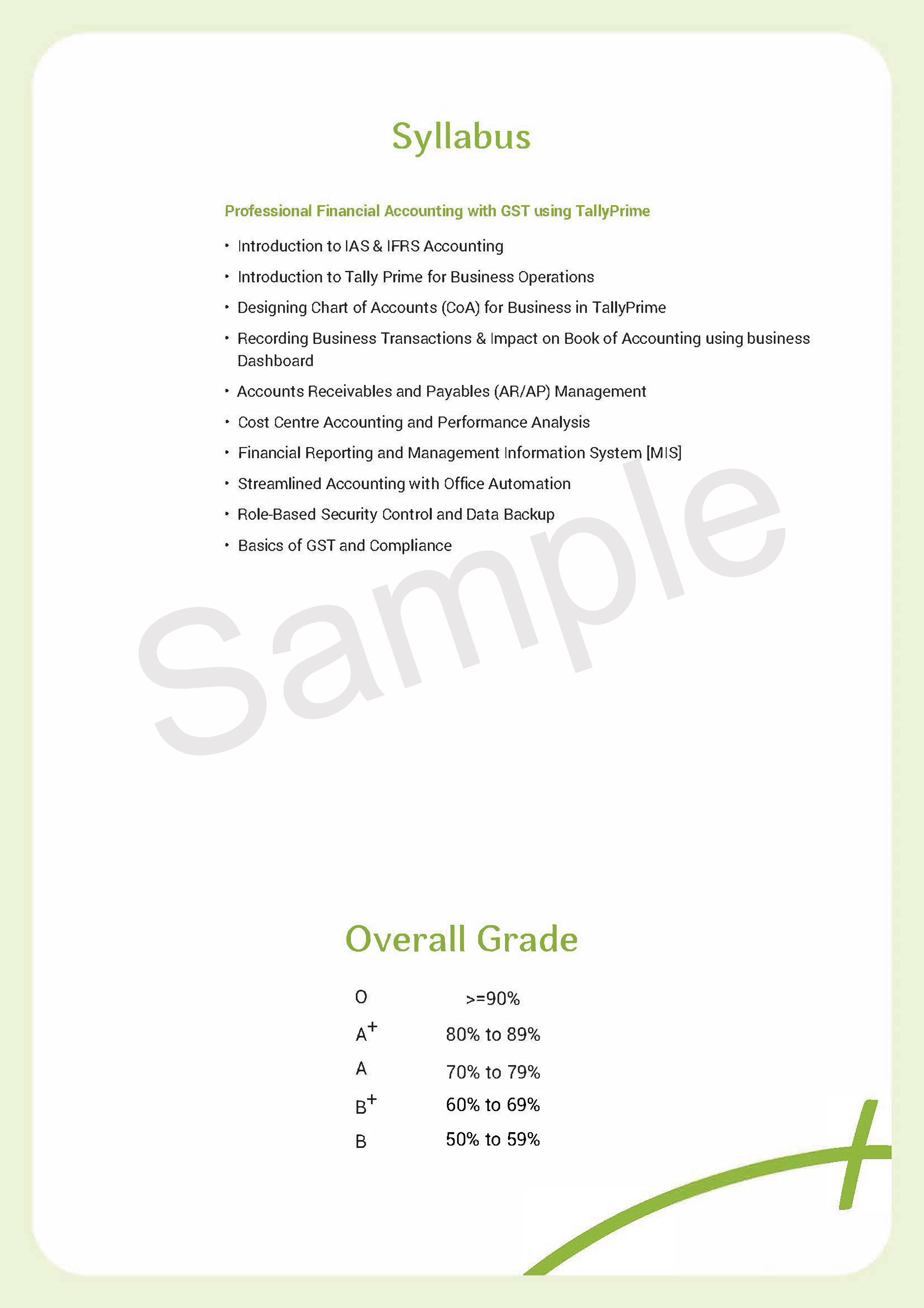
| Grade | Score Range |
|---|---|
| O | 90% and above |
| A+ | 80% to 89% |
| A | 70% to 79% |
| B+ | 60% to 69% |
| B | 50% to 59% |
Certification & Credits
Upon successfully completing the Professional Financial Accounting with GST using TallyPrime course and securing 50% or above in the assessment, you will earn 2 credits along with 2 certificates. These credits are stored in your Academic Bank of Credits (ABC) account.
Certificate of Merit from Tally Education

Certificate for credits from MSU
(Medhavi Skills
University)

Recognised Credit-Based Learning
This course is aligned with national education and skill development frameworks to ensure structured, recognised, and industry-relevant learning.
Framework Alignment
National Education Policy (NEP) 2020: Supports outcome-based learning with a focus on practical skill development and academic recognition.
National Credit Framework (NCrF): Enables recognition of learning through credit-based progression across academic, vocational, and professional pathways.
National Higher Education Qualifications Framework (NHEQF): Supports structured learning and recognised academic equivalence.
National Skills Qualifications Framework (NSQF) Level 4.5: Aligns the course with nationally recognised skill competency standards.
National Occupational Standards (NOS): Helps ensure industry-relevant learning for accounting, finance, and GST compliance roles.
Quick Course Credit Details
| Detail | Information |
|---|---|
| Skill Sector | BFSI |
| NSQF Level | 4.5 |
| Credits | 2 |
| Learning Hours | 60 |
Career Opportunities
Build practical accounting, GST, and business operations skills that can prepare you for entry-level roles across accounting, finance, and compliance functions.
This course is aligned with the BFSI sector and supports roles related to accounting, finance, and GST compliance.
Explore Career Opportunities Such As:
Industries Where You Can Explore Opportunities Group
Who Is This Course Suitable For?
This course is open to learners from different educational and professional backgrounds who want to build practical accounting, finance, and GST skills.
It is especially suitable for:
- Students (Commerce or non-commerce background)
- Graduates or working professionals in accounting, finance, or business operations
- Entrepreneurs, small business owners, and freelancers
Frequently Asked Questions (FAQs)
Anyone who has completed 12th grade or a Pre-University Course (PUC) is eligible to enroll in this course.
This course is especially suitable for learners who want to build a successful career in accounting, finance, taxation, or administration, as well as aspiring entrepreneurs looking to develop practical business and accounting skills.
Yes. Beginners can build a strong foundation in financial accounting, GST, and practical accounting using TallyPrime, while working professionals can strengthen their existing knowledge and upgrade their skills to align with current industry requirements.
No. The course starts with foundational accounting concepts and gradually progresses to practical applications in TallyPrime and GST, making it suitable for both beginners and learners looking to strengthen their accounting skills.
Yes. The course includes practical exercises and hands-on learning to help you apply accounting concepts, GST processes, and business workflows in real-world scenarios using TallyPrime.
After completing this course, you can explore entry-level opportunities in accounting, finance, GST compliance, and business operations roles such as Accounts Executive, GST Assistant, Billing Executive, Accounts Assistant, and related roles.
The course content can be accessed through the LMS portal, where learners can view course materials and learning resources throughout the course duration.
The total duration of the Professional Financial Accounting with GST using TallyPrime course is 60 structured learning hours.
Yes. This course is aligned with the National Credit Framework (NCrF) under National Education Policy (NEP) 2020, ensuring recognised and structured learning. The program also follows National Occupational Standards (NOS) and is aligned with the BFSI sector, providing industry-relevant accounting and finance skills.
Yes. The course covers practical accounting concepts, GST compliance, financial reporting, and TallyPrime operations, helping you build job-relevant skills for entry-level roles in accounting and finance.
Yes. Learners can access course content and supporting learning resources through the LMS portal.
Upon successful completion of the course and securing 50% or above in the assessment, learners will earn 2 credits and receive:
- Certificate of Merit from Tally Education
- Certificate for credits from MSU (Medhavi Skills University)
The Academic Bank of Credits (ABC) is a secure digital system that allows learners to store, track, and manage their academic credits in one place.
Once you successfully complete the course and earn credits, they are reflected in your ABC account, making it easier to track your academic progress, manage credits, and support verification across recognised institutions.
You can create an Academic Bank of Credits (ABC) account through the DigiLocker platform by generating your APAAR ID (Automated Permanent Academic Account Registry).
Guide to Generating Your APAAR ID