

Common Accounting Errors in Receivables & Payables and How TallyPrime Solves Them


Here is a scenario most finance professionals will recognise. The month-end review is approaching. The accounts team is chasing outstanding invoices, reconciling ledgers, and trying to figure out why the payables figure does not match what the vendors are saying. Sound familiar? If you have ever found yourself there, you already know the cost of getting Accounts Receivables & Payables wrong. And the uncomfortable truth is: most of those errors were entirely preventable.
Let us look at where things go wrong, why they keep going wrong, and how TallyPrime turns a genuinely stressful process into something you can actually feel confident about.
30-Second Summary
Most accounting errors do not happen because professionals are careless. They happen because manual tracking of Accounts Receivables & Payables (AR & AP) is genuinely difficult to get right at scale. Missed due dates, mismatched entries, duplicate payments, and unreconciled bills quietly build up until they become a very expensive problem. This article walks you through the most common errors in AR and AP management, explains why they occur, and shows how TallyPrime’s structured workflows eliminate them before they reach the books.
Why Accounts Receivable and Payable Errors Are So Common
Before we get into the list, it is worth acknowledging something. Managing Accounts Receivables & Payables (AR and AP) is not simply a data entry job. It requires tracking credit terms, due dates, GST compliance, advance payments, and outstanding balances across multiple parties, often simultaneously. The moment any one of those threads gets dropped, the downstream impact is real.
Here are the errors that show up most frequently:
1. Failing to Track Bills Bill-Wise:
One of the most common mistakes in receivables and payables management is recording transactions at the party level rather than the bill level. When you settle a payment against a party account without linking it to a specific invoice, you lose the ability to track which invoices are paid and which are still outstanding.
The result? Aged balances that nobody can explain. Disputes with customers over what is owed. Vendors following up on invoices that were actually cleared three months ago.
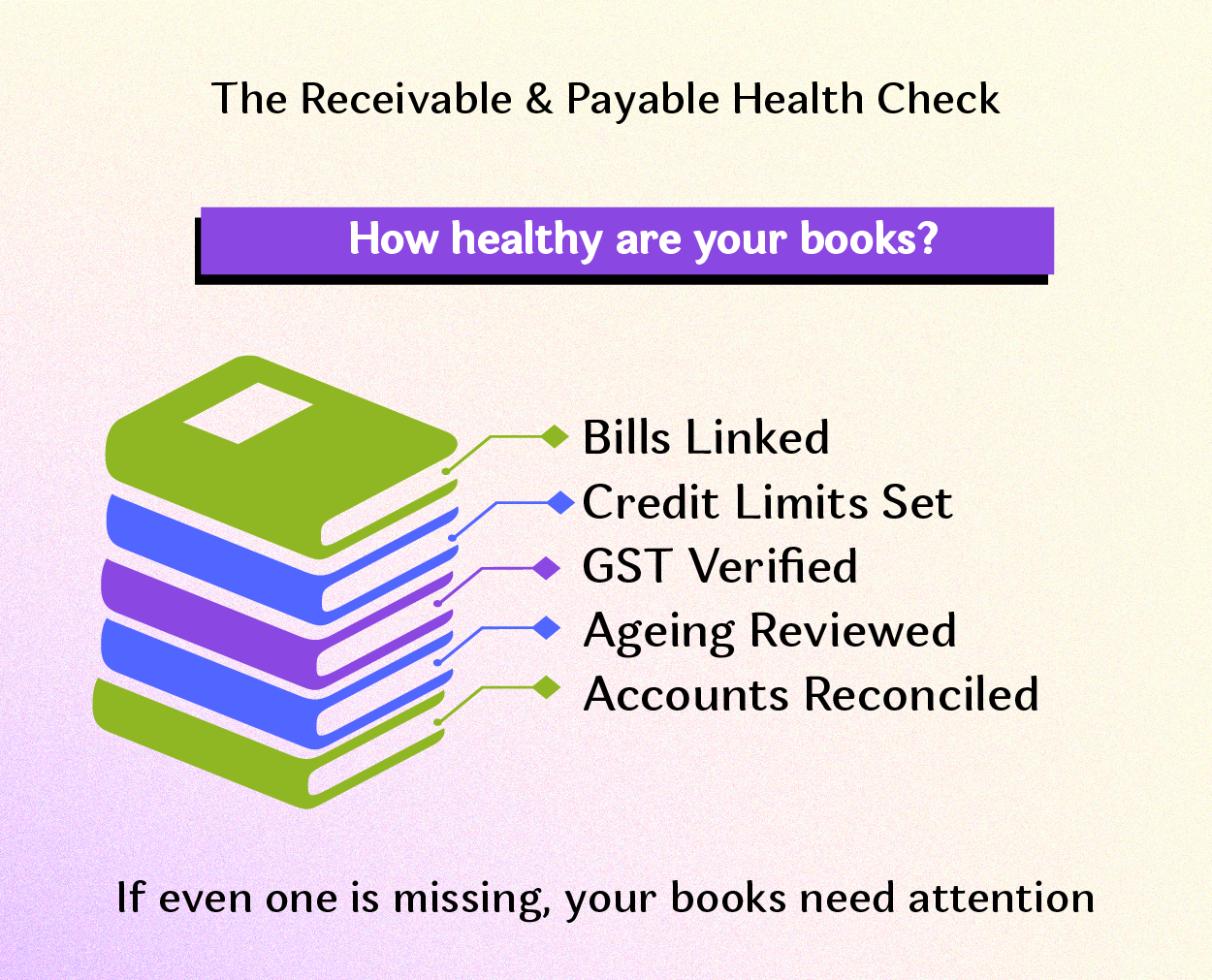
TallyPrime’s bill-wise entry system resolves this directly. Every transaction is linked to a specific bill reference. The Bills Receivable and Bills Payable reports then give you a clean, real-time view of what is outstanding, from whom, and since when. No guessing. No manual cross-checking.
2. No Credit Limits, No Controls:
Extending credit to customers without a defined credit limit is a risk most businesses only recognise once a large amount goes unpaid. Without controls, sales teams can continue booking orders for customers who are already well past their payment terms.
TallyPrime allows you to set customer-specific credit limits and payment terms at the ledger level. Once a customer exceeds their limit, the system flags it. This keeps the receivables pipeline under control and reduces the risk of large outstanding balances building up silently.
3. Mishandling Advance Payments:
Advances from customers and advances to suppliers are among the trickiest entries to manage. Recorded incorrectly, they either inflate your liabilities or understate your debtors. Adjusted too late, they leave the books looking inconsistent.
The Order to Cash (O2C) and Procure to Pay (P2P) cycles in TallyPrime are designed to handle advance payment scenarios in a structured way. You can record advances, link them to subsequent invoices, and track the adjustment through the system so nothing falls through the cracks.
4. GST Errors in Sales and Purchase Entries:
Incorrect GST treatment on invoices is a surprisingly persistent problem. Whether it is using the wrong tax rate, missing reverse charge applicability, or forgetting to include GST in an export invoice, these errors create mismatches between your books and your GSTR filings. And those mismatches can attract notices.
TallyPrime supports GST-compliant invoice creation as part of the standard Accounts Receivables & Payables workflow. Tax rates are applied at the ledger or stock item level, which reduces the possibility of manual errors at the time of entry. The system validates GST data before you proceed, not after things have already gone wrong.
To better understand how businesses can streamline these processes, explore How Does Tally Help with Accounts Payable and Receivable?
5. Overlooking Overdue Payments Until It Is Too Late:
This one is less about an entry error and more about a process gap. Many businesses do not have a reliable system for monitoring which invoices are approaching their due dates. The follow-up happens reactively, usually after a payment is already overdue.
TallyPrime’s ageing analysis reports break down outstanding balances by how long they have been due. You can see at a glance which debtors are in the 30-day bucket, which are in the 60-day bucket, and which are starting to look problematic. This kind of visibility makes proactive follow-up genuinely possible.
6. Duplicate Payments to Vendors:
Duplicate payments happen more often than most accounts teams are comfortable admitting. An invoice gets processed twice, or a payment is made against a bill that was already settled under a different reference. The error often only surfaces during reconciliation, by which point recovering the amount from the vendor can be awkward.
Bill-wise tracking in TallyPrime flags whether a bill has already been linked to a payment entry. This structural check reduces the likelihood of paying the same invoice twice, which is a small thing that saves a significant amount of embarrassment.
7. Unreconciled Party Accounts:
Perhaps the most time-consuming problem on this list. When AR and AP accounts are not reconciled regularly, differences accumulate. By the time a year-end audit or a vendor statement arrives, matching entries can become a significant effort.
TallyPrime’s account confirmation reports and outstanding statements can be shared with customers and vendors to verify balances. Regular reconciliation becomes a much lighter task when the system maintains a structured, bill-level record of every transaction.
How Structured Learning Helps You Handle All of This
Understanding these errors is useful. Knowing how to prevent them inside an actual accounting system is what makes you valuable. This is precisely what the Accounts Receivables & Payables Simplified with TallyPrime course from Tally Education is designed to deliver.
Over 25 hours of structured, practical content, you will learn to:
- Manage the complete O2C and P2P cycles in TallyPrime
- Set up and monitor credit limits and payment terms
- Handle advance payments and bill adjustments accurately
- Generate Bills Receivable and Payable reports and ageing analysis
- Create GST-compliant invoices within the AR and AP workflow
- Use budget and variance reports to stay on top of financial projections
The course uses TallyPrime on Cloud, which means you get hands-on access to a licensed version of the software from the moment you enroll. No separate setup required.
Upon completion, you receive a verifiable Certificate of Merit from Tally Education, the only entity authorised by Tally Solutions to issue official certifications on computerised accounting with TallyPrime. You can also access the Tally Job Portal, which connects certified learners directly with employers.
Conclusion
Let us be direct about something. Errors in receivables and payables do not announce themselves politely. They accumulate quietly, show up at the worst possible moment, and then require a significant effort to untangle. The good news is that most of them are entirely avoidable with the right system and the right skills.
TallyPrime gives you the system. Tally Education gives you the skills to use it properly. The only thing left is to decide whether you want to keep finding errors after the fact, or start preventing them from the outset.
Enroll in Accounts Receivables & Payables Simplified with TallyPrime today. Your future self, and quite possibly your next employer, will thank you.
Frequently Asked Questions
Question 1: Who should enroll in Accounts Receivables & Payables Simplified with TallyPrime?
Answer: This course is well-suited for commerce students, accounting graduates, junior accountants, accounts executives, and anyone looking to build practical skills in financial management. If you are working with or planning to work with receivables and payables in a business environment, this course is directly relevant to your role.
Question 2: Do I need prior experience with TallyPrime to take this course?
Answer: A basic familiarity with accounting concepts is helpful, but you do not need to be an experienced TallyPrime user to begin. The course is structured to walk you through the relevant workflows step by step, using TallyPrime on Cloud so you can practise in a real software environment as you learn.
Question 3: What kind of certificate will I receive after completing the course?
Answer: Upon successfully completing the course and its assessment, you will receive a digital Certificate of Merit issued by Tally Education and Distribution Services Pvt. Ltd., the only entity authorised to issue official certifications on computerised accounting with Tally. Your certificate includes a grade based on your assessment score and can be verified on the Tally Education website.
Question 4: How long does the course take, and how long do I have access to the materials?
Answer: The course runs for 25 hours of structured content, with a 60-minute assessment at the end. Once enrolled, you have access to all course materials, including explainer videos, tutorials, quizzes, and infographics, for one full year. This gives you the flexibility to learn at your own pace and revisit content whenever you need a refresher.

Tally Education
Tally Education empowers learners with industry-relevant skills in accounting, finance, taxation, and business management through practical learning and certifications. Our blogs are created and reviewed by subject matter experts to deliver accurate, practical, and up-to-date insights on accounting, GST, taxation, finance, and TallyPrime.