

Schedule III Balance Sheet: Format, Components, Requirements & Importance Explained


A balance sheet is one of the most important financial statements prepared by a business. A balance sheet is a snapshot of a company’s financial position at a particular point in time. It shows what a company owns (its assets), what it owes (its liabilities) and how much the owners have invested (its equity). But the preparation of a balance sheet is not enough. It is mandatory for the companies incorporated under Companies Act, 2013 to prepare in a format prescribed under Schedule III. This ensures consistency, transparency and comparability of financial statements across businesses.
30-Second Summary
A Schedule III Balance Sheet is a standardised financial statement format prescribed under the Companies Act, 2013 for presenting a company’s financial position. It divides assets, liabilities and shareholders’ equity into current and non-current categories while maintaining uniformity, transparency and regulatory compliance. Knowledge of the Schedule III balance sheet format, its essential elements and disclosure obligations facilitate companies in preparing precise financial reports and allows investors, lenders and other stakeholders to take educated financial decisions. In this blog, we will understand what Schedule III of the balance sheet is, its importance and key components that make up a Schedule III balance sheet.
What Is Schedule III Balance Sheet? Meaning, Format and Purpose Explained
Companies Act, 2013 Schedule III provides the format for preparation and presentation of financial statements of companies in India.
It lays down a uniform form for the presentation of balance-sheet and profit and loss account. Instead of allowing every company to prepare financial statements in its own format, Schedule III ensures that all companies follow a common reporting framework.
This standardisation simplifies the interpretation of financial statements for investors, lenders, auditors, regulators, and other stakeholders.
Why Is Schedule III Important for Companies?
Preparing a balance sheet according to Schedule III offers several benefits.
5 Key Benefits:
- Standardised Financial Reporting: Every company follows the same reporting format, making financial statements uniform and easier to interpret.
- Better Transparency: Schedule III requires companies to disclose detailed financial information, which reduces ambiguity and improves the quality of reporting.
- Easy juxtaposition: Since all companies use the same format, investors and analysts can compare the financial performance and position of different companies more effectively.
- Regulatory Compliance: Companies governed by the Companies Act, 2013 must prepare their financial statements in accordance with Schedule III. Non-compliance can lead to regulatory issues.
- Better Decision Making: Banks, investors, creditors and management can make informed financial decisions based on standardised financial statements.
Schedule III Balance Sheet Format: How Is It Structured?
Under Schedule III, the balance sheet is broadly divided into two sections:
| Equity and Liabilities | Amount (₹) | Assets | Amount (₹) |
|---|---|---|---|
| Shareholders’ Funds | XXX | Non-Current Assets | XXX |
| Non-Current Liabilities | XXX | Current Assets | XXX |
| Current Liabilities | XXX | ||
| Total | XXX | Total | XXX |
The total of the Assets side should always be equal to the total of the Equity and Liabilities side.
Let us understand each of these components in detail.
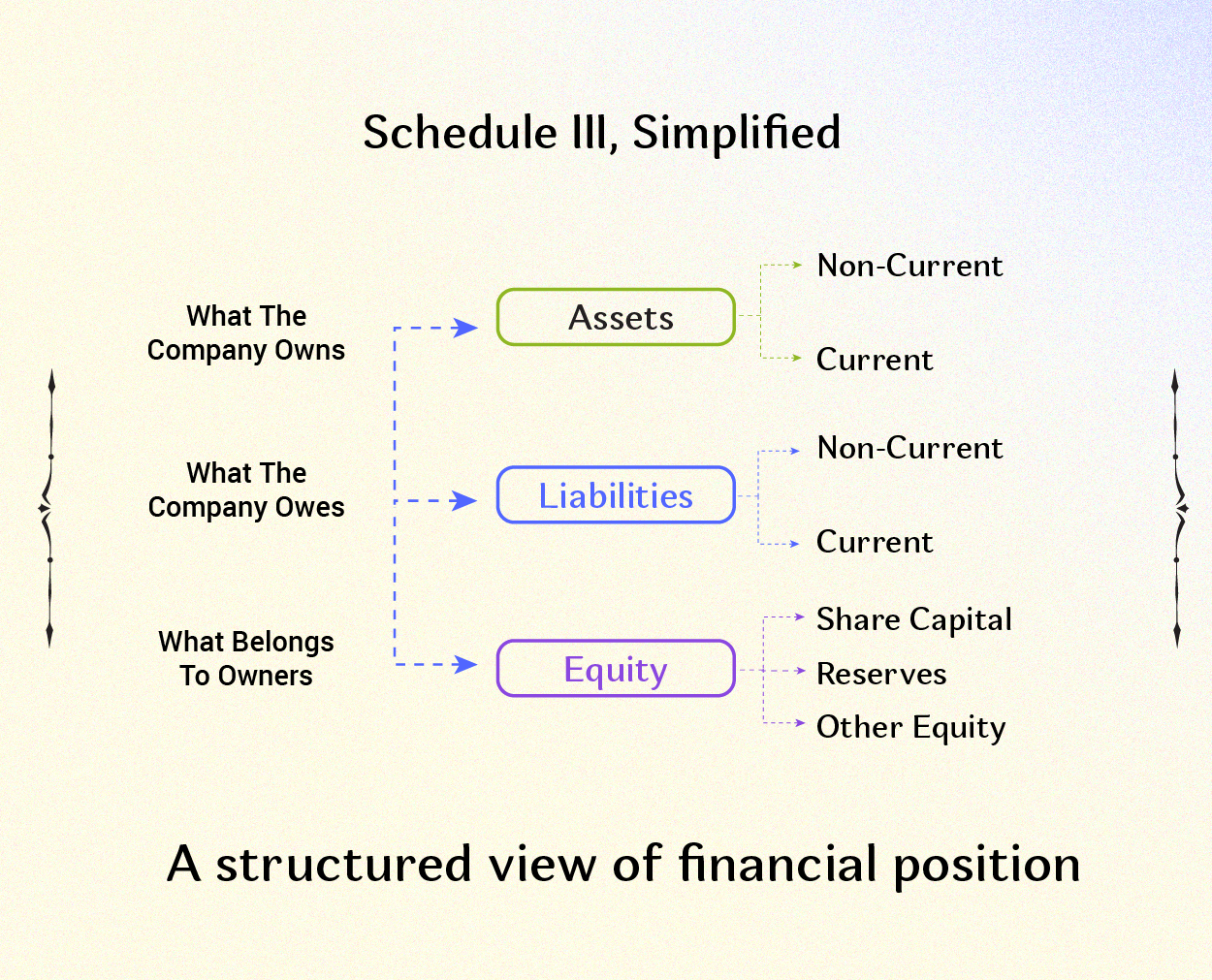
What Goes Under Equity and Liabilities in a Schedule III Balance Sheet?
1. Shareholders’ Funds: What Does This Section Include?
Shareholders’ funds are the money invested by the owners of the company and the profits retained in the business.
It usually consists of:
- Equity Capital Shares
- Preference Share Capital
- Reserves & Surplus
- Retained Earnings
- Other Equity Example: If the promoters invest ₹20 lakh into the company and the business earns profits that are retained instead of being distributed as dividends, both form part of shareholders’ funds.
2. Non-Current Liabilities: What Goes on the Balance Sheet?
They are long-term debts which fall due more than 12 months after the balance sheet date.
Some examples are:
- Long-term borrowings
- Deferred tax liabilities
- Long-term provisions
- Obligations under finance leases
- Other long-term financial liabilities
Example:
A five-year business loan borrowed from a bank will appear as non-current liabilities.
3. Current Liabilities: Which Obligations Are Due Within a Year?
Current liabilities are debts that must be paid within one year or within the company’s operating cycle, whichever is longer.
They usually contain:
- Trade Payables
- Short-term Borrowings
- Outstanding Expenses
- Current Tax Debts
- Other Current Liabilities
- Short-term Provisions
For example:
An unpaid supplier invoice due within 30 days will be classified as a current liability.
What Are the Main Asset Components Under Schedule III?
Assets are economic resources owned or controlled by a company that are expected to bring future economic benefits.
They are divided into two categories.
1. Non-Current Assets: Tangible Fixed Assets
These assets are to be used in the business for more than one year.
Typical examples are:
- Property, Plant and Equipment (PPE)
- Capital work in progress
- Property for Investment
- Non-Physical Assets
- Goodwill
- Investments (Long Term)
- Deferred Tax Assets
- Loans and Advances (Long Term)
Example:
A manufacturing company purchases machinery of worth ₹50 lakh and records it under Property, Plant and Equipment under non-current assets.
2. Current Assets: Working Capital
Current assets are expected to be realised, sold or consumed within one year.
They normally consist of:
- Inventory
- Trade Receivables
- Cash and Cash Equivalents
- Banking balances
- Temporary investments
- Loans and Advances (Short-Term)
- Other property: Goods that are in a warehouse and are available for sale are reported as inventory, which is an item of current assets.
Schedule III Disclosure Requirements: What Must Companies Report?
Apart from classification, Schedule III also specifies various disclosure requirements that improve financial reporting.
Some of the key disclosures include:
- Breakdown of share capital and reserves
- Classification of borrowings into current and non-current
- Ageing schedule of trade receivables and trade payables
- Details of property, plant, and equipment
- Contingent liabilities and commitments
- Related party disclosures (where applicable through applicable accounting standards)
- Additional notes to accounts supporting the financial statements
These disclosures provide stakeholders with deeper insights into the financial health of the company rather than just the summary figures.
Who Needs to Follow Schedule III of the Companies Act, 2013?
It is mainly applicable to the companies who are preparing financial statements as per the Companies Act, 2013. Companies prepare their financial statements under different divisions of Schedule III depending upon the accounting framework they follow.
The applicable format generally depends on whether the company follows the Accounting Standards (AS) and should make sure that they adopt the division as applicable to them as per the regulatory requirements.
Common Schedule III Balance Sheet Mistakes and How to Avoid Them
Businesses often make mistakes when preparing balance sheets that can impact the accuracy of financial reporting.
Some common mistakes are:
- Misclassification of current and non-current items
- Inadequate disclosures in the notes to accounts
- Loans and borrowings misclassification
- Not reconciling balances before they are settled
- Failure to comply with mandatory disclosures as required under Schedule III
- Failure to update financial statement formats based on amendments
Avoiding these mistakes helps ensure compliance and improves the reliability of financial statements.
If you want to go beyond balance sheet classification and understand how structured learning builds full financial statement mastery, read our guide on How Advanced Accounting Courses Help You Master Financial Statements.
Schedule III Balance Sheet: The Key Points at a Glance
A Schedule III balance sheet is far more than a statutory requirement. It provides a standardised and transparent framework for presenting a company’s financial position. By classifying assets, liabilities, and shareholders’ funds in a structured manner and requiring detailed disclosures, Schedule III enhances the quality and comparability of financial reporting.
Whether you’re a finance student, an accounting professional, or a business owner, understanding the Schedule III balance sheet is crucial for understanding financial statements and for compliance with the Companies Act, 2013. By understanding the structure and components, you can make financial reporting easier and help with financial analysis and business decision making.
Professionals looking to strengthen their accounting knowledge and practical skills can explore a Professional Accounting Course.
Frequently Asked Questions (FAQs)
Question 1: What is Schedule III of the Balance Sheet?
Answer: Schedule III is a part of the Companies Act, 2013 that prescribes the format and disclosure requirements for preparing a company’s balance sheet and statement of profit and loss. It provides consistency, transparency and comparability in financial reporting.
Question 2: Why is Schedule III important for companies?
Answer: Schedule III provides a standardised format for companies to present their financial statements, making it easier for investors, lenders, auditors, and regulators to read and compare. It also ensures compliance with the Companies Act, 2013.
Question 3: What are the main components of a Schedule III Balance Sheet?
Answer: A Schedule III balance sheet is split into two major parts:
- Equity and Liabilities which consists of shareholders’ funds, non-current liabilities and current liabilities.
- Assets, which are classified into non-current assets and current assets.
Question 4: What is the difference between current and non-current assets under Schedule III?
Answer: Current assets are expected to be converted into cash, sold, or consumed within one year or the company’s operating cycle. Non-current assets are long-term assets that provide economic benefits for more than one year, such as property, plant, equipment, and intangible assets.
Question 5: What is the distinction between current and non-current liabilities in Schedule III?
Answer: Current liabilities are debts that must be paid within a year. Examples include trade payables and short-term borrowings. Non-current liabilities are long-term debts that are due to be paid in more than one year, for example long-term loans and deferred tax liabilities.
Question 6: Who needs to prepare financial statements under Schedule III?
Answer: Companies preparing financial statements under the Companies Act, 2013 are generally required to adhere to the applicable division of Schedule III depending on the accounting standards they follow like Accounting Standards (AS) or Indian Accounting Standards (Ind AS).
Question 7: What disclosures are required under Schedule III of the Companies Act, 2013?
Answer: As per Schedule III, the companies must disclose information like share capital, reserves and surplus, borrowings, trade receivables, trade payables, property, plant and equipment, contingent liabilities, etc., by way of notes to accounts for better transparency.
Question 8: What is the use of Schedule III in financial statements?
Answer: The objective of Schedule III is to ensure uniformity in the presentation of financial statements, enhance the quality of financial disclosures, ensure compliance with the law and assist the stakeholders in taking informed decisions relating to financial matters.

Nita R
Nita is a content writer specialising in Accounting, Finance, GST, and Taxation. She creates easy-to-understand, research-driven content that simplifies complex financial and tax concepts for learners, professionals, and businesses. Her expertise lies in translating technical accounting and GST topics into practical insights, helping readers stay informed about tax compliance, financial processes, and industry best practices. Through her content, she aims to make accounting and taxation accessible, accurate, and relevant for today's evolving business environment.