


Fund Flow Statement: Definition, Format, Elements, Importance and Examples


30-Second Summary
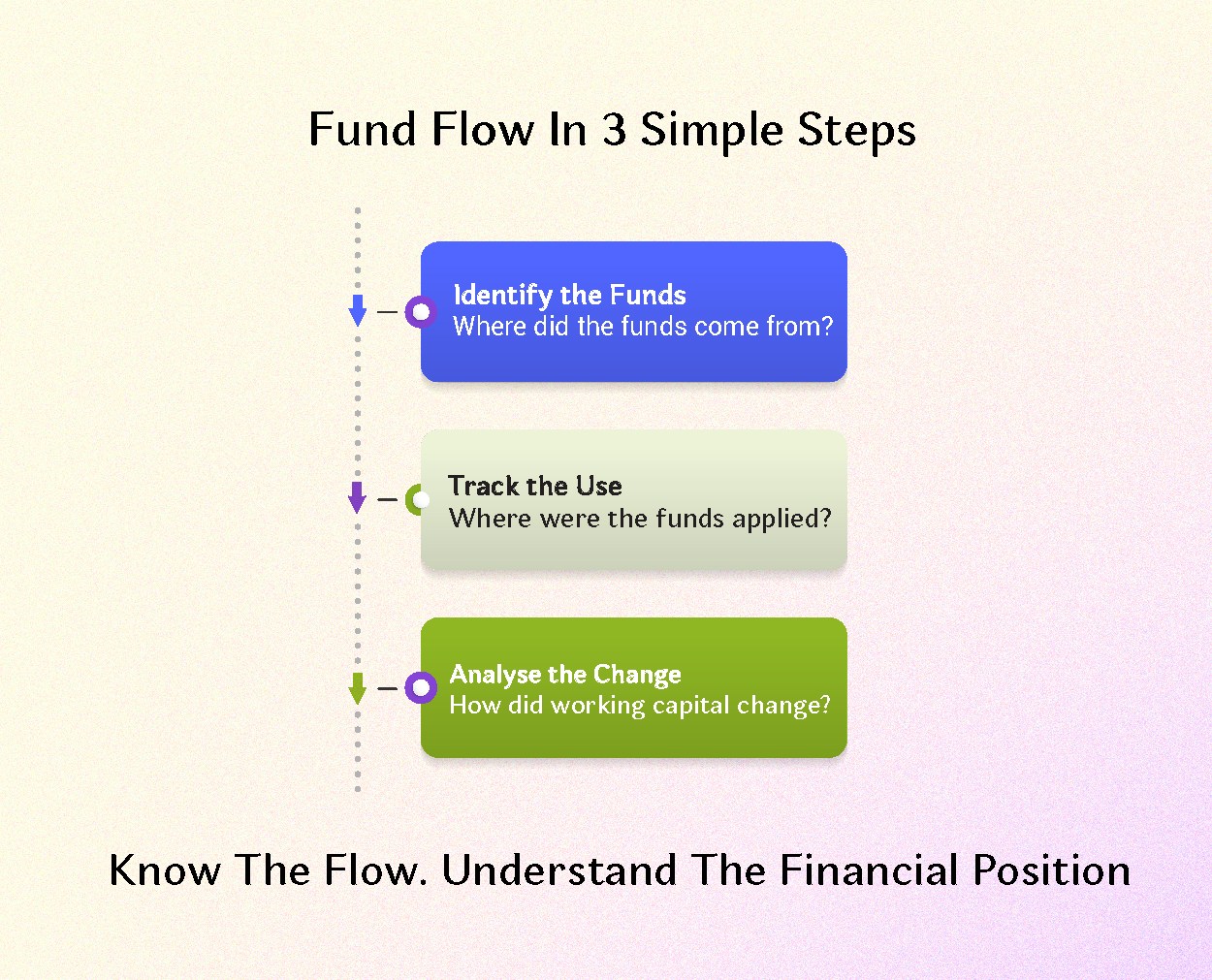
Where did the money come from? Where did it go? It is important to understand these changes when trying to evaluate how a business uses its financial resources. This picture is provided by a Fund Flow Statement which shows the sources from which and the uses to which funds have been put during a particular accounting period and analyses their effect on working capital. Fund Flow Statement is related to working capital changes. Cash Flow Statement is related to cash and cash equivalents. In this blog, we will try to understand the meaning, importance, sources and uses of funds and how it helps in analysing the financial position of a business.
Introduction
A business is constantly receiving and using money. It may generate funds from operations, issue shares, borrow funds, dispose of fixed assets or use its existing resources to finance its activities. To understand these movements is important to assess how a business handles its financial resources.
The Fund Flow Statement is a conventional financial analysis tool which explains the changes in the financial position of a company between two accounting periods. It reports the source of funds and their expenditure during the period.
The Cash Flow Statement deals specifically with cash and cash equivalents while the Fund Flow Statement deals generally with working capital. This makes it useful for understanding changes in the short-term financial position of a business.
Let us understand the meaning, importance, components and format of Fund Flow Statement. Learning these concepts can also help students build a strong foundation through an Advanced Accounting Course, where they can explore financial analysis and accounting practices in greater depth.
What is a fund flow statement?
A Fund Flow Statement is a statement of sources from and uses to which funds are put during a given accounting period. The term “fund” is used in the traditional sense for working capital calculated as: Working Capital = Current Assets – Current Liabilities
A Fund Flow Statement explains the transactions that cause an increase or decrease in the working capital between two balance sheet dates. Let’s say a company gets a long-term bank loan. It gets the money which can help its working capital. In contrast, if the company purchases machinery by cash, then its working capital may reduce.
The statement helps to answer two basic questions:
• Where did the money come from?
• Where has the money gone?
• Why do we need a fund flow statement?
Although the Fund Flow Statement is not a major financial statement under current accounting standards, as the Cash Flow Statement is, it can still be a useful tool for analysis.
- It Helps in Understanding Changes in Working Capital: It explains the reasons for an increase or decreases in working capital from one accounting period to the next.
- Sources of Funding Identified: It indicates the sources of funds from operations, borrowings, issue of shares, sale of assets etc.
- Shows how funds will be used: It explains the utilisation of funds such as the purchase of fixed assets, payment of loans, dividends or the increase in working capital.
- Helps in Financial Planning: Management uses fund flow analysis to know availability and application of long-term funds and plan future financial requirements.
- Aids in Analysing Financial Position: Comparing sources and uses of funds can provide management and other stakeholders with a better understanding of important changes in the company’s financial structure.
What are the Key Components of Fund Flow Statement?
A Fund Flow Statement is generally divided into two major parts:
1. Sources of funds
2. Application or Uses of Funds
Let’s know them in detail.
Where does the money come from?
Source of funds is a transaction that creates funds or increases working capital. Common sources are:
1. Operating Funds: A business can earn money from its day-to-day operations. Normally the calculation is made from profit and adjusted for non-fund/non-operating items as necessary.
For example: Depreciation is charged as an expense in the Profit and Loss Account but does not involve any actual outflow of funds. Hence, it is usually added back in the funds from operations calculation.
2. Share Allotment: Thus, when a company issues equity or preference shares for cash, it receives funds. It is regarded as a source of funds.
3. Issue of Debentures or Long-Term Borrowings: The funds may be raised by issue of debentures or by long term loans.
4. Disposal of Fixed Assets: Proceeds from the sale of a fixed asset may be a source of funds. When a firm sells a fixed asset and receives the proceeds.
5. Sale of Long-Term Investments: Long term investments may also be treated as a source of fund from the proceeds of sale.
Uses of funds: What are they?
Fund applications are transactions that consume funds or reduce working capital.
Some of the common uses are:
1. Acquisition of Fixed Assets: When a company uses funds to buy machinery, buildings, vehicles or other long-term assets, it is called an application of funds.
2. Repayment of Long-Term Loans: When you pay off a long-term loan or redeem debentures it uses up cash, so it is treated as an application.
3. Redemption of Preferred Stock: When preference shares are redeemed for cash the funds used for redemption represent an application of funds.
4. Dividend Distribution: Dividends paid to shareholders, where applicable, may be treated as an application of funds.
5. Rise in Working Capital: An increase in working capital during the accounting period is an application of funds. It is caused by an increase in current assets or funds being tied up in current assets.
Schedule of Changes in Working Capital
Schedule of Changes in Working Capital is one of the most important parts of fund flow analysis. It compares the current assets and current liabilities of two accounting periods to find out whether the working capital has increased or decreased.
A simplified format:
| Particulars | Previous Year (₹) | Current Year (₹) | Change in Working Capital (₹) |
|---|---|---|---|
| Current Assets | XXX | XXX | XXX |
| Current Liabilities | XXX | XXX | XXX |
| Net Working Capital | XXX | XXX | Increase / (Decrease) |
How does it work?
Increasing current assets usually increases working capital.
A reduction of current assets generally reduces working capital.
Increase in current liabilities tends to decrease working capital
Current liabilities are usually decreased to increase working capital.
For example, if inventory goes up from ₹5 lakh to ₹7 lakh, working capital goes up by ₹2 lakh, all other things being equal.
Fund Flow Statement Format
| Sources of Funds | Amount (₹) | Applications of Funds | Amount (₹) |
|---|---|---|---|
| Funds from Operations | XXX | Purchase of Fixed Assets | XXX |
| Issue of Shares | XXX | Repayment of Long-Term Loans | XXX |
| Long-Term Borrowings | XXX | Redemption of Debentures | XXX |
| Disposal of Fixed Assets | XXX | Dividend Paid | XXX |
| Sale of Investments | XXX | Increase in Working Capital | XXX |
| Total Sources of Funds | XXX | Total Applications of Funds | XXX |
In a correctly prepared Fund Flow Statement, the total sources of funds should normally be equal to the total applications of funds.
Fund Flow Statement Vs Statement of Cash Flow
Both statements analyse financial movements, but the focus is different.
| Flow of Funds Statement | Statement of Cash Flows |
|---|---|
| Traditionally concentrates on working capital | Focuses on cash & cash equivalents |
| Explains working capital changes | Description of the change in cash and cash equivalents |
| Classifies sources and uses of funds | Classifies cash flows from operating, investing, and financing activities |
| Used mainly as an analytical tool | A financial statement recognised by the applicable accounting standards |
So, the Cash Flow Statement is more directly related to liquidity and cash management. The Fund Flow Statement would give a broader traditional analysis of changes in working capital.
Limitations of Fund Flow Statement
However, a Fund Flow Statement is useful but has some limitations.
• It doesn’t provide a detailed view of actual cash inflows and outflows.
• It may not be enough for short-term liquidity evaluation.
• It is based on changes between two balance sheet dates and will not necessarily account for each individual transaction.
• It has been largely supplanted by the Cash Flow Statement for statutory financial reporting purposes under relevant accounting frameworks. Thus, the fund flow statement is best used as a supplementary analytical tool and not as a substitute of the Cash Flow Statement.
Final thoughts
The statement of fund flows is a useful way to see how a business obtained and used funds in an accounting period. Businesses can find out the reasons for changes in their financial position by looking at the sources and uses of money and by preparing a Schedule of Changes in Working Capital.
The Cash Flow Statement has almost entirely replaced the Fund Flow Statement in modern financial reporting, but it is still useful for accounting students and professionals to understand the concepts. It gives a good background for understanding working capital management, financial analysis and flow of funds in a business. These concepts are also valuable for learners pursuing a Business Accounting Course, as they help develop practical knowledge of financial management and accounting.
Frequently Asked Questions (FAQs)
Question 1: What is a Fund Flow Statement?
Answer: A Fund Flow Statement is a statement showing the sources and uses of funds for a particular accounting period. It traditionally looks at changes in working capital.
Question 2: What are the major features of Fund Flow Statement?
Answer: The two main components are sources of funds and uses of funds. Sources of funds include funds from operations, issue of shares, borrowings and sale of assets. Uses of funds include purchase of assets, repayment of loans and other uses of funds.
Question 3: How do you define funds in a Fund Flow Statement?
Answer: In a Fund Flow Statement, “fund” is commonly taken to mean working capital, which is current assets fewer current liabilities.
Question 4: What is a Working Capital Change Schedule?
Answer: A Schedule of Changes in Working Capital shows the current assets and current liabilities from one accounting period to the next so that you can see whether working capital has increased or decreased.
Question 5: What is the difference between Fund Flow Statement and Cash Flow Statement?
Answer: Traditionally, a Fund Flow Statement deals with changes in working capital. A Cash Flow Statement deals specifically with cash and cash equivalents and classifies cash flow as operating, investing and financing activities.
Question 6: Must a company prepare a Fund Flow Statement?
Answer: The Fund Flow Statement is not a required financial statement under the current financial reporting framework as is the Cash Flow Statement. The main application is as an analytical tool.
Question 7: Why is a statement of fund flow required?
Answer: Fund Flow Statement helps in understanding the sources and uses of funds, changes in working capital, long term financial planning and major changes in financial position of the firm.

Nita R
Nita is a content writer specialising in Accounting, Finance, GST, and Taxation. She creates easy-to-understand, research-driven content that simplifies complex financial and tax concepts for learners, professionals, and businesses. Her expertise lies in translating technical accounting and GST topics into practical insights, helping readers stay informed about tax compliance, financial processes, and industry best practices. Through her content, she aims to make accounting and taxation accessible, accurate, and relevant for today's evolving business environment.