


MSME Form-1: Filing, Due Dates, Penalties & Compliance Under Companies Act


30-Second Summary
Timely payment is key to the survival and growth of Micro and Small Enterprises (MSEs). But when big companies pay late, it causes cash flow problems for these businesses. For increasing transparency and to facilitate timely payments, MCA has introduced MSME Form-1. This half-yearly return must be filed by certain companies having outstanding payments to Micro and Small Enterprises beyond the prescribed period. Knowing what information needs to be reported, who must file, and what happens if you don’t comply can help businesses avoid penalties and keep good vendor relationships.
What Is MSME Form-1? Meaning, Purpose and Applicability
MSME Form-1 is a half-yearly return which certain companies are required to file with the Ministry of Corporate Affairs (MCA) if they have payments due to Micro and Small Enterprises that are overdue beyond the time limit specified under the Micro, Small and Medium Enterprises Development (MSMED) Act, 2006. This return is not about raising taxes or collecting revenue, it is about making companies accountable for their payment practices and ensuring they disclose delayed payments.
Suppose you are a small manufacturing unit supplying to a large corporation. You’ve done your part on time, but weeks become months and you’re still waiting for your pay. While large companies might have sufficient cash reserves to absorb the delays, the working capital of Micro and Small Enterprises can get badly affected in such situations.
To address this, the Government has introduced MSME Form-1, a compliance mechanism which promotes transparency in reporting delayed payments made to Micro and Small Enterprises.
Who Does MSME Form-1 Apply To?
MSME Form-1 is applicable only in cases where the supplier is registered as a Micro or Small Enterprise under the MSMED regime. This return does not report payments to Medium Enterprises.
Why Was MSME Form-1 Introduced? Understanding Its Purpose
MSME Form-1 was introduced by the Ministry of Corporate Affairs (MCA) through a notification in January 2019. It has become an important corporate compliance requirement for companies dealing with registered Micro and Small Enterprise suppliers.
Micro and Small Enterprises generally have limited financial resources and rely on timely payments to run their day-to-day operations. Even a small delay in receiving payments can affect their ability to pay employees, buy raw materials or meet customer orders.
In view of this challenge, Government has launched MSME Form-1 with the following objectives:
- Encourage Fast Payments: The main objective is to ensure that buyers make payments to Micro and Small Enterprises within the stipulated timelines under the MSMED Act.
- Enhance Transparency: This will give regulators improved visibility of payment practices across industries by requiring companies to report outstanding dues.
- Boost Corporate Accountability: Delayed dues must be reported to the Ministry of Corporate Affairs, which makes companies more aware of their payment obligations.
- Support the Growth of SMEs: Improved payment discipline allows small businesses to have a healthy cash flow, invest in their growth and continue to contribute to employment and economic growth.
Who Needs to File MSME Form-1? Applicability Explained
MSME Form-1 is not mandatory for all companies.
A company shall file the return where the following conditions are satisfied:
- It has purchased goods or services from a supplier registered as a Micro or Small Enterprise under the MSMED Act.
- The payment to such supplier is delayed beyond 45 days from the date of acceptance or deemed acceptance of the goods or services.
If any of these conditions is not met, the company is not generally required to file MSME Form-1 for that transaction.
Let’s understand this with an example:
ABC Ltd. bought machinery components from a registered Micro Enterprise on 10 July. The supplier delivers the goods. Agreed payment period is 30 days. In the event ABC Ltd. does not pay the amount within the maximum period allowed under the MSMED Act and such amount remains outstanding beyond 45 days, the company may have to disclose such outstanding dues when filing MSME Form-1.
What Details Are Required in MSME Form-1?
The objective of MSME Form-1 is to furnish the Government with particulars of payments which are outstanding to Micro and Small Enterprises.
While filing the return, companies are generally required to provide information such as:
- Supplier’s Name (Micro or Small Enterprise).
- The amount outstanding at the date of reporting.
- Date on which the amount became due.
- Reason for the delay in making the payment.
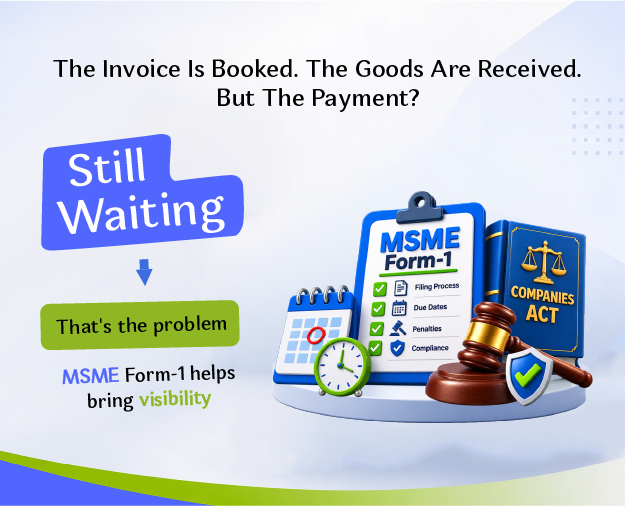
MSME Form-1 Due Date and Filing Frequency
MSME Form-1 is not a monthly/ quarterly compliance. It is a half yearly return to be filed with the Ministry of Corporate Affairs (MCA).
| Reporting Period | Due Date |
|---|---|
| April to September | 31 October |
| October to March | 30 April |
What Happens If MSME Payments Are Delayed?
Imagine a Micro Enterprise has supplied goods worth ₹5 lakh to a large company. The goods have been delivered, but the payment keeps getting delayed. For a small business, waiting for months to receive ₹5 lakh can put pressure on its working capital and day-to-day operations.
To discourage such delays, the MSMED Act, 2006 provides for interest on delayed payments to Micro and Small Enterprises.
If a buyer fails to make the payment within the prescribed time, the buyer is liable to pay compound interest with monthly rests on the outstanding amount. The interest is calculated at three times the Bank Rate notified by the Reserve Bank of India (RBI).
Why does this matter?
This provision serves two important purposes:
- Encourages timely payments: Companies have a financial reason to avoid unnecessarily delaying payments to Micro and Small Enterprises.
- Protects MSME cash flow: The interest provision provides compensation for the financial impact of delayed payments.
What Is the Penalty for Not Filing MSME Form-1?
Filing MSME Form-1 is not simply a formality that companies can overlook.
If a company is required to file the form but fails to submit it within the prescribed timeline, the company may face penalties under the Companies Act, 2013.
The results could include:
- Financial penalties against the company.
- Increased regulatory scrutiny during inspections or audits.
- Repeated defaults increased the chance of non-compliance.
- Failure to comply with the law can also adversely affect a company’s governance practices and business reputation, in addition to statutory penalties.
MSME Form-1 Compliance: Key Takeaways
MSME Form-1 is not just a statutory filing; it is a declaration of a company’s commitment to ethical business practices and sound financial management. To improve transparency, strengthen payment discipline, and foster the development of India’s MSME sector, the Government has mandated that companies must disclose delayed payments made to Micro and Small Enterprises.
Ultimately, a strong payment culture is good for MSMEs, but it also leads to a healthier and more sustainable business ecosystem.
Frequently Asked Questions (FAQs)
Question 1: What is the MSME form-1?
Answer: MSME Form-1 is a half yearly return to be filed with the Ministry of Corporate Affairs by certain companies which have outstanding payments due to Micro and Small Enterprises beyond the prescribed period under the MSMED Act.
Question 2: Who is required to file MSME Form-1?
Answer: The MSME Form-1 filed should be for companies having outstanding dues payable to registered Micro and Small Enterprises (MSEs) beyond the prescribed period of payment.
Question 3: What is the due date for MSME Form-1?
Answer: The return is filed twice a year:
- 31 October for the period April to September.
- 30 April for the period October to March.
Question 4: What is the maximum period of payment under the MSMED Act?
Answer: Payment should normally be made within the agreed time, which may not exceed 45 days after the date of acceptance or deemed acceptance of goods or services.
Question 5: What is the penalty for delayed payment to MSME?
Answer: The buyer shall be liable to pay compound interest with monthly rests at a rate equal to 3 times the RBI Bank Rate on the amount outstanding.
Question 6: What if a company does not file MSME Form 1?
Answer: Failure to file return may lead to penalties under the Companies Act, 2013 and increased regulatory scrutiny and compliance risks.
Question 7: Does MSME Form-1 apply to Medium Enterprises?
Answer: No. MSME Form-1 is applicable only for the payments which are outstanding to Micro and Small Enterprises registered under the MSMED Act.

Nita R
Nita is a content writer specialising in Accounting, Finance, GST, and Taxation. She creates easy-to-understand, research-driven content that simplifies complex financial and tax concepts for learners, professionals, and businesses. Her expertise lies in translating technical accounting and GST topics into practical insights, helping readers stay informed about tax compliance, financial processes, and industry best practices. Through her content, she aims to make accounting and taxation accessible, accurate, and relevant for today's evolving business environment.