

What is a Balance Sheet? Meaning, Components and Importance


30-Second Summary
Want to know where a business stands financially? The Balance Sheet gives you the answer! It provides a snapshot of a business’s financial position on a particular date by showing what it owns (assets), what it owes (liabilities), and the owner’s equity. These details help business owners understand their financial health, assess their ability to meet financial obligations, and make informed decisions. It also helps investors, lenders, and other stakeholders understand how financially sound a business is.
What is a Balance Sheet?
Imagine that you have a business and you want to know how it is doing financially. Maybe you have cash in the bank, products to sell, equipment that keeps your day to day running and bills due vendors. But how do you pull it all together to see where your business stands? And this is where a Balance Sheet becomes useful.
Balance Sheet is a financial statement that shows the financial position of a business at a particular point of time. It shows the assets of the business, its liabilities and the owner’s interest in the business. Say you own a small clothing store. Your business may have cash, stock, furniture and money owed to you by your customers. You may have a loan to repay and payments to suppliers. This information is compiled into one report within a Balance Sheet.
The Balance Sheet tells you where the business stands at a certain date. It is different from an income statement, which shows income and expenses over a period.
What is Contained in a Balance Sheet?
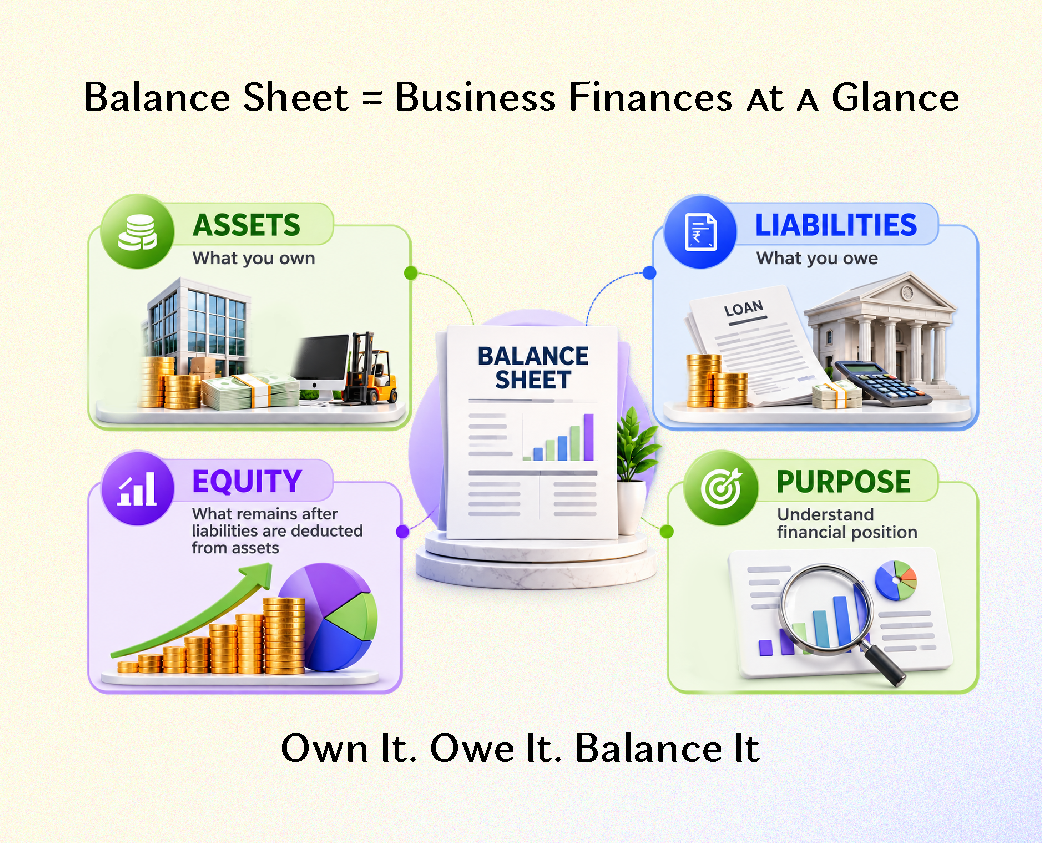
A Balance Sheet has three main things; assets, liabilities and owner’s equity. Let’s try to understand each of them with some simple examples.
1. Assets: What does the business own?
An asset is a resource that a business owns and expects to provide future economic benefits. Simply put, assets are the things a business uses to function and generate income. A business may have a shop, computers, furniture, inventory and cash in its bank account. It may have money due from customers to whom it has sold goods on credit. Assets are generally classified into two types:
a) Current Assets: These assets are expected to be sold, used or converted into cash within the normal operating cycle or the applicable short-term period. Cash, bank balances, inventories and receivables from customers.
b) Non-Current Assets: These are assets that are held for long term use in the business. Buildings, machinery, furniture and equipment. Example: Suppose a business has cash of ₹50,000, stock of ₹1,00,000 and machinery worth ₹2,00,000. Total assets of the business are ₹3,50,000.
2. Liabilities: What the company owes?
Liabilities are amounts which a business owes to others. You may have such obligations because you borrowed money, bought something on credit or otherwise entered into a business transaction. For example, if a business has taken a loan from a bank or bought merchandise from a supplier and promised to pay later, the business has a liability. In general, liabilities are divided into two groups:
a) Current Liabilities: These are debts that have to be paid within the short duration applicable to them. Accounts payable to suppliers, accrued expenses and short-term loans.
b) Non-Current Liabilities: These are obligations that are typically due in over a longer period of time. Example: Long term loans and other long-term liabilities. A business has a bank loan of Rs. 1,00,000 and owes to its suppliers Rs. 50,000. Total liabilities of the business are Rs. 1,50,000. Knowing the liabilities of a business helps the owners to know what they owe and what they need to repay hence plan their finances properly.
3. Owner’s Equity: What is the Owner’s?
Owner’s equity is the owner’s residual interest in the business after liabilities have been subtracted from assets. It can include owner’s capital, retained earnings and any other applicable reserves or adjustments. Simply put, what’s left for the owner after subtracting the business’s liabilities.
Let’s look at a business having total assets of ₹5,00,000 and total liabilities of ₹2,00,000. Then the Owner’s equity will be ₹3,00,000.
Owner’s Equity = Total Assets – Total Liabilities
For a company this section is normally shown as Shareholders Equity and may include share capital, reserves, amongst other things.
Related Read: Schedule III Balance Sheet: Format, Components, Requirements & Importance Explained.
Why is a balance sheet important to a company?
A Balance Sheet is more than just a financial report, it also helps business owners to understand their financial position and make informed decisions. Here’s why that’s important.
- Know the Financial Position: A Balance Sheet gives a clear picture of the assets, liabilities and equity of a business at a particular date. This tells the owners what the business owns and what the business owes.
- Liquidity Ratio: Liquidity ratio is the ratio of current assets to current liabilities. It tells us whether business can pay its short-term liabilities or not. This is helpful if you are arranging to pay suppliers, employees and others.
- Aids business decisions: Planning to buy new equipment, open another branch or take a loan? A Balance Sheet can help business owners assess their current assets and liabilities before making such decisions.
- Assists banks and investors to evaluate the Business: A bank might look at a Balance Sheet when considering a loan application. It can also be used by investors and other stakeholders to assess the financial position and risk of the company.
- Allows you to track changes in finance: By comparing Balance Sheets at different dates, a business can see how its assets, liabilities and equity have changed. For example, an increase in inventory or borrowings might prompt the owner to look more closely at business operations and cash needs.
However, a Balance Sheet alone does not tell the full story about a business. It is best understood along with reports like Profit and Loss Statement, Cash Flow Statement.
A Simple Example of a Balance Sheet
Let’s understand how a Balance Sheet works with a small example.
Suppose a business has the following balances:
| Particulars | Amount |
|---|---|
| Assets | |
| Cash and bank balance | ₹50,000 |
| Inventory | ₹1,00,000 |
| Machinery | ₹1,50,000 |
| Total Assets | ₹3,00,000 |
| Liabilities | |
| Supplier payments due | ₹50,000 |
| Bank loan | ₹1,00,000 |
| Total Liabilities | ₹1,50,000 |
| Owner’s Equity | ₹1,50,000 |
| Total Liabilities and Equity | ₹3,00,000 |
In this example, the business has total assets of ₹3,00,000 and total liabilities of ₹1,50,000. Owner’s equity = Assets – Liabilities = ₹ 1,50,000
Notice that total assets equal total liabilities plus owner’s equity. This is the basic accounting equation behind a Balance Sheet:
Assets = Liabilities + Owner’s Equity
Thus, the name Balance Sheet; the two sides must balance if the figures have been properly recorded and classified.
Balance Sheet Made Easy
It is easier to understand a Balance Sheet if you think of it as a snapshot of your business’s finances. It tells you what you own, what you owe and the equity the owner still holds. If you’re a small shop owner, running a growing business or learning accounting for the first time, knowing how to read a Balance Sheet can help you make sense of important financial information. It is also more useful when compared with other financial statements to get the whole picture.
Want to prepare a balance sheet yourself? Learn accounting and TallyPrime step by step in our Accounting Course.
Frequently Asked Questions (FAQs)
Question 1: What is a Balance Sheet in simple words?
Answer: A Balance Sheet is a financial statement reporting on a company’s assets, liabilities and owner’s equity at a specific point in time.
Question 2: What are the three main components of a Balance Sheet?
Answer: There are 3 main parts. Assets, liabilities, and owner ‘s equity.
a) Assets are resources the business owns or controls.
b) Liabilities are the obligations of the business.
c) Owner ‘s equity is the residual interest in the assets of the entity after deducting liabilities.
Question 3: Why is a Balance Sheet important?
Answer: A Balance Sheet helps a business know its financial position, look at its obligations, plan for future investments, and provide useful information to lenders and investors.
Question 4: What is the difference between assets and liabilities?
Answer: Assets are resources that have economic value for a business, such as cash, inventory, and machinery. Liabilities are obligations that the company has to pay, such as loans and money owed to suppliers.
Question 5: How is a Balance Sheet different from a Profit and Loss Statement?
Answer: Balance Sheet is a statement of the financial position of a business at a particular date. A Profit and Loss Statement shows its income, expenses and resulting profit or loss over a period.
Question 6: Who uses a Balance Sheet?
Answer: The Balance Sheet is used by business owners, accountants, banks, lenders, investors and other stakeholders to understand the financial position of a business and to help make financial decisions.

Nita R
Nita is a content writer specialising in Accounting, Finance, GST, and Taxation. She creates easy-to-understand, research-driven content that simplifies complex financial and tax concepts for learners, professionals, and businesses. Her expertise lies in translating technical accounting and GST topics into practical insights, helping readers stay informed about tax compliance, financial processes, and industry best practices. Through her content, she aims to make accounting and taxation accessible, accurate, and relevant for today's evolving business environment.