


What is an NBFC? Meaning, Types, Functions and How It Works


30-Second Summary
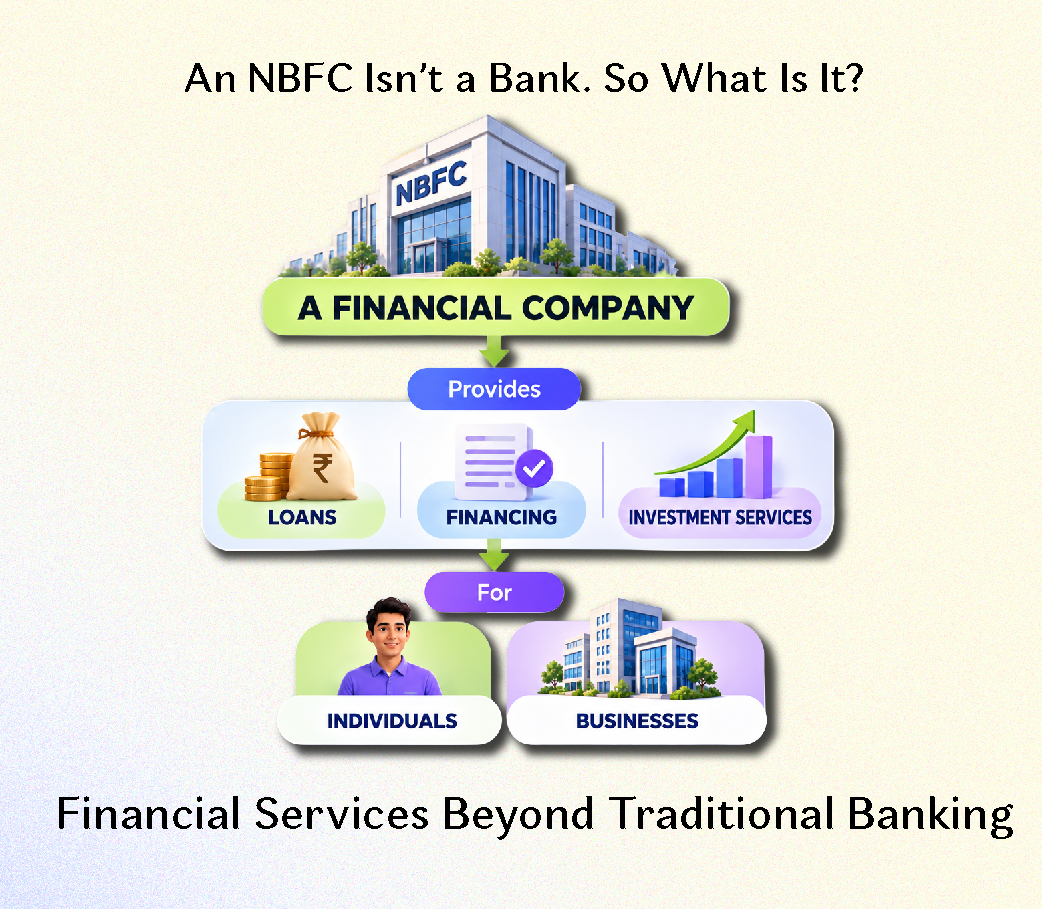
Naturally, banks are not the only institutions that offer financial services. Non-Banking Financial Companies (NBFCs) are also major players in the market. They provide services like loans, financing, and investments. But what is an NBFC and how is it different from a bank? In this blog, we will understand what an NBFC is, how it works, its types, key functions, and the difference between NBFC and bank.
What do you mean by NBFC?
When you think about borrowing money or getting financial services, banks may be the first option that comes to mind. But banks are not the only institutions that provide financial services. Non-Banking Financial Companies (NBFCs) also play an important role in providing loans, financing and other financial services to individuals and businesses.
An NBFC is a company registered under the Companies Act and engaged in specified financial activities, such as lending, investment, leasing, hire purchase and other permitted financial services. In India, NBFCs are regulated by the Reserve Bank of India (RBI) under the applicable provisions of the Reserve Bank of India Act, 1934 and other relevant regulations.
So, while an NBFC is not a bank, it can provide several financial services that help people and businesses meet their funding and investment needs. For example, an NBFC may provide a business loan to a small enterprise, finance the purchase of a vehicle, or help a business acquire machinery and equipment.
How does NBFC Work?
Think of it as a financial intermediary. An NBFC raises funds through permitted sources and then uses those funds for activities such as lending and investments. They are engaged in managing its loans, repayments, expenses and investments as part of its day-to-day operations.
One such simplified NBFC lending process could be like:
1. Customer applies for a loan
2. NBFC evaluates the application
3. Loan is approved
4. Funds are disbursed
5. Customer pays off the loan with the applicable interest and charges
The NBFC’s primary source of revenue are activities such as interest on loans and other permitted financial services.
For example, let’s say an NBFC provides a business loan of ₹5 lakh. The customer pays back the loan with its applicable interest over an agreed period. The NBFC accounts for the loan, repayments and related income and expenses as part of its financial and accounting processes.
What are the Primary Functions of an NBFC?
NBFCs perform several financial functions depending on the business model and regulatory classification.
1. Loan and Credit Facility: Many NBFCs have lending as one of their principal activities. They may offer various types of loans to individuals, businesses and other customers.
For example:
• Personal Loans
• Loans for business
• Auto rickshaw loans
• Housing finance
• Loans Against Gold
• Financing of equipment
2. Providing Asset Finance: Some NBFCs are focused on financing for the purchase or use of assets, like vehicles, machinery and equipment.
For example, a business might require machinery but not want to pay the full price upfront. Financing helps the business obtain the asset and pay for it over an agreed period
3. Investing Activities: NBFCs may also be carrying out permitted investment activities. Depending upon their classification and applicable regulations, they may invest in securities and other financial instruments.
4. Supporting Small and Medium Businesses: NBFCs can provide financing to businesses which need funds for working capital, expansion, equipment or other business needs. This is particularly important for businesses that need credit to fund their day-to-day operations or expansion.
To understand financial markets, financial services and related concepts in greater detail, explore the Financial Market and Services course.
What are the Different Types of NBFCs?
NBFCs can be classified by activity and by regulatory regime. Categories commonly discussed include:
| Type of NBFC | Main Activity |
|---|---|
| Investment and Credit Company (ICC) | Primarily carries out investment and credit-related activities |
| Housing Finance Company (HFC) | Provides housing finance, subject to the applicable regulatory framework |
| Infrastructure Finance Company (IFC) | Provides financing for infrastructure projects, subject to applicable conditions |
| Infrastructure Debt Fund-NBFC (IDF-NBFC) | Provides long-term debt financing for infrastructure projects |
| Micro Finance Institution (NBFC-MFI) | Provides microfinance loans to eligible borrowers |
| Account Aggregator (NBFC-AA) | Facilitates the secure sharing of financial information with customer consent |
| Core Investment Company (CIC / CIC-ND-SI) | Holds at least 90% of its assets in group companies via equity, debt, or shares. |
| Peer-to-Peer Lending Platform (NBFC-P2P) | Operates a digital platform connecting lenders and borrowers directly. |
| NBFC-Factor | Purchases trade receivables and provides factoring services to businesses. |
| Mortgage Guarantee Company (MGC) | Provides specialised mortgage guarantee services for housing loans. |
| Standalone Primary Dealer (SPD) | Deals in government securities and treasury bills under RBI guidelines. |
| Non-Operative Financial Holding Company (NOFHC) | Acts as a special vehicle to promote new commercial bank licences. |
NBFC vs Bank: What are the differences?
Banks and NBFCs provide some similar financial services but they are not the same.
| Basis | Bank | NBFC |
|---|---|---|
| Primary role | Accepts deposits, provides loans and offers various banking services | Provides specified financial services such as lending and investment |
| Demand deposits | Banks can accept demand deposits, subject to applicable rules | NBFCs generally cannot accept demand deposits |
| Payment system | Banks are part of the payment and settlement system | NBFCs generally do not have the same role as banks in the payment system |
| Cheque facility | Banks can provide cheque-related banking facilities | NBFCs generally cannot issue cheques drawn on themselves |
| Regulator | RBI regulates banks | RBI regulates applicable NBFCs |
Wrapping up About NBFCs
NBFCs carry out important functions like lending, asset financing, investment etc. while functioning under the regulatory framework for them. NBFCs are like banks in some ways but they have their own features and regulations. Knowledge of how NBFCs function can be useful for knowing the financial sector and the accounting processes.
To see how NBFCs fit into the wider market this year, read Top Financial Market Trends Every Student Should Watch in 2026.
Frequently Asked Questions (FAQs)
Question 1: Is NBFC a bank?
Answer: No. An NBFC is not a bank. However, it can provide some financial services like banks.
Question 2: Who is the regulator of NBFCs in India?
Answer: NBFCs are governed by the Reserve Bank of India (RBI) under the applicable regulatory framework.
Question 3: Whether NBFCs can take deposits?
Answer: Demand deposits are not generally accepted by NBFCs. Deposit-taking is subject to certain regulatory requirements and permissions.
Question 4: What are the services provided by NBFCs?
Answer: NBFCs can offer loans, asset financing, investment services, microfinance and other permissible financial services based on their classification and business models.
Question 5: Why is accounting important to NBFCs?
Answer: Accounting enables NBFCs to keep proper records of loans, repayments, interest income, borrowings, investments, expenses and other financial transactions, for financial reporting and regulatory compliance.

Nita R
Nita is a content writer specialising in Accounting, Finance, GST, and Taxation. She creates easy-to-understand, research-driven content that simplifies complex financial and tax concepts for learners, professionals, and businesses. Her expertise lies in translating technical accounting and GST topics into practical insights, helping readers stay informed about tax compliance, financial processes, and industry best practices. Through her content, she aims to make accounting and taxation accessible, accurate, and relevant for today's evolving business environment.