

What is TCS? Meaning, Rates, Rules, Due Dates and Form 143


30-Second Summary
Ever wondered why tax is collected at the time of certain sales or transactions, even before the buyer files their income tax return? This is where Tax Collected at Source (TCS) comes into the picture. When a business sells certain specified goods or receives certain specified payments, it may have to collect tax from the buyer or collectee and deposit it with the government. In this blog, we’ll understand what TCS is, how it works, when it applies, important TCS rules, compliance requirements, due dates, and the TCS returns and certificates businesses need to know about.
What is TCS?
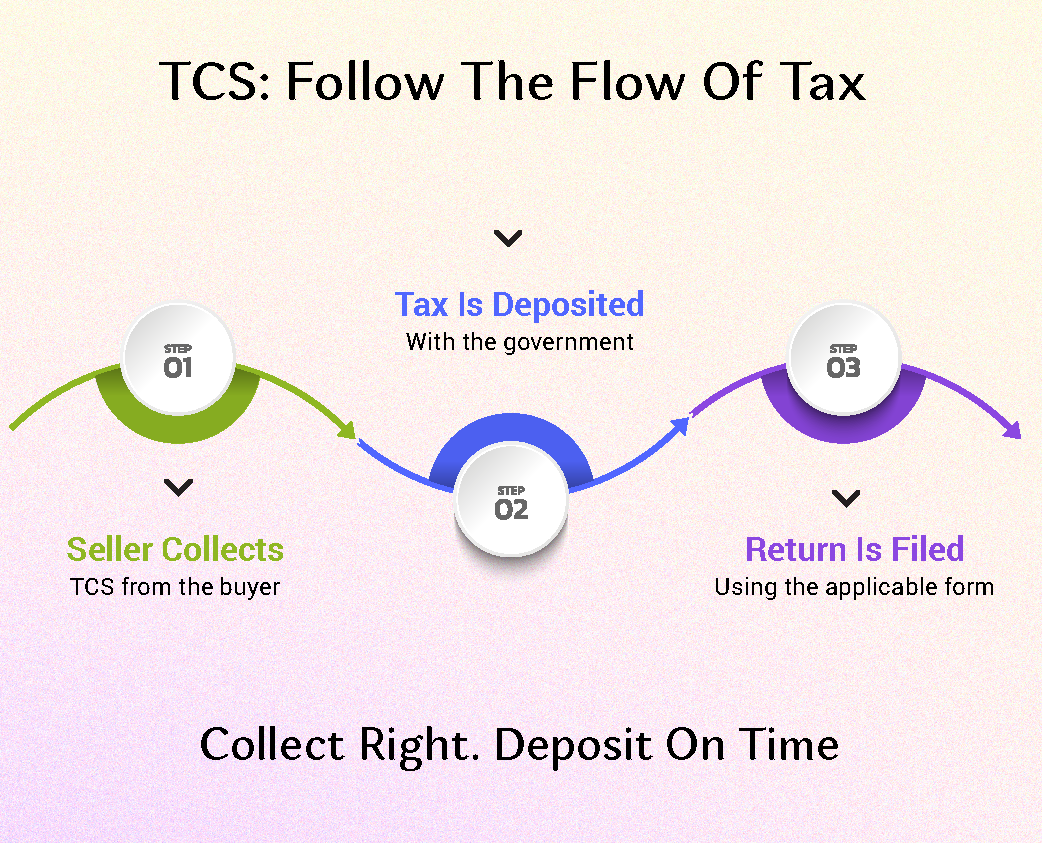
Tax Collected at Source (TCS) is a mechanism in which the person collecting the tax collects a specified amount of tax from the buyer or collectee at the applicable rate and deposits the same with the government.
TCS is applicable only to transactions and payments which are covered by the relevant provisions of the Income-tax Act.
TCS provisions are consolidated in section 394 of the Income-tax Act, 2025. With effect from 1st April, 2026. Transactions under the old framework up to 31 March 2026 will continue to be governed by Income-tax Act, 1961.
How Does TCS Work?
TCS generally involves three parties:
- Collector: The seller or other person responsible for collecting TCS.
- Collectee: The buyer or person from whom TCS is collected.
- Government: The tax collected is deposited with the Central Government.
For example, suppose a transaction is covered by TCS provisions and the applicable TCS amount is ₹5,000.
The seller collects the applicable amount from the buyer along with the transaction value, subject to the relevant rules. The seller then deposits the TCS with the government and reports the transaction in the prescribed TCS statement. The tax collected is reflected against the collectee’s tax records and can be considered as tax credit, subject to the applicable provisions.
When is TCS Applicable?
TCS does not apply to every sale or receipt. It applies only to transactions specifically covered by the Income-tax Act.
Some examples of transactions covered under the TCS framework include:
| Transaction / Activity | Person Generally Responsible for Collection |
|---|---|
| Sale of specified goods | Seller |
| Sale of certain motor vehicles | Seller |
| Sale of scrap | Seller |
| Sale of alcoholic liquor for human consumption | Seller |
| Sale of tendu leaves and certain forest produce | Seller |
| Use of parking lot, toll plaza, mine or quarry for business | Person responsible for collection |
| Certain overseas tour programme packages | Seller |
| Certain remittances under the Liberalised Remittance Scheme | Authorised dealer |
The exact applicability, threshold and rate depend on the nature of the transaction and the relevant provision. The current framework is set out under Section 394 of the Income-tax Act, 2025.
TCS Rates and Thresholds
TCS rates are not the same for every transaction. The applicable rate and threshold depend on the type of transaction and the conditions specified under the law.
For example, the Finance Act, 2026 made changes to certain TCS rates from 1 April 2026. One of it is as specified 2% rate for specified sales of alcoholic liquor, tendu leaves, scrap and certain minerals.
Therefore, businesses should check the applicable provision and current rate before collecting TCS rather than relying on older rates or thresholds.
Important TCS Rules Businesses Should Know
- Identify whether TCS applies: Before collecting TCS, determine whether the transaction falls under a specified TCS provision.
- Check the applicable threshold: Some TCS provisions apply only when the transaction or aggregate amount crosses a specified threshold. The threshold can vary depending on the nature of the transaction.
- Collect TCS at the prescribed time: The timing of collection depends on the applicable provision. Under the general framework of Section 394, collection can be linked to the time of debiting the amount payable or receipt of the amount, whichever is earlier, subject to the specific provision.
- Deposit the tax collected: The collector must deposit the TCS with the government within the prescribed time and through the applicable tax-payment mechanism.
- File the TCS statement: The collector must report the details of tax collected and deposited through the prescribed quarterly TCS statement.
- Issue the TCS certificate: The collector also needs to provide the prescribed TCS certificate to the collectee so that the tax collected can be appropriately reflected in the collectee’s tax records.
TCS Return: Form 143
From Tax Year 2026-27, the quarterly TCS return is filed through Form 143, which has replaced the earlier Form 27EQ. Form 143 is a quarterly statement filed by collectors responsible for collecting tax at source on specified transactions.
The statement contains details such as:
- Collector details
- Transaction details
- Collectee details
- PAN
- Tax collected
- Challan or payment details
- Other information required for reporting TCS
TCS returns for periods up to 31 March 2026 continue to follow the earlier Form 27EQ framework. From 1 April 2026 onwards, Form 143 applies under the new framework.
TCS Return Filing Due Dates
Form 143 is filed quarterly. The prescribed due dates are:
| Quarter | Period | Due Date |
|---|---|---|
| Q1 | April–June | 31 July |
| Q2 | July–September | 31 October |
| Q3 | October–December | 31 January |
| Q4 | January–March | 31 May of the following tax year |
These due dates are specified by the Income Tax Department for Form 143.
TCS Certificate
A TCS certificate provides details of the tax collected from the collectee.
The certificate helps the collectee verify the amount of TCS collected and use the corresponding tax credit while complying with income-tax requirements.
Under the new framework, the TCS certificate has also been assigned a new form number. Form 133 corresponds to the earlier Form 27D.
TCS vs TDS: What is the Difference?
| Basis | TDS | TCS |
|---|---|---|
| Full Form | Tax Deducted at Source | Tax Collected at Source |
| Basic Mechanism | Tax is deducted from specified payments | Tax is collected from specified buyers/collectees |
| Person Responsible | Deductor | Collector |
| Common Context | Salary, interest, commission, rent and other specified payments | Specified goods and transactions |
| Return | Relevant TDS statement | Form 143 for current TCS reporting |
| Certificate | TDS certificates such as Form 16/16A | TCS certificate |
Understanding whether a transaction falls under TDS or TCS helps businesses determine the correct compliance process.
To understand how tax is deducted on payments, read What is TDS? Meaning, Rules, Due Date and TDS Returns to be Filed.
Understand TCS for Better Tax Compliance
TCS may appear to be a little complicated in the beginning especially due to its applicability being subject to the type of transaction, threshold, rate and other conditions. Once you get the basic process down, it’s a lot easier to deal with.
Begin by determining whether TCS applies to the transaction, determine the applicable rate and threshold, collect and deposit the tax within the time frame as well as do the quarterly reporting. Businesses are also required to be aware of Income-tax Act, 2025 and Form 143 (as opposed to earlier Form 27EQ) for TCS reporting for transactions made from 1 April 2026.
By understanding these basic steps, companies and accounting experts may more accurately and with greater confidence meet their TCS obligations.
Build job-ready skills in tax compliance and accounting with Professional Financial Accounting with GST using TallyPrime.
Frequently Asked Questions (FAQs)
Question 1: What is TCS?
Answer: TCS stands for Tax Collected at Source. It is a mechanism under which the person responsible for collection collects tax from the buyer or collectee on specified transactions and deposits it with the government.
Question 2: Who is responsible for collecting TCS?
Answer: The seller or another person specified under the applicable TCS provision is responsible for collecting TCS.
Question 3: What is the new TCS return form from 1 April 2026?
Answer: Form 143 is the quarterly TCS statement under the Income-tax Act, 2025. It replaces the earlier Form 27EQ.
Question 4: How often is the TCS return filed?
Answer: The TCS statement is filed quarterly. The due dates are 31 July, 31 October, 31 January and 31 May for Q1, Q2, Q3 and Q4 respectively.
Question 5: Is TCS applicable to every sale?
Answer: No. TCS applies only to transactions specifically covered by the applicable provisions of the Income-tax Act and subject to the relevant conditions and thresholds.
Question 6: What is the difference between TDS and TCS?
Answer: TDS involves deduction of tax from specified payments, while TCS involves collection of tax from the buyer or collectee on specified transactions.
Want hands-on practice with deduction rules, rates and returns? Explore TDS for Services under Direct Taxation.
Question 7: What is the TCS certificate?
Answer: A TCS certificate provides details of tax collected from the collectee and helps support the corresponding tax credit in the collectee’s records.

Nita R
Nita is a content writer specialising in Accounting, Finance, GST, and Taxation. She creates easy-to-understand, research-driven content that simplifies complex financial and tax concepts for learners, professionals, and businesses. Her expertise lies in translating technical accounting and GST topics into practical insights, helping readers stay informed about tax compliance, financial processes, and industry best practices. Through her content, she aims to make accounting and taxation accessible, accurate, and relevant for today's evolving business environment.