

Input Service Distributor (ISD) Under GST - Complete Guide


30-Second Summary
For those businesses that operate through multiple branches, it is obvious that common services such as software subscriptions, legal consultancy, advertising or audit services are received at their Head Office. Since these services are GST-rated, the tax credit should ideally be shared with the branches that actually use them. Here is where the Input Service Distributor (ISD) mechanism comes in.
ISD enables a business to distribute Input Tax Credit (ITC) on common input services to its registered branch(es) in a prescribed manner to ensure proper credit distribution and GST compliance.
What is an Input Service Distributor (ISD)?
Suppose a company has its Head Office at Bengaluru and branches at Mumbai, Chennai and Delhi. The Head Office makes a software subscription available to all branches for company-wide use. Since the invoice is raised in the name of Head Office, the GST credit also belongs to the Head Office.
But the real customers of the service are the branches. However, instead of allowing the Head Office to enjoy the full Input Tax Credit, the GST law has provided a mechanism called the Input Service Distributor (ISD).
Input Service Distributor (ISD) means an office of the business which receives the invoice for the input services used by the registered taxable person having the same PAN as that of the ISD and distributes the eligible ITC to such registered persons, based on the prescribed documents.
In short, an ISD is a central office, which collects common service bills and distributes the GST credit fairly to the branches using those services. To understand how the credit distributed by an ISD can be claimed, utilised, or reversed under GST, read ITC Under GST Explained: Eligibility, Ineligible Credits and ITC Reversal.
When was Input Service Distributor (ISD) introduced?
The concept of the Input Service Distributor (ISD) is not a new one. Initially it was introduced under Service Tax regime through CENVAT Credit Rules to enable entities to apportion credit on common input services to multiple units. The government has continued this method in the CGST Act, 2017 under section 2(61) and Section 20 when the Goods and Services Tax (GST) was introduced on 1st July 2017.
Initially, businesses may choose to register with ISD. However, with the rising demand for uniform credit distribution and to remove the ambiguities between the ISD and cross-charge mechanism, the government amended the provisions. With effect from 1st April 2025, the ISD mechanism has been made mandatory for businesses who are receiving invoices of common input services on behalf of multiple GST registrations under the same PAN.
Objectives of Input Service Distributor (ISD)
The government has introduced the Input Service Distributor (ISD) mechanism with the following objectives:
- Make sure that Input Tax Credit is equitably shared among the branches using the services.
- Provide a uniform way of allocation of credits and thereby prevent erroneous or multiple claims of ITC.
- Increase transparency and accuracy of GST compliance for businesses operating from multiple locations.
- Furnish seamless flow of tax credit which is one of the basic objectives of the GST regime.
- Provide a clear mechanism for distribution of ITC on common input services to reduce disputes during GST audits.
The ISD mechanism is basically a way of ensuring that the right amount of Input Tax Credit is passed on to the right branch, helping businesses make effective use of their eligible tax credit while being compliant with GST regulations.
Who is the Input Service Distributor?
An Input Service Distributor is not a separate legal entity, nor a different type of business.
It is just an office of an organisation that:
- Receives invoices for common inputs
- Registered separately as ISD under GST.
- Distributes eligible ITC to branches or units registered under the same Permanent Account Number (PAN).
This registration is not a supply of goods or services by the ISD. It only serves the purpose of distribution of Input Tax Credit arising out of common input services.
ISD Registration Eligibility Criteria
In case a business is receiving invoices for input services which are used by multiple GST registrations under the same PAN, they should take ISD registration.
The following conditions apply in general:
- Businesses should have more than one GST registration in the same PAN.
- Provided common input services across multiple branches or business units.
- All invoices for such services should be received at one central location.
- An office intending to distribute ITC must register separately with ISD.
- Input services credit alone can be distributed under the ISD mechanism.
It may be noted that ITC in respect of goods or capital goods cannot be distributed through ISD.
How the ISD Mechanism Works?
A simple example might help in understanding the working of an ISD.
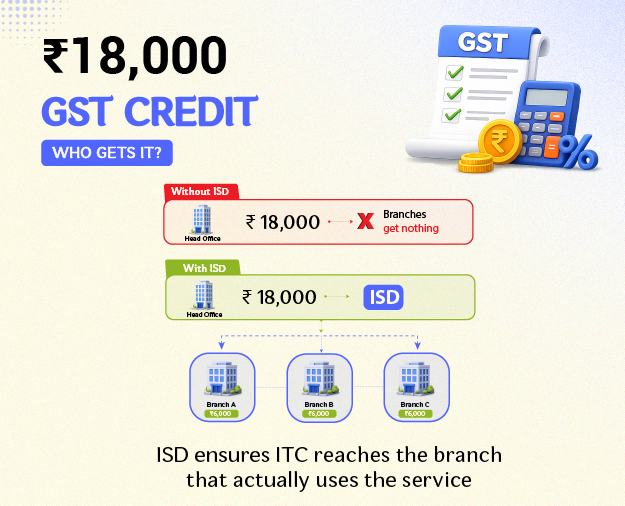
ABC Ltd. The Head Office receives an invoice of ₹1,18,000 (including GST of ₹18,000) for a software subscription shared equally by three branches. The Head Office, as an ISD, instead of using the entire GST credit itself distributes the eligible Input Tax Credit among the three branches as per the prescribed distribution rules. Each branch can then file its own GST returns using its allocated ITC.
This ensures that the credit is given to the business unit that actually uses the service.
Significance of the Input Service Distributor (ISD)
ISD mechanism plays a very important role in fair and transparent distribution of Input Tax Credit amongst the organisations having multiple GST registrations.
Its importance consists of:
- Proper distribution of ITC: This ensures that tax credit goes to the branch that is actually using the service and not lying with the Head Office.
- Avoids incorrect utilisation of credit: Without ISD, there is a risk of claiming ITC incorrectly, which may result in GST notices, interest or penalties.
- Increased Compliance: The ISD mechanism provides a uniform process for distribution of common service credits under the GST law.
- Better Financial Precision: Each branch will show the correct tax credit for more accurate financial reporting and GST reconciliation.
- Multi-State Business Support: Common expenses for businesses that operate in multiple states include:
-
- Audit fees
- Legal guidance
- ERP subscriptions
- Advertising costs
- Cloud software
- Professional services
Benefits of an Input Service Distributor
- Simplifies ITC Distribution: Businesses do not need to manually distribute GST credit across branches.
- Guarantees GST Compliance: ITC is distributed as per GST provisions reducing compliance risks.
- Enhances Transparency: Each branch earns credits based on actual usage which enhances transparency for tax reporting.
- No Lawsuits: Proper credit distribution reduces disputes in GST audit.
- Improved Cash Flow Management: Branches get eligible ITC immediately, thus reducing their overall GST liability.
Drawbacks of an Input Service Distributor
- Further Registration: Businesses need to have a separate ISD registration.
- More compliance: ISD should file returns and keep proper documentation for credit distribution.
- Applicable only for input services: The ISD mechanism cannot allocate credit relating to goods or capital goods.
- Complex Mathematics: It can be difficult to determine the correct distribution ratio where the services are used by multiple branches in varying proportions.
- Relying on Accurate Records: Incorrect allocation can lead to ITC reversal, interest or penalty.
Things to Remember for Companies
Things to consider before becoming or operating an ISD for businesses
- Input Tax Credit shall be distributed only in relation to input services.
- Distribution permitted only to GST registrations with same PAN
- Credit needs to be allocated as per the GST rules prescribed.
- Each distribution should have appropriate documentation.
- Businesses should regularly match ISD credits with their GST returns. To gain practical knowledge of GST return filing and reconciliation using Tally, read The Safest Way to Master GST Return from Tally.
- With recent amendments in GST, the provisions for ISDs have been strengthened and businesses may have to reassess whether they are required to take ISD registration for their business.
Final Thoughts
The Input Service Distributor (ISD) mechanism is an important compliance framework under GST for businesses having multiple branches. It ensures equitable distribution of Input Tax Credit on common input services among the units consuming such services.
Proper implementation of ISD mechanism will help the businesses in enhancing the GST compliance, avoiding the wrong ITC claims, maintaining transparent accounting records and optimising the tax credit utilisation.
FAQs (Frequently Asked Questions)
Question 1: What is Input Service Distributor (ISD) under GST?
Answer: An ISD is a registered office which receives invoices for common input services and distributes the eligible Input Tax Credit to the branches registered under the same PAN.
Question 2: Must I register with ISD?
Answer: However, as per applicable GST provisions, businesses receiving common input service invoices for multiple GST registrations under a common PAN may have to get ISD registered. The businesses should review their operations under the existing GST rules.
Question 3: Can an ISD pass on ITC on goods?
Answer: No. The ISD mechanism is applicable only on Input services. ITC on goods and capital goods is not distributable through ISD.
Question 4: Eligibility for ITC from an ISD?
Answer: GST registrations functioning under the same PAN as the ISD can avail Distributed Input Tax Credit only.
Question 5: What are some common input services?
Answer: Typical examples are software subscriptions, legal services, audit fees, consultancy, advertising, cloud services and professional fees.
Question 6: What is the chief advantage of the ISD mechanism?
Answer: The main advantage is the correct distribution of Input Tax Credit to the consuming branches on the input services, for proper GST compliance.
Question 7: Can an ISD offer goods or services?
Answer: No. The purpose of an ISD registration is only to distribute Input Tax Credit and not to make taxable outward supplies.

Nita R
Nita is a content writer specialising in Accounting, Finance, GST, and Taxation. She creates easy-to-understand, research-driven content that simplifies complex financial and tax concepts for learners, professionals, and businesses. Her expertise lies in translating technical accounting and GST topics into practical insights, helping readers stay informed about tax compliance, financial processes, and industry best practices. Through her content, she aims to make accounting and taxation accessible, accurate, and relevant for today's evolving business environment.