

No More Last-Minute GST Panic: Your TallyPrime Playbook


30-Second Summary
GST panic is not caused by a lack of knowledge. It is caused by a lack of structured practice. This article walks you through why last-minute stress happens, what a calm and reliable GST workflow looks like inside TallyPrime, and how a practical GST Course gives you the confidence to handle compliance without anxiety. By the end, you will have a clear picture of the process, not just the theory.
It Starts Manageable. Then the Date Gets Closer.
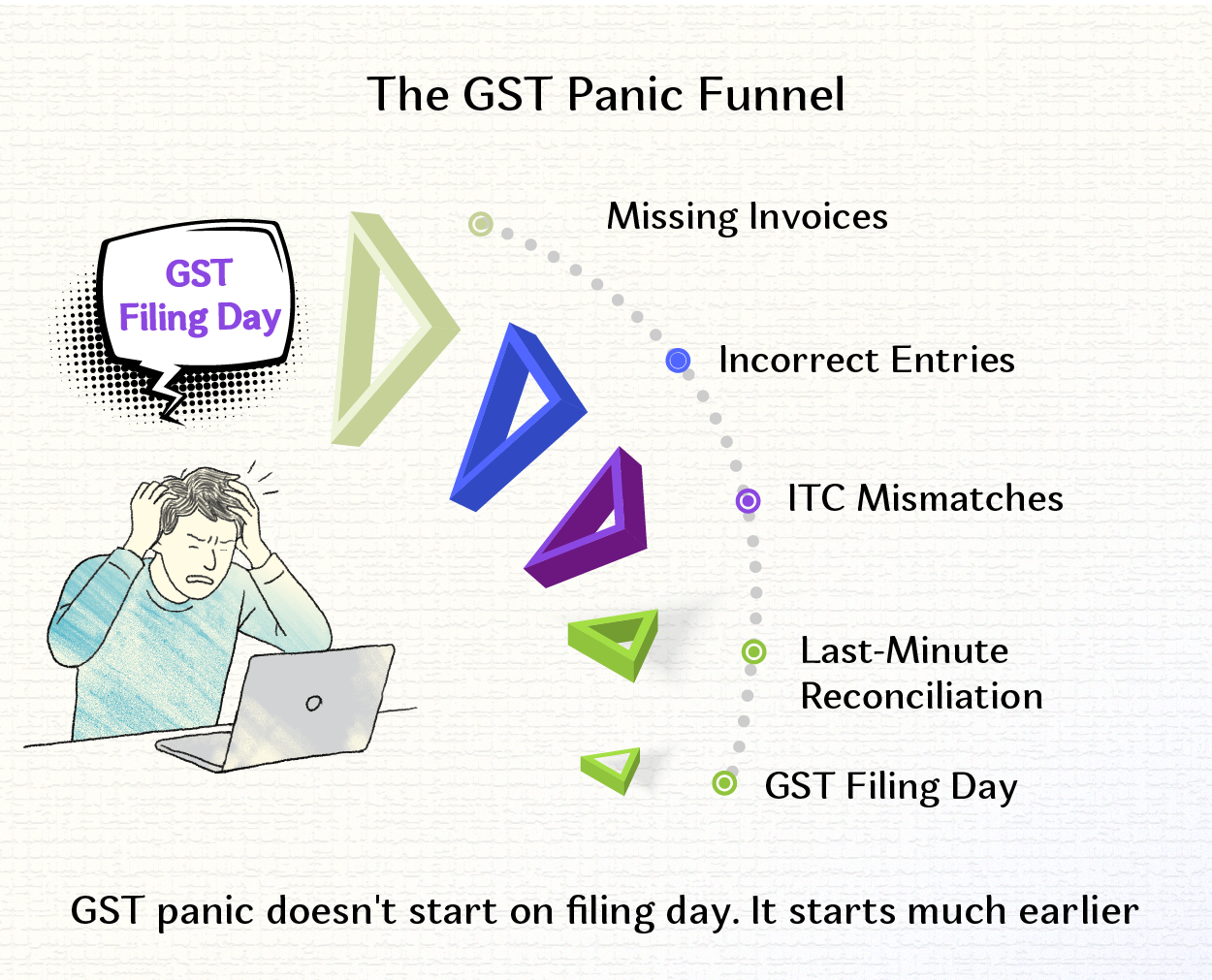
At the beginning of the month, GST filing feels fine. The deadline is weeks away. There is time to sort the invoices, check the entries, and reconcile the figures. It feels manageable. Then the last week arrives. Suddenly, the reconciliation does not match. An invoice is missing. The ITC figures look off. And somewhere in the background, there is that familiar tightening feeling: what if I have made an error, and I have to submit in 48 hours? That feeling has a name. GST panic. And it is far more common than people admit.
The important thing to understand is this: the panic rarely comes from ignorance. Most people who experience it know what GST is. They have studied the structure. They understand input tax credit and return types. The panic comes from something else entirely.
But before we go further, here is something worth knowing. If that month-end panic sounds familiar, or if you are building a career in accounting and finance, a GST course paired with TallyPrime is exactly the practical playbook you have been looking for. One that takes you from last-minute scrambling to confident, end-to-end GST Return Filing Process in India: A Step-by-Step Guide, every single month.
The Real Reason GST Feels Stressful
Here is what most GST guides will not tell you. The panic is almost never about a lack of knowledge. But it is about the lack of practice. Most accounting graduates can explain the difference between GSTR-1 and GSTR-3B. They understand the Input Tax Credit conceptually. They know what reverse charge means.
The problem is execution. When you sit down inside actual accounting software with real business data, a different set of questions emerge:
- Where exactly do I record this inter-state sale?
- Why does my ITC figure not match the GSTR-2B data?
- How do I handle this export invoice without making the return messy?
- What happens if I submit and realise I missed an entry?
These are not textbook questions. They are the everyday realities of GST compliance, and they only get comfortable with practice inside a real system. The problem is, most learners never get the chance to work through the full workflow before it actually counts. That is exactly the gap the GST Course from Tally Education is built to close, so that when the deadline arrives, you are not guessing. You are ready
Did you know? Most GST errors are not made during filing. They are made weeks earlier, in how the transactions were recorded.
Why TallyPrime Changes the Experience
GST compliance in India does not happen in isolation. It does not happen just on the government portal. It happens entry by entry, inside the accounting software that a business actually runs on. For the majority of small and mid-sized businesses across India, that software is TallyPrime.
This is worth pausing on. If you learn GST without learning how it flows through TallyPrime, you are only learning half of what the workplace actually requires. Understanding how a GST course online improves tax compliance skills becomes especially clear here, because the gap between theory and practice shows up the moment you open real accounting software with real business data.
Here is what the full picture looks like when you work with GST inside TallyPrime:
- Every transaction is recorded with the correct tax treatment applied at the point of entry
- Input tax credit flows automatically from purchase entries into your ITC tracker
- GSTR-1 and GSTR-3B reports are generated directly from the data you have already entered
- Validation checks flag potential issues before you reach the filing stage
- Reconciliation with GSTR-2B happens within the same system, not across three different tools
The result is a workflow that feels logical and connected. Each step leads naturally to the next. No jarring jumps between platforms. No manual data transfers creating last-minute errors. When the workflow is clear and the system does its job, the deadline stops feeling like a threat. That is when something shifts. The scrambling stops. The second-guessing quietens. What replaces it is something far more useful: the kind of calm that only comes from actually knowing what you are doing.
The 5 Habits of Calm GST Filers
If you watch someone who never panics at GST time, you notice something interesting. It is not that they are smarter. It is not that GST is somehow simpler for them. They just do certain things differently. Consistently. All month long. These are the five habits that separate calm filers from last-minute scramblers.
Habit 1: They treat the month-end as already settled by the 20th
Calm filers do not leave reconciliation for the final 48 hours. By the third week of the month, most of their entries are done, reviewed, and sitting cleanly in TallyPrime.
This is not a discipline trick. It is a structural one. When you understand how GST data flows through TallyPrime, from a single transaction entry all the way through to a return, you stop treating filing as a separate month-end event. It becomes the natural outcome of work you have already done. The deadline stops feeling like a wall you are running towards. It becomes a date you are already ahead of.
Habit 2: They never treat ITC as a month-end task
This is one of the most consequential habits to build. And one of the least talked about. Input Tax Credit is not something you reconcile once, at the end of the month, under pressure. It is something you track continuously, as purchases are recorded.
Calm filers know, at any point in the month, roughly what their eligible ITC looks like. When GSTR-2B data comes in, there are no surprises. The reconciliation is a confirmation, not a crisis. TallyPrime supports this habit directly. But you have to understand the system well enough to use it that way.
Habit 3: They read an unusual number rather than ignore it
Every GST filer occasionally sees a figure that looks slightly off. A tax amount that seems higher than expected. An ITC balance that does not quite match what they anticipated.
The anxious filer hopes it resolves itself and submits anyway. The calm filer pauses. Traces the figure back to its source transaction. Understands why it looks the way it does. And either confirms it is correct or catches an error before it becomes a compliance problem. This habit is built through practice. Through working with real GST data enough times, you develop an instinct for what numbers should look like.
Habit 4: They validate as a matter of course, not as a last resort
Validation is often treated as a final desperate check, done minutes before submission. For calm filers, it is simply part of how they work. A routine review built into the process, not bolted onto the end of it.
TallyPrime has built-in mechanisms that flag common issues before you reach the submission stage. But knowing how to interpret those flags, and what to do when one appears, is a skill that comes from having practised it. Not from reading about it once.
Habit 5: They separate learning from doing, early on
Perhaps the most important habit of all. Calm filers did not learn GST by doing live filings and hoping for the best. They have practised the workflow, made mistakes in a safe environment, and built their understanding before the stakes were real.
That separation, between the learning phase and the doing phase, is what makes the doing feel calm. Because by the time a real deadline arrives, the process is already familiar.
This is exactly what structured training gives you. Not just knowledge. Familiarity.
Why Structured Learning Matters More Than Self-Study
There is nothing wrong with trying to learn GST on your own. Between the GSTN portal, YouTube tutorials, and government documentation, there is no shortage of information available.
The challenge is that self-study tends to be fragmented. You pick up pieces of knowledge from different sources, but the connective tissue, the sense of how everything links together from transaction to return, remains unclear.
Structured training solves this by giving you a logical sequence. You start with the right foundation, build through realistic scenarios, and by the time you reach return filing, it actually makes sense.
The GST Filing with TallyPrime course by Tally Education is designed precisely for this. Rather than simply explaining what GST is, it puts you inside the workflow, working through real scenarios, actual filing processes, and transaction-level accuracy checks. It is a GST Course built for people who want to be workplace-ready, not just exam-ready.
Who This Playbook Is Built For
A structured GST course using TallyPrime is relevant across several situations:
- Students who have studied GST in college but never applied it in a real accounting environment
- Fresh graduates who are struggling to answer practical interview questions with confidence
- Junior accounts executives who handle GST entries every day but feel uncertain about whether they are doing it correctly
- Business owners or self-employed professionals managing their own compliance without professional support
What all of these situations have in common is the same underlying need: to move from understanding GST in theory to handling it accurately and independently in practice.
The Confidence Shift: From Learner to Professional
There is a moment that most accountants remember clearly; the first time GST filing stops feeling stressful and starts feeling routine.
It happens when the workflow becomes familiar. When you know exactly where to look if a figure looks off. When you can generate a GSTR-3B, review it with a clear head, and submit it without that familiar last-minute panic.
That shift does not come from reading more theory. It comes from having practised the process enough times that it becomes second nature.
And once it does, something else changes too. The kind of roles you can step into confidently expands considerably:
- GST Executive
- Accounts Executive
- Tax Consultant
- Finance and Compliance Professional
More importantly, you stop approaching GST filing as a deadline you are racing against and start treating it as a professional task you are in full control of.
Your Next Step
If you are serious about building a career in accounting or finance, the question worth sitting with is this:
Are you preparing for exams, or are you preparing for the workplace?
Because employers across India are not interviewing for GST knowledge. They are interviewing for GST capability. The ability to open TallyPrime, handle compliance end-to-end, and deliver accurate results without hand-holding.
A well-structured GST Course is what takes you from one to the other. And if you are ready to make that shift, GST Filing with TallyPrime is a great place to start.
Frequently Asked Questions
Question 1: Do I need prior accounting experience to take a GST course using TallyPrime?
Answer: Not necessarily. Most structured GST courses are designed to build from the ground up. If you have a basic understanding of accounting concepts, you have enough to get started. The course structure handles the rest progressively.
Question 2: Why is TallyPrime specifically important for learning GST filing?
Answer: Because most Indian businesses manage their GST compliance inside TallyPrime. Learning GST in theory without practising it inside the software that workplaces actually use leaves a practical gap that employers notice quickly.
Question 3: What is the most common GST mistake that structured training helps prevent?
Answer: Incorrect recording of transactions at the entry stage. Most filing errors do not originate at the submission point. They originate weeks earlier, when a sale, purchase, or credit note was recorded with the wrong tax treatment. A structured GST course builds accuracy at that foundation level.
Question 4: How does a GST course improve job prospects in accounting?
Answer: Employers in accounting and finance roles ask practical questions. They want to know if you can file a return without support, manage ITC accurately, and work within real accounting systems. A structured course gives you the practice and confidence to answer those questions with real experience behind you.
Question 5: Is GST filing something that gets easier with practice?
Answer: Significantly. The first time you work through a full filing cycle, it will feel unfamiliar. The second time, it will feel more structured. By the fourth or fifth cycle, it becomes a process you move through with clarity and confidence. Structured training accelerates that learning curve considerably.

Tally Education
Tally Education empowers learners with industry-relevant skills in accounting, finance, taxation, and business management through practical learning and certifications. Our blogs are created and reviewed by subject matter experts to deliver accurate, practical, and up-to-date insights on accounting, GST, taxation, finance, and TallyPrime.