

Step-by-Step Guide to Learning Payroll and HR Management Using Tally


30-Second Summary
Payroll is one of those business functions that looks simple from the outside and gets complicated fast once PF, ESI, gratuity, professional tax and income tax all show up on the same payslip. This guide walks you through exactly how payroll and HR management work inside Tally, from setting up payroll masters to generating income tax reports, and shows why a structured Payroll Course Online builds the kind of practical confidence that job interviews (and payroll deadlines) actually test for.
Payroll Looks Easy Until You Actually Have to Run It
Nobody tells commerce students this: knowing that “net pay equals gross pay minus deductions” will not save you on the 28th of the month when fifty employees are waiting for their salary and the PF challan is due tomorrow.
Payroll is not a math problem. It is an operations problem wearing a maths costume. It involves statutory compliance, employee master data, attendance, tax declarations and report generation, all of which need to work together without a single mismatched figure. And in most Indian businesses, all of this runs through one system: TallyPrime.
So, if you are eyeing a career in HR, accounts or finance, the real question is not “do I understand payroll concepts?” It is “can I actually process a payroll cycle without breaking a sweat?” That is precisely the empowerment that a good HR Payroll Course is designed to provide.
Why Payroll Skills Are Suddenly Non-Negotiable
Ask any hiring manager what separates a shortlisted candidate from the rest, and payroll competency comes up more often than you would expect. Every organisation, big or small, needs someone who can:
- Set up and maintain employee and salary structures accurately
- Configure statutory components like PF, ESI, Gratuity and Professional Tax correctly
- Process monthly payroll without errors
- Generate compliance reports on time, every time
Miss any one of these, and the consequences are not small. A wrong PF calculation, a missed ESI deadline or an incorrect income tax deduction can mean penalties, unhappy employees, and a very uncomfortable conversation with your manager. This is exactly why a well-structured payroll management course matters so much. It is not about memorising rules; it is about building the muscle memory to apply them correctly, every single time.
Related Read: How to Start a Career in Payroll Management in 2026
What Practical Payroll Learning Actually Covers
A genuinely useful payroll program does not stop at theory. It should walk you through the entire payroll lifecycle, the way it actually happens inside a business.
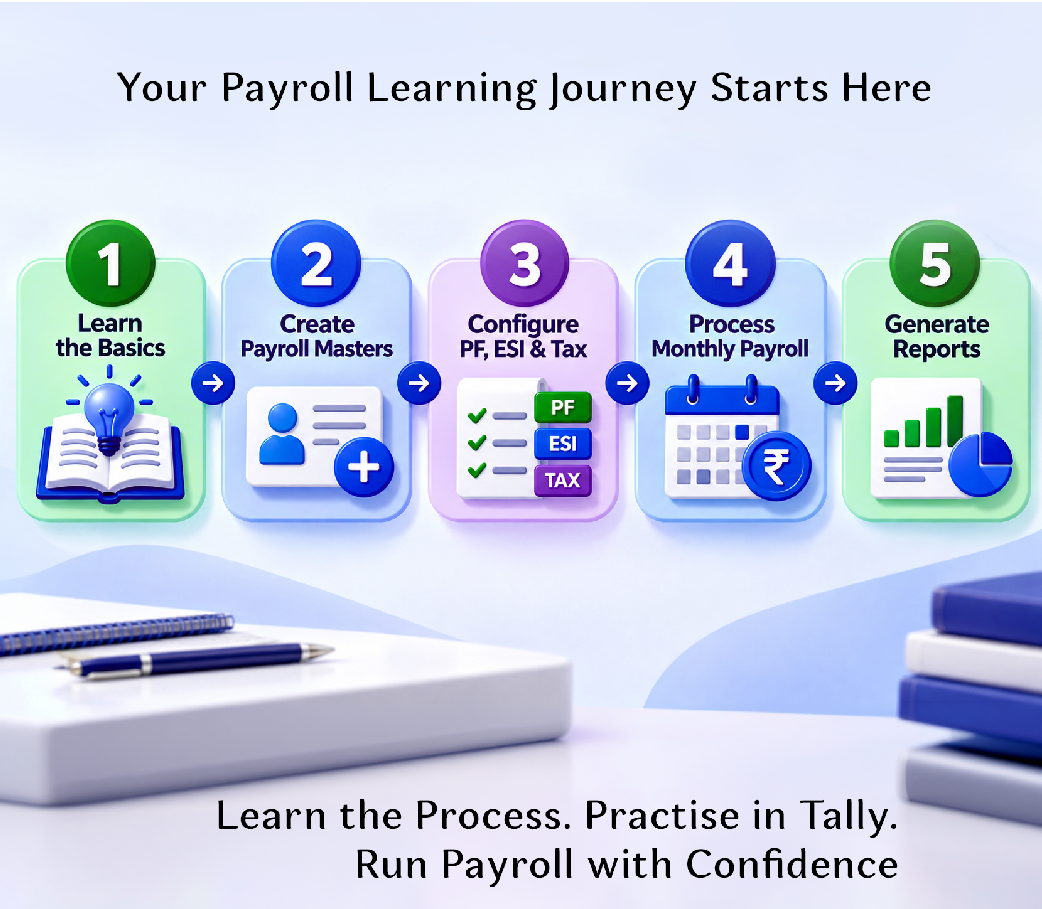
- Building the Foundation
You start with the basics of payroll systems and income tax regulations, so later steps make sense in context rather than feeling like memorised steps. - Creating Payroll Masters in Tally
This is where the real work begins. You learn to set up units of attendance and production, create pay heads, and configure statutory components such as Provident Fund, Employer’s Other Charges for PF, Employees State Insurance, Professional Tax, Gratuity and Income Tax. You also define salary structures and configure income tax declarations, so the system calculates deductions correctly from day one. - Processing Payroll with Income Tax
Once the masters are ready, you move to processing itself: payroll vouchers, user-defined pay heads, statutory pay head processing, and payment vouchers for salary, PF, ESI, Professional Tax and Income Tax remittances to the respective departments. This is the part that separates people who “know payroll” from people who can actually run it. - Generating Payroll Reports
Finally, you learn to generate the reports that keep a business compliant and audit-ready, including Employee Payroll Reports, Payroll Statutory Reports, ESI and Professional Tax reports, Income Tax Computation, Salary Projection, Challan Reconciliation, Income Tax E-Return, and Exceptions Reports. These are the exact documents an employer or auditor will ask for, so knowing how to generate them cleanly is worth more than any textbook definition.
Why Learn Payroll Specifically Inside Tally
Here is the honest truth: understanding payroll concepts in isolation only gets you halfway. Businesses do not run payroll on paper, they run it inside accounting software, and in a large share of Indian organisations, that software is TallyPrime.
When you learn payroll inside Tally rather than around it, you get:
- A complete workflow, from employee master creation right through to income tax filing
- Fewer errors, thanks to system-driven validations at every stage
- Faster reporting, since reconciliation and challan generation happen within the same system
- Real confidence, because you have handled the process, not just read about it
That is the difference between saying “I studied payroll” and saying “I can run a full payroll cycle end to end.” Employers notice that difference within the first five minutes of an interview.
Who Should Be Paying Attention Right Now
This is worth your time if you fall into any of these categories:
- A student who wants payroll and HR skills that actually translate into a job offer
- A fresher trying to move from “I know the theory” to “I can do the work”
- An HR or accounts professional looking to upskill and take on payroll responsibilities
- A business owner who currently manages payroll manually and wants it done right
If you see yourself here, a structured program like mastering payroll management with Tally is built exactly for this transition. It is a focused, 20-hour online Payroll Course Online that takes you from payroll fundamentals to generating income tax reports, with hands-on scenarios, a verifiable certificate, and access to the Tally Job Portal once you complete it.
The Bottom Line
Payroll will always be part of running a business, and someone always has to own it accurately. The question is whether that someone is confidently trained, or quietly guessing every month.
If you are ready to stop guessing and start owning payroll the way employers expect, it is time to move from theory to practice. Explore the Mastering Payroll Management with Tally course today and turn “I’ve studied payroll” into “I run payroll.” Your future payslip, and your future employer, will thank you.
Frequently Asked Questions
Question 1: Do I need prior accounting knowledge to take this Payroll Management Course?
Answer: No prior payroll expertise is required. The course starts with foundational concepts of payroll and income tax before moving into hands-on work inside TallyPrime, so beginners and working professionals can both follow along comfortably.
Question 2: What will I actually be able to do after completing this HR Payroll Course?
Answer: You will be able to set up payroll masters, configure statutory pay heads like PF, ESI, Gratuity and Professional Tax, process monthly payroll with income tax calculations, and generate reports such as Income Tax Computation, Salary Projection, e-24Q and ITR1.
Question 3: How long does the course take and what do I get at the end?
Answer: The course runs for about 20 hours of learning plus a 60-minute assessment. On completion, you receive a verifiable digital Certificate of Merit from Tally Education, along with access to the Tally Job Portal to connect with potential employers.
Question 4: Is this Payroll Course Online suitable for someone who wants to specialise in HR rather than pure accounting?
Answer: Yes. Payroll sits right at the intersection of HR and accounting, and this course is designed for exactly that overlap, covering employee master data, statutory compliance and reporting, all skills that HR and payroll-focused professionals use daily. Upgrade Your Skills with the Right Payroll Course Online Today
Question 5: How to manage payroll in HR?
Answer: Managing payroll in HR involves the full cycle: maintaining accurate employee and salary data, configuring statutory pay heads (PF, ESI, Professional Tax, Gratuity), processing monthly payroll without errors, and generating compliance reports on schedule. TallyPrime handles this entire cycle in one system, which is why most Indian businesses run HR payroll through it.
Question 6: Is HR payroll a good career?
Answer: Yes. Payroll is a consistently in-demand HR specialisation because every business needs it done accurately and on time. Strong payroll skills, especially system-based ones learned in TallyPrime translate directly into job offers, upskilling opportunities, and long-term career stability in HR and accounts roles.
Question 7: How to learn payroll for beginners?
Answer: Begin with the basic concepts (gross pay, deductions, net pay, statutory components), then move into a structured, hands-on program like Mastering Payroll Management with Tally, which teaches payroll masters, processing and reporting inside TallyPrime from the ground up with no prior accounting knowledge needed.

Tally Education
Tally Education empowers learners with industry-relevant skills in accounting, finance, taxation, and business management through practical learning and certifications. Our blogs are created and reviewed by subject matter experts to deliver accurate, practical, and up-to-date insights on accounting, GST, taxation, finance, and TallyPrime.