

What is TDS? Meaning, Rules, Due Date and TDS Returns to be Filed


30-Second Summary
Deducting TDS may seem simple, but knowing when to deduct it, how much to deduct and when to file the returns can get confusing at times. So, how do you think we can get it right without missing important deadlines? This blog breaks down Tax Deducted at Source (TDS) in simple terms, covering the key rules, deduction and deposit timelines, TDS return due dates, and forms such as Form 138, Form 140, Form 16 and Form 16A. By the end of this blog, you will have a clearer idea of how TDS works and what you need to do to stay on track with regards to the tax compliance.
What does TDS mean?
TDS is the short form of Tax Deducted at Source. It is a mechanism in which the person making a certain payment deducts the tax and pays it over to the government for the benefit of the person who receives the payment.
For example, a business pays a specialist for services. In case the payment is subject to the applicable TDS provisions, the business may be required to deduct TDS before making the payment and deposit the deducted amount with the government.
The person making the payment is called the deductor and the person receiving the payment is called the deductee. TDS applies to specified payments and is subject to conditions, thresholds and rates prescribed under the applicable tax law.
Note: TDS provisions on transactions under the new tax framework are governed by the Income-tax Act, 2025 with effect from 1 April 2026 Transactions where the relevant earlier event of credit or payment has taken place on or before 31 March 2026 shall continue to be governed by the Income-tax Act, 1961.
How TDS Works?
TDS can be explained with a simple example. Say a company needs to pay ₹50,000 to a professional and the TDS applicable is ₹5,000.
The firm:
1) Computes the applicable TDS on the Payment.
2) Deducts Rs 5,000 from payment.
3) Pays ₹45,000 to the professional.
4) Deposits ₹ 5,000 with the government.
5) Reports the transaction in the applicable TDS statement.
The TDS deducted usually gets reflected in the tax records of the recipient and can be considered while determining the recipient’s final tax liability.
When does TDS apply?
Every payment made by a business is not subject to TDS. It is applicable if the payment is covered under certain TDS provisions and the required conditions are met. Some common types of payments to which the TDS provisions may apply are:
- Wages
- Interests
- Commission or brokerage
- Lease
- Payments to sub-contractors.
- Professional or technical fees
- Some payments to non-residents
- Other specified payments
The applicable threshold and rate depend on the nature of payment, recipient and other conditions as prescribed under the relevant provisions. Thus, the deductor should first determine the nature of payment and check the applicable provision, threshold and rate before deducting TDS.
Related reading: Financial institutions such as NBFCs also deduct and deposit TDS on interest payments. Learn more in What is an NBFC? Meaning, Types, Functions.
Points to Remember about TDS Rules
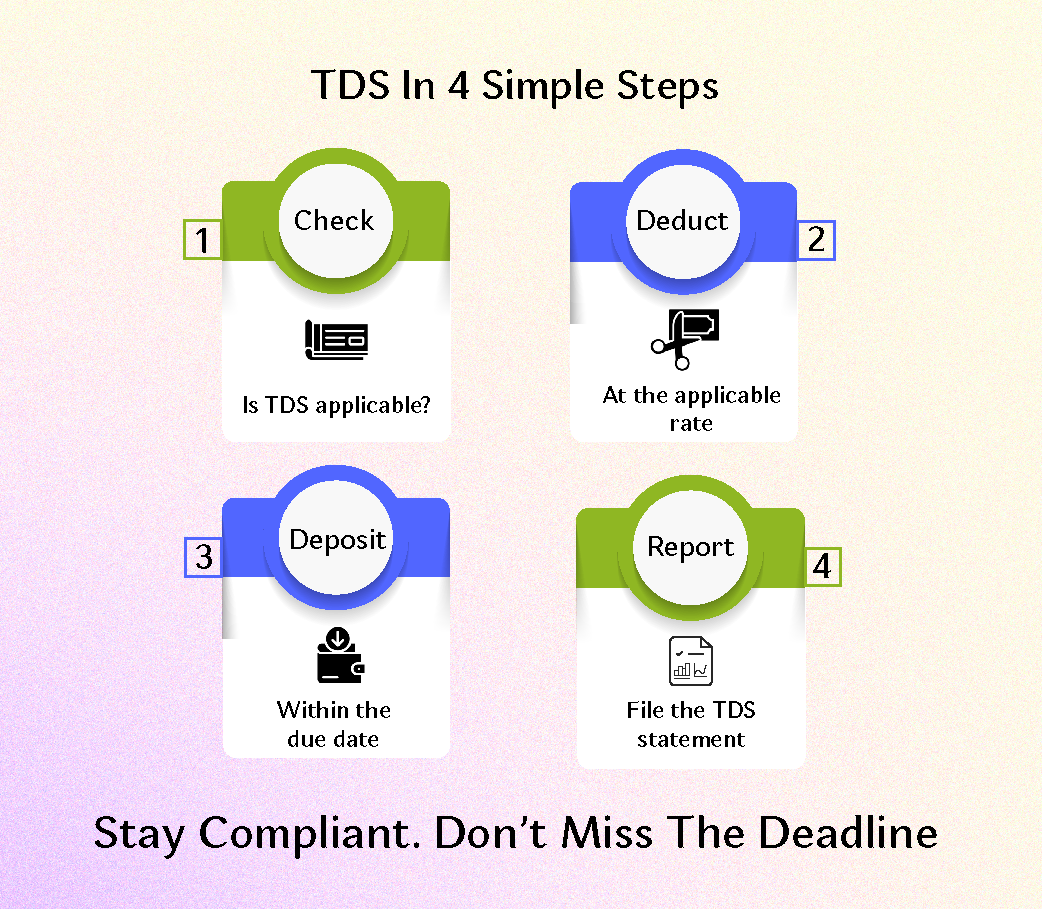
- Determine If TDS Is Applicable: The first step is to find out whether the payment is covered under TDS provisions. Payment nature, amount, recipient and other applicable conditions need to be considered.
- Verify the Applicable Rate and Threshold: TDS is not deducted at the same rate for all payments. Different types of payments may have different rates and thresholds. The Income-tax Department has said that the provisions have been reorganized but TDS rates and monetary thresholds have been retained under the Income-tax Act, 2025.
- Deduct TDS At Applicable Time: For many payments, TDS is deducted when the amount is credited or paid, whichever happens earlier. This timing also determines which Income-tax Act applies during the 2026 transition.
- File the TDS with the Government: The deductee shall deposit the amount after deducting TDS within the specified time limit. The regular TDS is due in most cases on the 7th of the succeeding month. TDS deducted by a non-government deductor in the month of March is generally due by 30 April. In some cases, the challan-cum-statement is processed within a different time.
- Submit the concerned TDS Statement: Deducting & depositing TDS is not the end of the process. The deductor must report the deduction through the applicable TDS statement or form.
What TDS Reports and Forms to be Filed?
The type of payment and the status of the recipient, mainly, determine the TDS statement that is applicable. The forms relevant for transactions under the Income-tax Act, 2025 are as follows:
| Form under Income-tax Act, 2025 | Earlier Form | Purpose |
|---|---|---|
| Form 138 | Form 24Q | Quarterly TDS statement for salary and certain pension/interest-related deductions |
| Form 140 | Form 26Q | Quarterly TDS statement for payments other than salary made to residents |
| Form 144 | Form 27Q | Quarterly TDS statement for payments other than salary made to non-residents |
| Form 141 | Forms 26QB, 26QC, 26QD and 26QE | Challan-cum-statement for specified transactions |
As per the Income Tax Department, Forms 138, 140 and 144 are the new equivalents of Forms 24Q, 26Q and 27Q respectively.
TDS Return Due Dates
The regular quarterly TDS statements are due on:
| Period | Quarter | Due Date |
|---|---|---|
| April-June | Q1 | 31 July |
| July-September | Q2 | 31 October |
| October-December | Q3 | 31 January |
| January-March | Q4 | 31 May |
These dates are applicable for Form 138, 140 and 144 as prescribed by the Income Tax Department. Once the TDS is deducted, deposited and reported through the applicable TDS statement, the deductor may also need to provide a TDS certificate to the person from whose payment the tax was deducted.
Practice rates, thresholds and deductions with real scenarios in our TDS for Services under Direct Taxation – Free Course.
What are Form 16 and Form 16A?
TDS compliance also includes issuing TDS certificates to the deductee. These certificates provide details of the income on which TDS was deducted and the tax deducted and deposited with the government.
Form 16 is the TDS certificate issued for salary income. The employer provides it to the employee.
Form 16A is the TDS certificate for income other than salary. It is generally issued quarterly by the deductor and contains details such as the amount credited or paid, TDS deducted and TDS deposited.
These certificates help the recipient verify the TDS deducted and use the information while filing their income tax return.
Understand TDS for Better Compliance Management
TDS can be confusing at first, because it is contingent upon the nature of payment, threshold, recipient and other conditions. However, compliance is simpler when you follow the steps. First, verify whether the payment is liable for TDS or not. Find out the rate and threshold limit applicable. Deduct the tax at the appropriate time. Deposit it before the due date. File the applicable TDS statement and issue the necessary TDS certificate.
Knowing these simple steps can help businesses make better decisions on how to manage their TDS responsibilities and not miss out on key compliance deadlines.
Frequently Asked Questions (FAQs)
Question 1: What does TDS mean?
Answer: TDS means Tax Deducted at Source. It is a mechanism for collecting tax at the time of making or crediting certain specified payments.
Question 2: What is a deductor in TDS?
Answer: Generally, the deductor is the person or entity who makes a specified payment and deducts TDS, where applicable.
Question 3: What is the difference between Form 138 and 140?
Answer: Form 138 is the quarterly TDS statement for salary and specified pension/interest related deductions, whereas Form 140 is for TDS on non-salary payments made to residents.
Question 4: What is the purpose of Form 144?
Answer: Form 144 is the quarterly TDS statement for payments made to non-residents other than salary.
Question 5: What is Form 16A?
Answer: Form 16A is a TDS certificate issued for income other than salary. It provides details of payment, TDS deducted and TDS deposited.
Question 6: By when to submit the quarterly TDS statements?
Answer: The quarterly due dates are normally 31 July, 31 October, 31 January and 31 May for Q1, Q2, Q3 and Q4 respectively.

Nita R
Nita is a content writer specialising in Accounting, Finance, GST, and Taxation. She creates easy-to-understand, research-driven content that simplifies complex financial and tax concepts for learners, professionals, and businesses. Her expertise lies in translating technical accounting and GST topics into practical insights, helping readers stay informed about tax compliance, financial processes, and industry best practices. Through her content, she aims to make accounting and taxation accessible, accurate, and relevant for today's evolving business environment.