

What Is Depreciation? Meaning, Methods and Calculation With Examples


30-Second Summary
Have you ever wondered why a computer, vehicle or machine loses its value as it gets older? That’s where depreciation comes into play in accounting. Depreciation is the method of spreading the cost of an asset over the years in which it is used by a business. But how do you calculate depreciation? This blog will help you understand what depreciation means and why it matters. It also explains three methods of calculation: Straight Line, Written Down Value and Annuity with simple examples to help you understand every one of them.
What Is Depreciation?
A business buys a computer for ₹ 60,000. The computer will be used over the next few years to help employees in their daily work. The entire ₹ 60,000 should be treated as an expense in the year of purchase? Not always. The computer will be used over a few years. Its cost is usually spread over its useful life. This process is known as depreciation.
In simple terms, depreciation is the allocation of the cost of an asset over its expected useful life. Some assets can be depreciated, such as computers, machinery, furniture and vehicles. The charge made in each year depends upon the cost of the asset, its estimated useful life, its residual value and the method of depreciation used.
Why Is Depreciation Calculated?
Depreciation is more than an accounting calculation. It helps a business to know its expenses and its financial position more accurately. Here’s why you should care:
• Profit Calculation: Depreciation is a cost charged and affects the profit shown for the year.
• To match asset usage: It allocates the cost of an asset to the years during which it is used.
• To know the book value of the asset: This helps to know the remaining value in the accounting records after the depreciation.
One thing to keep in mind is that depreciation is an accounting expense. That doesn’t mean the business spends cash each year for the depreciation taken.
Related Read: 21 Accounting Interview Questions You Must Know Before Your Next Interview – Part 1
What Are the Different Methods of Calculating Depreciation?
Businesses can depreciate assets in a number of different ways. Let’s understand three of them with simple examples.
1. Straight-Line Method (SLM)
The Straight-Line Method is one of the easiest methods to calculate depreciation. Under this method, the depreciation charged each year is the same over the useful life of the asset.
Formula: Annual Depreciation = (Asset Cost – Residual Value) / Useful Life
Let’s understand what residual value is, it is the estimated amount that the business expects to obtain from the disposal of the asset, after deducting its disposal costs, where applicable.
Example: Take a business which purchases a machine for ₹1,00,000. It expects the machine will be useful for five years and estimates that after that time it will be worth ₹ 10000.
Annual Depreciation = ₹ 1,00,000 – ₹ 10,000 ÷ 5 = Rs. 18,000
If the estimates remain the same and the asset is used for the whole period, then the business will record ₹18,000 as the depreciation every year for five years.
Note: Straight-Line Method = Same depreciation amounts each year.
2. Written Down Value Method (WDV)
In this method, depreciation is calculated on the book value remaining every year instead of the original cost of the asset as in the Straight-Line Method. That means the depreciation level tends to fall each year.
Formula: Annual Depreciation = Depreciation Rate x Opening Written Down Value
Example: A company buys a machinery for ₹1,00,000 and charges 20% depreciation on the same applying WDV Method.
| Year | Opening Value | Depreciation (20%) | Closing Value |
|---|---|---|---|
| 1 | ₹1,00,000 | ₹20,000 | ₹80,000 |
| 2 | ₹80,000 | ₹16,000 | ₹64,000 |
| 3 | ₹64,000 | ₹12,800 | ₹51,200 |
See what happens? Depreciation in first year is Rs. 20,000. In the 2nd year, it comes down to ₹16,000 because it is calculated on ₹80,000 instead of ₹1,00,000.
Note: WDV Method = Depreciation is calculated on the reduced value. So the amount generally decreases each year.
3. Annuity Method
The Annuity Method considers both the cost of an asset and the interest on the money invested in it. In simple terms, it takes into account the cost of using the asset and the interest associated with the investment.
Example: Suppose a business purchases a machine for ₹1,00,000, which it plans to use for five years. The interest rate is 10% per year, and the machine has no residual value.
Under the Annuity Method, the annual combined charge for depreciation and interest is approximately ₹26,380.
Here is how the first year’s charge is worked out:
- Interest: ₹1,00,000 × 10% = ₹10,000
- Depreciation: ₹26,380 – ₹10,000 = ₹16,380
So, the total charge for the first year is ₹26,380, made up of ₹10,000 in interest and ₹16,380 in depreciation.
In the second year, interest is calculated on the remaining book value of the machine. As the book value decreases, the interest amount also decreases, while the depreciation portion increases to make up the annual combined charge.
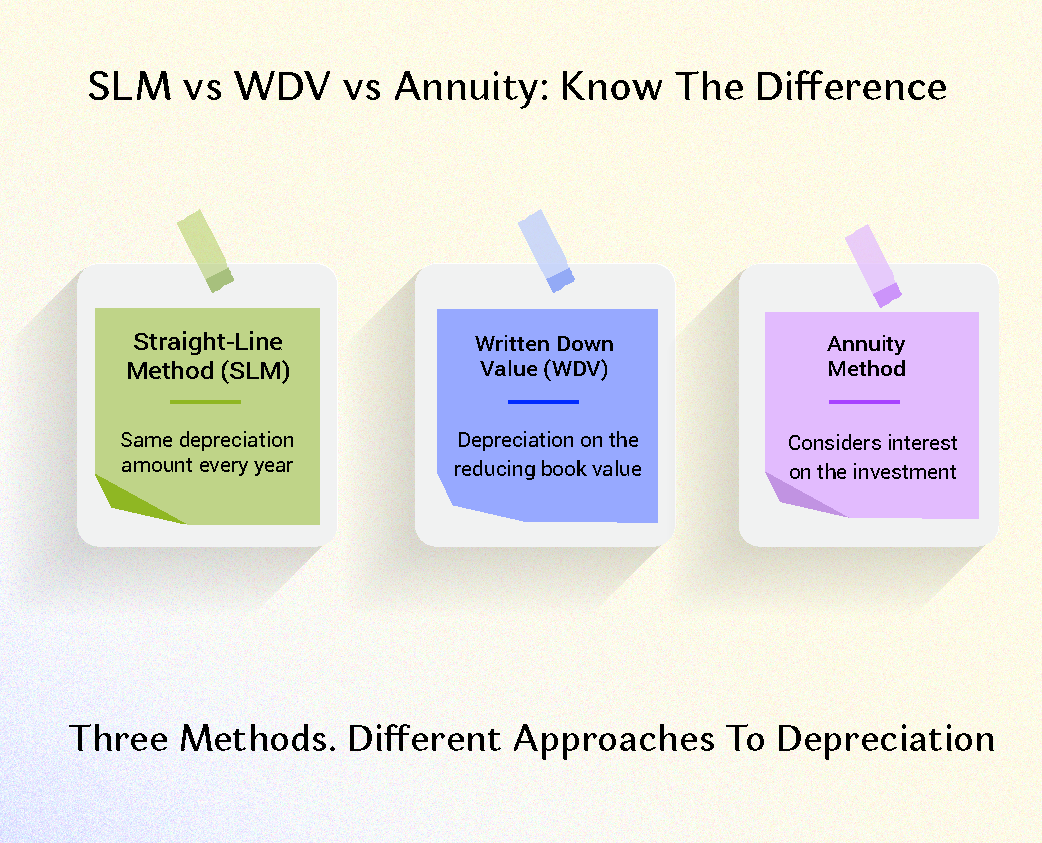
What Is the Difference Between SLM, WDV and the Annuity Method?
| Method | How it works | Key point to remember |
|---|---|---|
| Straight-Line Method | Depreciation is spread evenly over the useful life. | Same amount each year |
| Written Down Value Method | Depreciation is calculated on the remaining book value. | Amount generally decreases |
| Annuity Method | Calculation considers interest on the investment in the asset. | Interest is part of the calculation |
Depreciation Made Simple
It might seem complicated at first, but the basic idea is simple: when a business uses an asset over several years, its cost is usually spread out over those years. The Straight-Line Method deducts the same amount each year, the Written Down Value Method calculates the depreciation on the reducing balance of the asset and the Annuity Method takes into consideration the interest attached to the investment. The best way to understand these methods is to work through examples and see how the calculations change.
To practise depreciation and other accounting tasks hands-on in Tally, explore the Master accountant using Tally course.
Frequently Asked Questions (FAQs)
Question 1: What is depreciation in accounting?
Answer: Depreciation in accounting is the process of spreading the cost of an asset over the years it is used by a business. It helps record the asset’s cost as an expense over its useful life.
Question 2: Why is depreciation calculated?
Answer: It is calculated to reflect the cost of using an asset over time. It also helps businesses to calculate their profit and determine the remaining book value of the asset.
Question 3: What are the different methods of calculating depreciation?
Answer: The three methods covered in this blog are the Straight-Line Method (SLM), Written Down Value (WDV) Method and Annuity Method.
Question 4: How is depreciation calculated using the Straight-Line Method?
Answer: Under the Straight-Line Method, depreciation is calculated by subtracting the asset’s estimated residual value from its original cost and dividing the result by its useful life.
Formula: Annual Depreciation = (Cost of Asset – Residual Value) ÷ Useful Life.
Question 5: What is the Written Down Value (WDV) Method of depreciation?
Answer: Written Down Value Method calculates depreciation on the asset’s opening book value each year. As the value decreases, the depreciation amount generally decreases as well.
Formula: Annual Depreciation = Opening Written Down Value × Depreciation Rate.
Question 6: What is the Annuity Method of depreciation?
Answer: Annuity Method considers the interest associated with the money invested in an asset, along with factors such as its cost and useful life. Its calculation is more complex than the Straight-Line and Written Down Value methods.
Question 7: What is the difference between the Straight-Line Method and the Written Down Value Method?
Answer: Straight-Line Method charges the same depreciation amount each year, assuming the estimates remain unchanged. The Written Down Value Method calculates depreciation on the asset’s reducing book value, so the amount generally decreases each year.

Nita R
Nita is a content writer specialising in Accounting, Finance, GST, and Taxation. She creates easy-to-understand, research-driven content that simplifies complex financial and tax concepts for learners, professionals, and businesses. Her expertise lies in translating technical accounting and GST topics into practical insights, helping readers stay informed about tax compliance, financial processes, and industry best practices. Through her content, she aims to make accounting and taxation accessible, accurate, and relevant for today's evolving business environment.