


GSTR-1: What Is It, Due Dates, and Key Tables Explained


30-Second Summary
If you are new to GST, first return to know is GSTR-1. This is a return containing details of all outward supplies (sales) made by a registered taxpayer for a given tax period. Filing of GSTR-1 accurately and on time by businesses is essential to stay GST compliant and to ensure that buyers can avail ITC and avoid penalties. In this blog, we will learn what is GSTR-1, features of GSTR-1, who needs to file GSTR-1, GSTR-1 filing frequency and due dates, why is it important to file GSTR-1 on time and key tables in GSTR-1 return.
What is GSTR-1?
GSTR-1 is a monthly or quarterly GST return that records every outward supply sale of goods or services made by a registered business, so tax authorities and buyers both have an accurate record of the transaction.
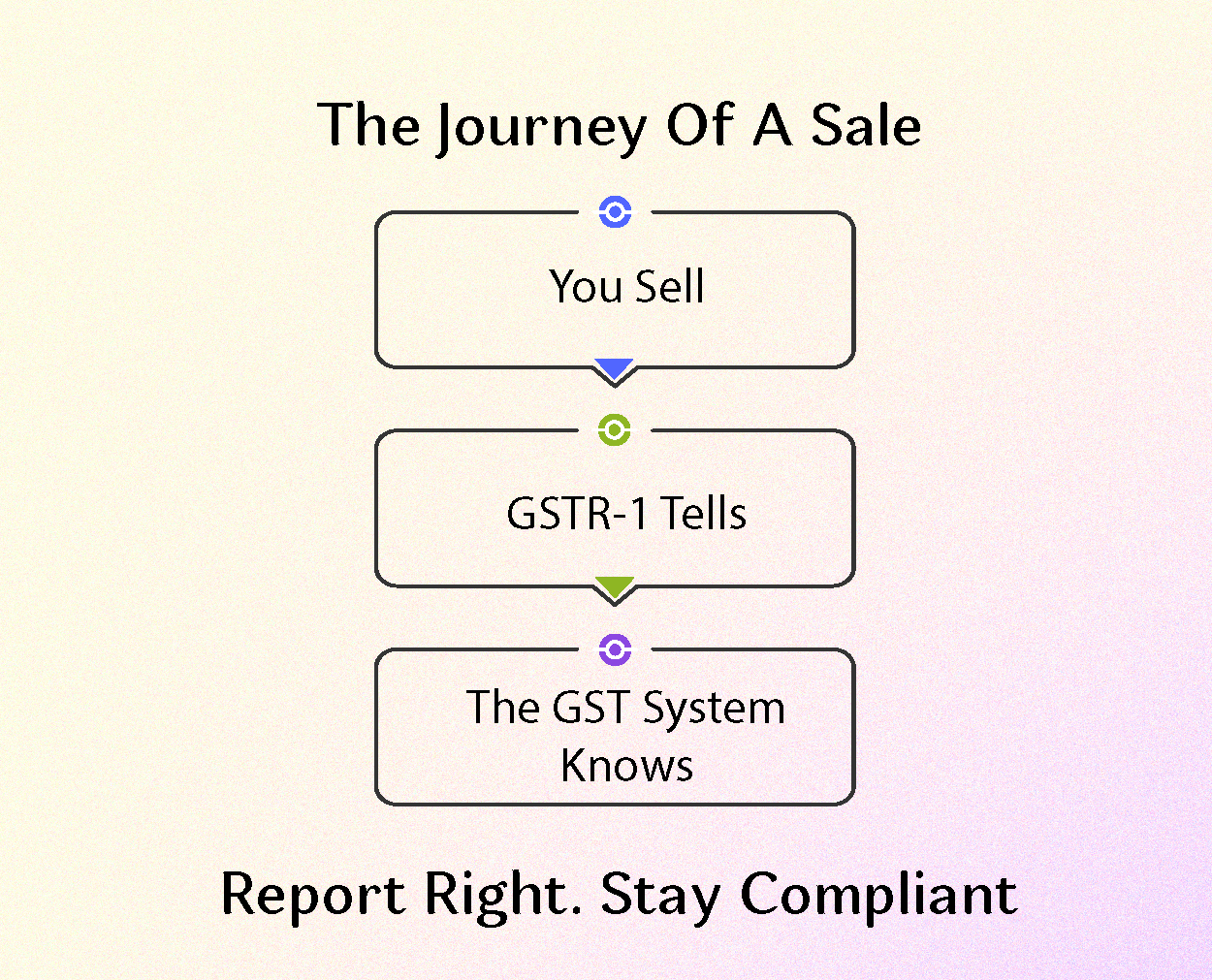
Think of running a business where you sell products or offer services daily. The government needs to know about these sales to collect the correct amount of GST. This is where GSTR-1 comes into play.
GSTR-1 is a GST return that includes details of all outward supplies made by a registered taxpayer. Outward supplies simply refer to the goods sold or services offered by a business.
The return contains information such as:
a) Sales to registered customers
b) Sales to unregistered customers
c) Export deals
d) Credit and debit notes raised’
e) Amendments
f) Advance receipts for sales and related adjustments
The data reported in GSTR-1 helps in the generation of GST records for buyers and enables them to claim Input Tax Credit (ITC). Hence, filing GSTR-1 accurately is very important. GSTR-1 is a statement of sales transactions of a business under GST.
GSTR-1 Features
GSTR-1 is an important GST return with many important features.
- Outward Supplies Records: The GSTR-1 is mainly used to report all sales transactions done in a tax period.
- Required for qualifying taxpayers: Businesses that have to file GSTR-1 must file it even if they have had no sales in the period. In such cases, Nil GSTR-1 can be filed.
- Helps Claim ITC for Buyers: The information shared by the suppliers goes to the buyers’ GST records for them to claim Input Tax Credit.
- Electronically Submitted: GSTR-1 can be filed electronically through the GST portal, which is convenient and transparent.
- Enables Invoice-Level Reporting: In particular, businesses can upload detailed invoice-wise information for transactions with registered persons.
- Permits Amendments: Errors in previously filed invoices can be rectified in subsequent GSTR-1 returns through amendment tables.
For businesses looking to simplify GST compliance beyond GSTR-1, understanding the connection between different GST returns is also important. From GSTR-1 to GSTR-3B: Filing Made Effortless with TallyPrime can help businesses understand how TallyPrime supports a smoother GST filing workflow.
Who Needs to File GSTR-1?
Most registered taxpayers supplying goods or services must file GSTR-1. Following persons are generally required to file GSTR-1:
Registered Taxpayers: If you are a GST registered business making taxable supplies you have to file GSTR-1.
Casual Taxable Persons: A person or business that occasionally makes taxable transactions in a state in which he does not have a fixed place of business is to file GSTR-1.
E-commerce Operators (sometimes): If you are a business selling through online platforms, you may have to provide details of your sales in GSTR-1.
Who does not need to file GSTR-1?
There are certain categories of taxpayers who are generally not required to file GSTR-1 such as:
a) Taxpayers opting for the Composition Scheme
b) Input Service Distributor (ISD)
c) Non-resident taxable persons (filing separate returns)
d) Taxpayers to deduct TDS under GST
e) Taxpayers liable to collect TCS under the GST
Businesses should verify the current GST rules that apply to them before filing their GST return.
GSTR-1 Due Dates and Filing Frequency
One of the most frequently asked questions by students and beginners is how often is GSTR-1 filed? This is subject to the turnover of the taxpayer and the filing option.
Monthly Filing: Businesses opting for the monthly scheme generally file GSTR-1 on a monthly basis.
Due Date: 11th of the next month.
Example: GSTR-1 is normally due on 11th May for April sales.
Quarterly Filing under QRMP Scheme: GSTR-1 quarterly filing for small taxpayers under the QRMP (Quarterly Return Monthly Payment) Scheme.
Completion Date: 13th day of the month after the quarter.
Example: For the April–June quarter, generally the due date of GSTR-1 is 13th July.
Why Track Due Dates Closely?
Because missed deadlines can lead to:
a) Overdue charges
b) Compliance problems
c) Input Tax Credit for customers postponed
d) Notices from the tax authorities
Maintaining a GST compliance calendar can assist businesses in preventing such issues.
Table of Content of GSTR-1
GSTR-1 has several tables to capture different types of sales transactions. By understanding these tables, taxpayers can file their returns correctly.
- Table 4A, 4B, 4C, 6B, 6C – B2B Invoices: Sales particulars to registered persons.
- Table 5A, 5B – B2C (Large) Invoices: This table reports inter-State B2C supplies made to unregistered customers, where the invoice value exceeds ₹1,00,000.
- Table 6A – Export Invoices: Export Invoices: Captures details of exports of goods and services.
- Table 7 – B2C (Small) Invoices: Unlike B2C (Large) invoices, this table includes both intra-State and inter-State B2C supplies. All applicable B2C transactions made within the same State are reported here. For inter-State supplies, transactions below the prescribed threshold (₹1,00,000) are reported in this table.
- Table 8A, 8B, 8C, 8D – Nil Rated, Exempt and Non-GST Supplies: This section reports nil-rated, exempt, and non-GST supplies made during the tax period.
Nil-rated supplies are taxable supplies to which GST is charged at the rate of 0%.
Exempt supplies are supplies that are exempt from GST under the provisions of Act or notifications issued but otherwise may be covered under GST.
Non-GST supplies are those which are not covered under the GST regime and accordingly not liable to GST. - Table 9B – Credit or Debit Notes (Registered and Unregistered): This table contains the credit notes and debit notes issued against invoices for registered and unregistered recipients. Credit notes (such as those issued for sales returns) are generally issued to reduce the taxable value or tax amount of the original invoice, also referred to as price de-escalation. Debit notes are issued to increase the taxable value or tax amount due to undercharging or other invoice corrections, also referred to as price escalation.
- Table 9A – Amended B2B, B2C (Large), Exports Invoices: This table reports details of amendments made to B2B, B2C (Large), and export invoices, along with the corresponding changes made to the prescribed invoice details.
- Table 9C – Amended Credit or Debit Notes (Registered and Unregistered): This table reports details of amendments made for credit or debit notes issued to registered and unregistered recipients, along with the corresponding changes made to the prescribed invoice details.
- Table 10 – Amendment B2C (Small) Invoices: This table reports details of amendments made for the B2C (Small) Invoices along with the corresponding changes or corrections made to the relevant invoice details.
- Table 11A (1), 11A (2) – Tax Liability (Advances Received): This table reports details of advances received by the supplier, including the amount received and the GST applicable on such advances, before the supply of goods or services is made.
- Table 11B (1), 11B (2) – Adjustment of Advances: This table reports details of adjustments made against advances received, helping the supplier determine the GST liability to be adjusted and the net GST liability after the supply of goods or services.
- Table 11A – Amended Tax Liability (Advances Received): This table reports details of amendments made to the tax liability related to advances received, along with the corresponding changes or corrections to the relevant details.
- Table 11B – Amendment of Adjusted Advances: This table reports details of amendments made to the transactions reported in Table 11B (1) and Table 11B (2) relating to advances adjusted after the supply of goods or services, along with the corresponding changes or corrections made to the relevant details.
- Table 12 – HSN Summary (B2B – B2C Supplies): This table provides a summary of goods and services based on their HSN or SAC classification codes, along with a classification of B2B and B2C supplies.
- Table 13 – Documents Summary: This table reports details of all documents issued during the tax period, including the document or voucher numbers (from and to), total document count, number of cancelled documents, and the net number of documents issued.
These tables help taxpayers make sure they report sales transactions fully and accurately.
Summary of the Contents
GSTR-1 is one of the most important GST returns as it provides the details of all the outward supplies made by a business. In this blog, we came to know that GSTR-1 is used to record sales transactions, which allows reporting at the invoice level and amendments, if required. GSTR-1 can be filed either on a monthly or quarterly basis, depending on eligibility, and timely filing helps avoid penalties and compliance issues.
Learning GSTR-1 is an important step towards GST compliance for students. If you aspire to be an accountant, tax professional, entrepreneur, or business owner, knowing the workings of GSTR-1 will give you a strong foundation of India’s GST system
Related Read: GST Return Filing Process in India
Frequently Asked Questions (FAQs)
Question 1: What is GSTR-1 and what is it for?
Answer: GSTR-1 is a GST return that contains details of outward supplies made by a registered taxpayer in a specific tax period. It is used for reporting of sales, exports, relevant credit and debit notes and other prescribed details.
Question 2: Who needs to file GSTR-1 under GST?
Answer: In general, normal GST registered taxpayers who are required to declare outward supplies must file GSTR-1. Some taxpayers are not required to file GSTR-1 such as composition taxpayers and taxpayers required to file separate returns.
Question 3: What is the due date for filing GSTR-1?
Answer: The general due date for the taxpayers filing the GSTR-1 monthly is on the 11th of the subsequent month. The eligible taxpayers under the QRMP Scheme usually file GSTR-1 quarterly by the 13th of the month following the quarter as per the applicable notifications.
Question 4: Is GSTR-1 required if there are no sales?
Answer: A taxpayer who is required to file GSTR-1 may have to file Nil GSTR-1 if he has no outward supplies or any other details to be reported during the tax period.
Question 5: What details are reported in GSTR-1?
Answer: GSTR-1 contains the details of Outward supplies like B2B sales, applicable B2C supplies, exports, supplies to SEZs, credit and debit notes, HSN/SAC-wise details etc.
Question 6: Can the details provided in GSTR-1 be amended after filing?
Answer: Yes. Subject to the applicable rules and time limits, certain errors or omissions in details reported in a previously filed GSTR-1 can be corrected through the relevant amendment tables in a subsequent return.

Nita R
Nita is a content writer specialising in Accounting, Finance, GST, and Taxation. She creates easy-to-understand, research-driven content that simplifies complex financial and tax concepts for learners, professionals, and businesses. Her expertise lies in translating technical accounting and GST topics into practical insights, helping readers stay informed about tax compliance, financial processes, and industry best practices. Through her content, she aims to make accounting and taxation accessible, accurate, and relevant for today's evolving business environment.