

Latest GST Rules Every Accountant Should Know in 2026


30-Second Summary
GST in 2026 is not the same beast you learned about in college. Between GST 2.0’s simplified slabs, a hard 3-year time bar on late returns, stricter e-invoicing thresholds, and portal-level ITC checks that leave zero room for guesswork, “I’ll figure it out on the job” is no longer a plan, it’s a risk. This article breaks down the latest GST rules every accountant should know in 2026, why they matter for your career, and how a structured GST Course Online can turn “I’ve read about GST” into “I can file it correctly, first time, every time.”
Key GST Rule Changes Accountants Need to Know in 2026
Here’s a mildly terrifying fun fact about GST in India: it doesn’t sit still. Just when you think you’ve mastered the return filing process, the GST Council or GSTN quietly rolls out a new validation rule, a new deadline, or a new penalty structure, and suddenly your “solid understanding” needs an update.
2026 has been a particularly busy year for GST. Between the GST 2.0 rate rationalisation, tighter e-invoicing rules, and a portal that now blocks non-compliant returns instead of politely reminding you, accountants who aren’t keeping up are finding themselves a step behind, sometimes literally locked out of filing.
So, let’s get you caught up. No jargon overload, no 40-page circulars, just what actually matters and why it should be on your radar, especially if you’re building (or rebuilding) a career in accounting and taxation.
Why This Matters More Than a Line on Your Resume
Knowing that GST changed is not the same as knowing how to work with the change. Businesses aren’t hiring people who can recite rate slabs. They’re hiring people who can log into a system, apply the correct treatment, and file a clean, error-free return without triggering a notice.
This is exactly what a good GST Course is designed to do: help you move from “I’ve read the notification” to “I’ve actually filed under it.”
1. GST 2.0: The New Rate Structure Is Here to Stay
The biggest shake-up in years arrived with GST 2.0, which simplified the old multi-slab structure into a cleaner system. Most goods and services now fall under a 0%, 5%, or 18% structure, with a 40% rate reserved for select luxury and “sin” category goods, and these rates have been in effect since September 2025.
Why it matters: If you’re still mentally categorising products under the old slab logic, you’re one wrongly-rated invoice away from a reconciliation headache. Getting this right at the point of billing saves everyone downstream pain in GSTR-1.
2. The 3-Year Time Bar Is No Longer a Warning, It’s a Wall
For years, “late filing” was expensive but possible. Not anymore. A statutory three-year time bar is now built into the CGST Act, meaning returns cannot be filed beyond that window at all, and the GST portal has been enforcing this hard cutoff since late 2025. Once a return period crosses that line, filing becomes impossible and any input tax credit tied to it is simply gone, with no way to recover it.
Why it matters: This isn’t a penalty you can pay your way out of. It’s a closed door. Accountants now need to actively track filing windows across every GSTIN they handle, not just file “whenever there’s time.
3. E-Invoicing Threshold Tightens Further
E-invoicing continues to apply to a growing base of businesses under GST. Since 1 August 2023, e-invoicing has been mandatory for eligible taxpayers whose aggregate annual turnover (AATO) exceeded Rs.5 crore in any financial year from FY 2017–18 onwards. The turnover threshold is calculated at the PAN level, covering all GSTINs registered under the same PAN across India. There’s a second deadline worth flagging too: since 1st April 2025, businesses with AATO of Rs. 10 crore or more must report invoices, credit notes, and debit notes to the Invoice Registration Portal (IRP) within 30 days of the document date. Miss that window, and the document simply won’t be considered valid for e-invoicing purposes.
Why it matters: A lot of mid-sized businesses that comfortably sat outside the e-invoicing net are now squarely inside it. If you’re advising or working with growing businesses, you need to know exactly when this threshold gets triggered, and how to set up compliant invoicing before the deadline, not after a notice arrives.
4. ITC Rules Have Gotten Stricter (and More Automated)
Input Tax Credit used to involve a fair amount of manual cross-checking. That’s changing fast. Businesses can now claim ITC only against eligible, verified invoices, which makes invoice-level checking more critical than it’s ever been. On top of that, newer rules now allow the system to automatically recover wrongly claimed ITC directly from a business’s electronic credit ledger when excess credit is detected.
Why it matters: The margin for “we’ll sort it out at year-end” has basically disappeared. Accountants need to validate ITC claims as they happen, not after the portal flags them.
Related Read: ITC Under GST Explained: Eligibility, Ineligible Credits and ITC Reversal
5. Bank Account Verification Isn’t Optional Anymore
Here’s one that catches people off guard. If a business hasn’t verified or updated its bank account details on the GST portal, its GST registration can be automatically suspended, which blocks return filing and e-way bill generation entirely.
Why it matters: This is one of those “small admin task, big consequence” situations. A five-minute oversight can freeze a business’s entire compliance activity. It’s exactly the kind of practical checklist item that theory-only learning tends to skip.
6. GTA Forward Charge and Export Rules Have Shifted Too
If you handle logistics-heavy or export-oriented clients, take note. Under the newer GTA forward charge option, transport agencies can now choose to pay GST themselves instead of the responsibility automatically falling on the recipient under reverse charge, changing how transport expenses get accounted for. Exporters aren’t off the hook either. Businesses exporting goods or services without paying IGST must file a fresh Letter of Undertaking (LUT) for financial year 2026-27, and skipping this means paying IGST upfront and claiming a refund later, which hits cash flow.
Why it matters: Missing an LUT renewal deadline is a classic, entirely avoidable cash flow problem. And that’s the theme running through almost every rule on this list.
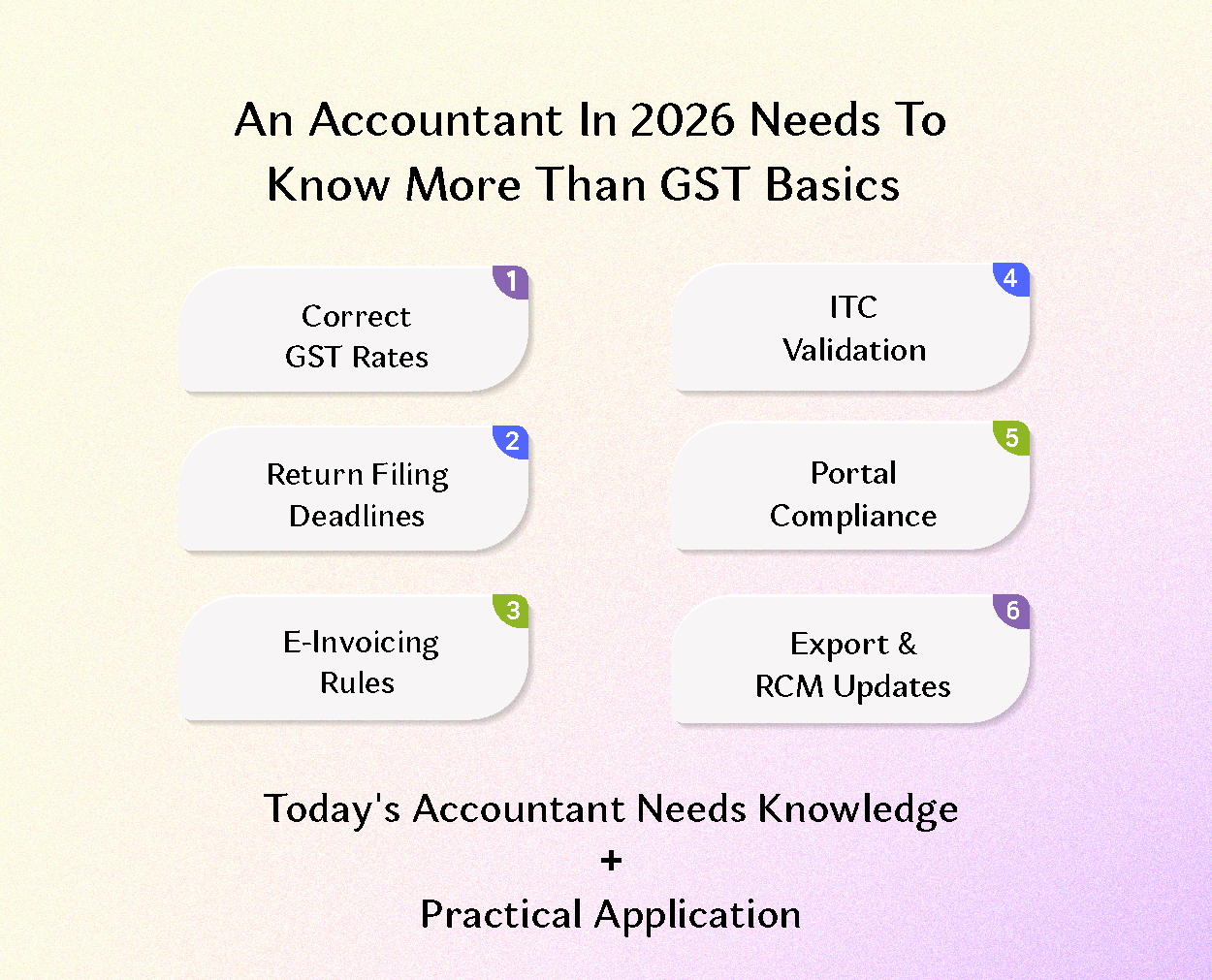
The Real Takeaway
Notice a pattern? Every single one of these updates isn’t really about “knowing the rule.” It’s about knowing what to actually do about it, inside a real system, before the deadline, not after the penalty notice.
That’s the exact difference between studying GST and working with GST. And it’s what decides whether you’re the candidate who gets hired, or the one who gets a polite “we’ll get back to you.“
How a Structured GST Course Helps You Stay Ahead (Instead of Catching Up)
The TallyPrime with GST Fundamentals is a GST certification course built exactly for this reason. Instead of memorising notifications, you practise:
- Recording GST-compliant transactions correctly, the first time
- Tracking and validating Input Tax Credit before it becomes a problem
- Generating and reviewing GSTR-1 and GSTR-3B inside TallyPrime
- Handling real scenarios like e-invoicing thresholds, reverse charge, and exports
- Building the kind of practical confidence that shows up in interviews, and in the first month on the job
Whether you’re a student who’s never filed a real return, a fresher trying to move past that awkward “I know the theory but not the practice” stage, or a working professional who needs to get current fast, this is the structured path that gets you there.
Conclusion: Don't Let the Rules Outpace You
GST in 2026 rewards accountants who are current, practical, and precise. The rules aren’t getting simpler, and honestly, they’re probably not going to. But you can absolutely get ahead of them, and stay there, with the right training behind you.
If you’re ready to move from “I’ve heard about GST 2.0” to “I can file confidently under it,” it’s time to build that skill properly.
Enroll in the TallyPrime with GST course today and turn GST from your biggest interview worry into your strongest selling point.
Frequently Asked Questions
Question 1: Who should take this GST Course Online?
Answer: This course is ideal for commerce students who understand GST theory but haven’t applied it, freshers looking for practical exposure, working accounts professionals wanting to upskill, and business owners handling their own GST compliance.
Question 2: Do I need prior accounting software experience to join this GST Course?
Answer: No. The program is structured to take you from foundational GST concepts through to hands-on filing inside TallyPrime, so you build both understanding and execution skills together.
Question 3: Will this course cover the latest 2026 GST rule changes?
Answer: The course focuses on practical, current GST workflows including transaction recording, ITC tracking, and return generation, the exact skills you need to apply updated rules confidently rather than just knowing they exist.
Question 4: What will I actually be able to do after completing the course?
Answer: You’ll be able to record GST-compliant transactions, track and validate Input Tax Credit, generate and review GSTR-1 and GSTR-3B, and handle real-world scenarios like reverse charge and exports, independently and accurately.

Tally Education
Tally Education empowers learners with industry-relevant skills in accounting, finance, taxation, and business management through practical learning and certifications. Our blogs are created and reviewed by subject matter experts to deliver accurate, practical, and up-to-date insights on accounting, GST, taxation, finance, and TallyPrime.