

Profit and Loss Account: From Revenue to Profit Explained


30-Second Summary
Want to know how well a business performed during a particular period? Start with its Profit and Loss Account. A Profit and Loss Account (P&L Account) summarises the revenue, costs and expenses of a business to show whether it has made a profit or loss. It also gives a clearer picture of where the business earns its revenue and where it spends its money. In this blog, we’ll explore the meaning, key components and importance of a P&L Account and understand how it helps assess a company’s financial performance.
Introduction
Every business wants to know one thing: Profit or Loss?
While a business might make sales and receive payments from customers, these numbers do not tell the full story. A business also incurs costs like salaries, rent, electricity, depreciation, interest and other operating costs.
The Profit and Loss Account, also called the P&L Account, combines the income earned and expenses incurred during an accounting period. It helps in deciding whether the business has made a profit or has made a loss.
The Profit and Loss Account is an important part of financial reporting, along with the Balance Sheet and Cash Flow Statement.
Let us understand what a Profit and Loss Account is, why is it important, what are its major components, format, and how profit or loss is calculated.
What is a Profit and Loss Statement?
Definition: The Profit and Loss Account is a financial statement prepared to find out the net profit or net loss of a business for a particular accounting period. It records the income earned and expenses incurred in the period.
The basic calculation is as follows:
Profit = Total Revenue – Total Cost
If income is greater than expenses, the business is profitable. If costs exceed income, the business suffers a loss.
Example: If a business makes revenue of ₹10 lakh and incurs total expenses of ₹7 lakh during the year, its profit before applicable taxes and other adjustments would be ₹3 lakh.
The P&L Account helps in measuring the financial performance rather than the financial position of a business at a given date.
Why a Profit and Loss Account Matters
There are some benefits of P&L Account.
- Measures Profit: It helps to find out whether the business has earned a profit or loss during the accounting period.
- Tracks Expenses and Income: The statement gives a systematic picture of the main sources of income and expenditure.
- Facilitates Decision-Making: Management can examine expenses and profitability to make decisions about pricing, cost control, expansion and investments.
- Supports Investors and Lenders: Profitability information is useful to investors and lenders in assessing the financial performance and financial strength of a business.
- Aids in Financial Planning: Historical data on income and expenses can help management prepare budgets and plan future business activities.
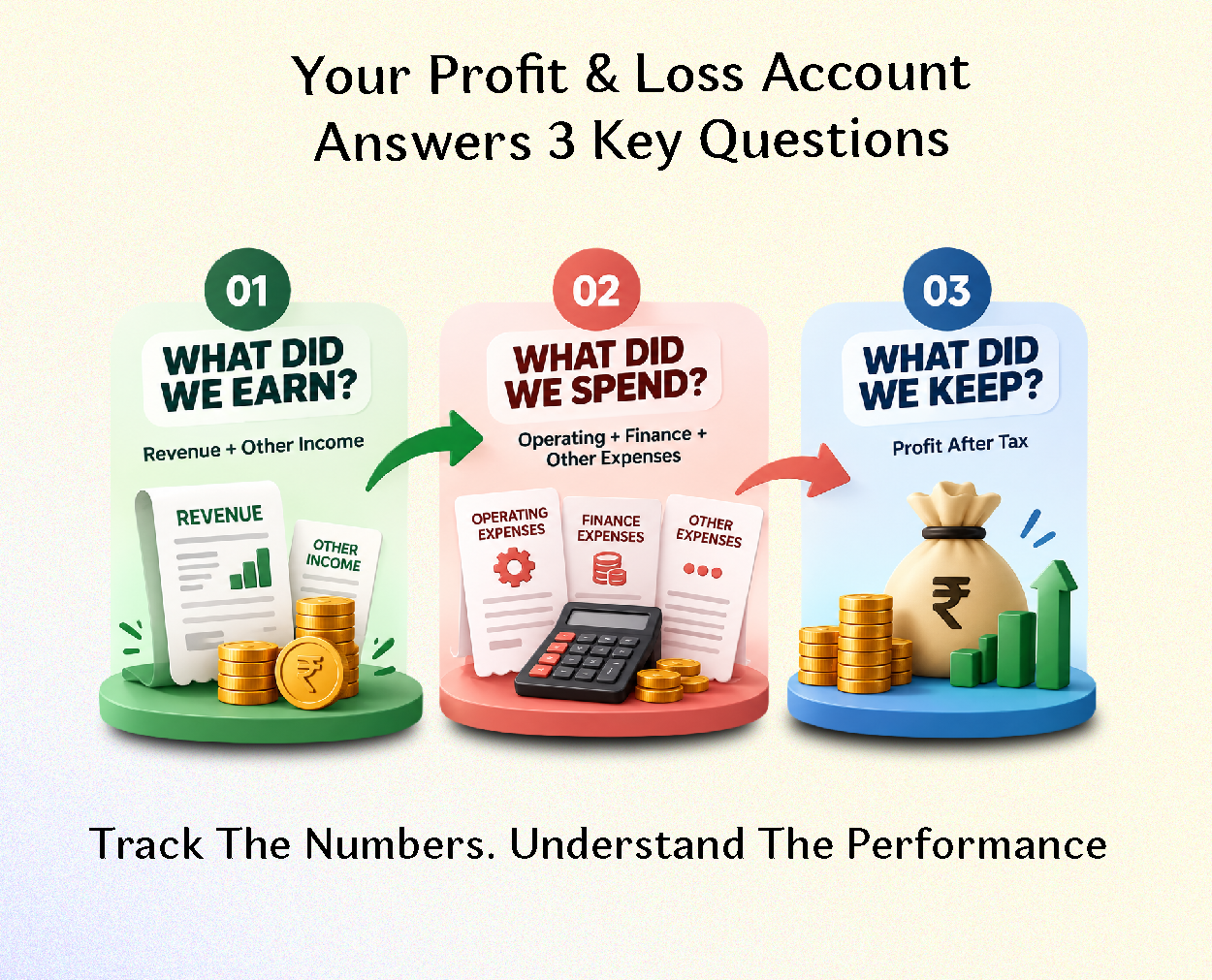
What are the Main Components of Profit and Loss Account?
The specific presentation may differ depending on the applicable accounting framework and the nature of the entity. However, a P&L Account generally has the following major components:
- Revenue from operations (net)
- Other revenues
- Expenditures
- Finance costs
- Amortisation and depreciation
- Income tax expense
- Profit/(loss) for the period
Let's Understand these Components
1. Revenue from Operations: Income from operation is the income earned from the main business operations of the company.
For instance:
• Sale of goods by a retail company
• Income of a consulting firm from professional services
• A manufacturing company’s revenue from sales of manufactured products
Revenue from operations is generally one of the most important indicators of the scale of a company’s business activities.
2. Miscellaneous Income: Other income includes income not derived from the company’s primary operating activities.
Examples can be:
• Income on interest
• Income from dividends
• Profit on the disposal of investments
Other income from non-operating activities in accordance with the applicable accounting requirements. For instance, a manufacturing company may earn interest on a bank deposit, which would be reported as other income rather than as revenue from its core manufacturing operations.
3. Cost: Expenses are costs incurred by a business in generating revenue and operating its activities.
Typical expenses are:
- Employee Benefits Costs: This includes salaries, wages, bonuses, contributions to employee benefit schemes and other employee costs.
- Cost of financing: These are costs related to borrowings and other financing arrangements. A common example is interest on loans.
- Depreciation and amortisation: Depreciation is the systematic allocation of the depreciable amount of a tangible asset over its useful life. Amortisation normally applies to intangible assets. For instance, when a business buys machinery for business purposes, the cost of the machinery is typically spread out over its useful life through depreciation.
- Miscellaneous Expenses: These might include:
• Lease
• Energy
• Maintenance and Repairs
• Insurance
• Advertising
• Fees for professional services
• Travel expenses
• Office expenses
The nature and classification of expenses depend on the business and applicable accounting requirements.
Profit Before Tax and Profit After Tax
The business then calculates its profit before tax, taking away income and expenses. A simple calculation is:
Profit Before Tax = (Total Income – Total Expenses)
Then the applicable tax expense is taken into consideration to determine the profit after tax.
Profit After Tax = Profit Before Tax – Tax Expense
Profit after tax is the profit attributable to the business after taking account of the applicable tax expense, in accordance with the applicable accounting framework.
Format of Profit and Loss A/c
A P&L format could be simplified to:
| Details | Amount (₹) |
|---|---|
| Revenue from Operations | XXX |
| Add: Other Income | XXX |
| Total Income | XXX |
| Less: Employee Benefits Expense | XXX |
| Less: Finance Costs | XXX |
| Less: Depreciation and Amortisation | XXX |
| Less: Other Expenses | XXX |
| Profit Before Tax | XXX |
| Less: Income Tax Expense | XXX |
| Profit After Tax | XXX |
The actual format and presentation may differ depending on the applicable accounting standards and Schedule III requirements for companies.
How to Prepare a Profit and Loss Account?
The following steps are generally involved in the preparation of a P&L Account. If you’re new to accounting and want to learn this process step by step, the TallyEssential Course covers the basics of recording transactions and preparing financial statements like the P&L Account:
Step 1: Calculate Revenue: Recognise and record the revenue earned during the accounting period.
Step 2: Determine Other Income: If any, add income from other sources outside the company’s principal business operations.
Step 3: List expenses: Consider expenses incurred in the period like employee costs, finance costs, depreciation and other operating costs.
Step 4: Compute profit before tax: Total income less the relevant expenses gives profit before tax.
Step 5: Consider Tax: Consider the income tax expense.
Step 6: Calculate Profit or Loss: The amount resulting after deduction of applicable tax expense and other relevant items is the profit or loss for the period.
If you’d like to go further and build stronger hands-on skills in preparing and analysing these statements, the Tally Professional Course covers this in depth, including advanced topics like taxation, payroll and detailed financial statement analysis.
Balance Sheet and Profit and Loss Account
Both are crucial financial reports but serve different purposes.
| Profit and Loss Statement | Balance Sheet (Equity) |
|---|---|
| Financial performance | Statement of financial position |
| Covers a particular period of time | Displays position at a given date |
| Tracks income and expenses | Records liabilities, assets, and equity |
| Calculates profit or loss | Shows the business’s assets and liabilities |
In simple terms, the P&L Account tells you how the business performed, and the Balance Sheet tells you what the business owns and owes at a particular date.
Limitations of a Profit and Loss Statement
The P&L Account is useful, but it should not be viewed in isolation.
- It does not give a complete picture of the company’s cash position.
- Profit may include non-cash expenses like depreciation.
- A business can be profitable yet have cash flow problems.
Ideally, the analysis of profitability should be carried out together with the Balance Sheet and the Cash Flow Statement. Thus, stakeholders should take into account all relevant financial statements when assessing a business.
Conclusion
The Profit and Loss Account enables businesses to understand how well they have performed financially. It shows the income, revenue, expenses and the profit or loss made in an accounting period. It helps business owners to identify areas of profitability and control unnecessary spending. It also gives investors and lenders insights into business performance.
Profit, though, is only part of the picture. You need to look at the P&L Account, Balance Sheet and Cash Flow Statement together to get an overall view of the financial health of a business.
Frequently Asked Questions (FAQs)
Question 1: What is a Profit and Loss Statement?
Answer: A Profit and Loss Account is a financial statement that shows the income and expenses of a business in an accounting period and helps to determine whether it has made a profit or loss.
Question 2: What is the prime object of a Profit and Loss Account?
Answer: A P&L Account’s main purpose is to determine the profit or loss of a business for a particular accounting period and provide information about its income and expenses.
Question 3: What are the main components of a Profit and Loss Statement?
Answer: The major components typically consist of revenue from operations, other income, employee expenses, finance costs, depreciation and amortisation, other expenses, tax expense and profit or loss for the period.
Question 4: How is profit worked out in a Profit and Loss Account?
Answer: Profit is generally calculated as total income less total expenses. Once the applicable tax expense and other relevant items are considered the result is the profit for the period.
Question 5: What’s the difference between a Profit and Loss Statement and a Balance Sheet?
Answer: A P&L Account shows the financial performance of a business over an accounting period while a Balance Sheet shows its financial position at a particular date.
Question 6: Is it possible for a company to be making a profit and still have cash flow problems?
Answer: Yes, Profit and cash flow are two separate things. A company may have a profit but still be short of cash because of credit sales, investment in assets, repayment of borrowings or other cash flow requirements. To understand how working capital and long-term funds move within a business, see Fund Flow Statement: Definition, Format, Elements, Importance and Examples.
Question 7: Why is the Profit and Loss Account useful to a business?
Answer: A P&L Account enables businesses to measure profitability, monitor income and expenses, support financial decision-making, plan future activities, and provide useful information to investors and lenders.

Nita R
Nita is a content writer specialising in Accounting, Finance, GST, and Taxation. She creates easy-to-understand, research-driven content that simplifies complex financial and tax concepts for learners, professionals, and businesses. Her expertise lies in translating technical accounting and GST topics into practical insights, helping readers stay informed about tax compliance, financial processes, and industry best practices. Through her content, she aims to make accounting and taxation accessible, accurate, and relevant for today's evolving business environment.