

Reverse Charge Mechanism (RCM) Under GST: Meaning, Applicability, Benefits, and Important Provisions


30-Second Summary
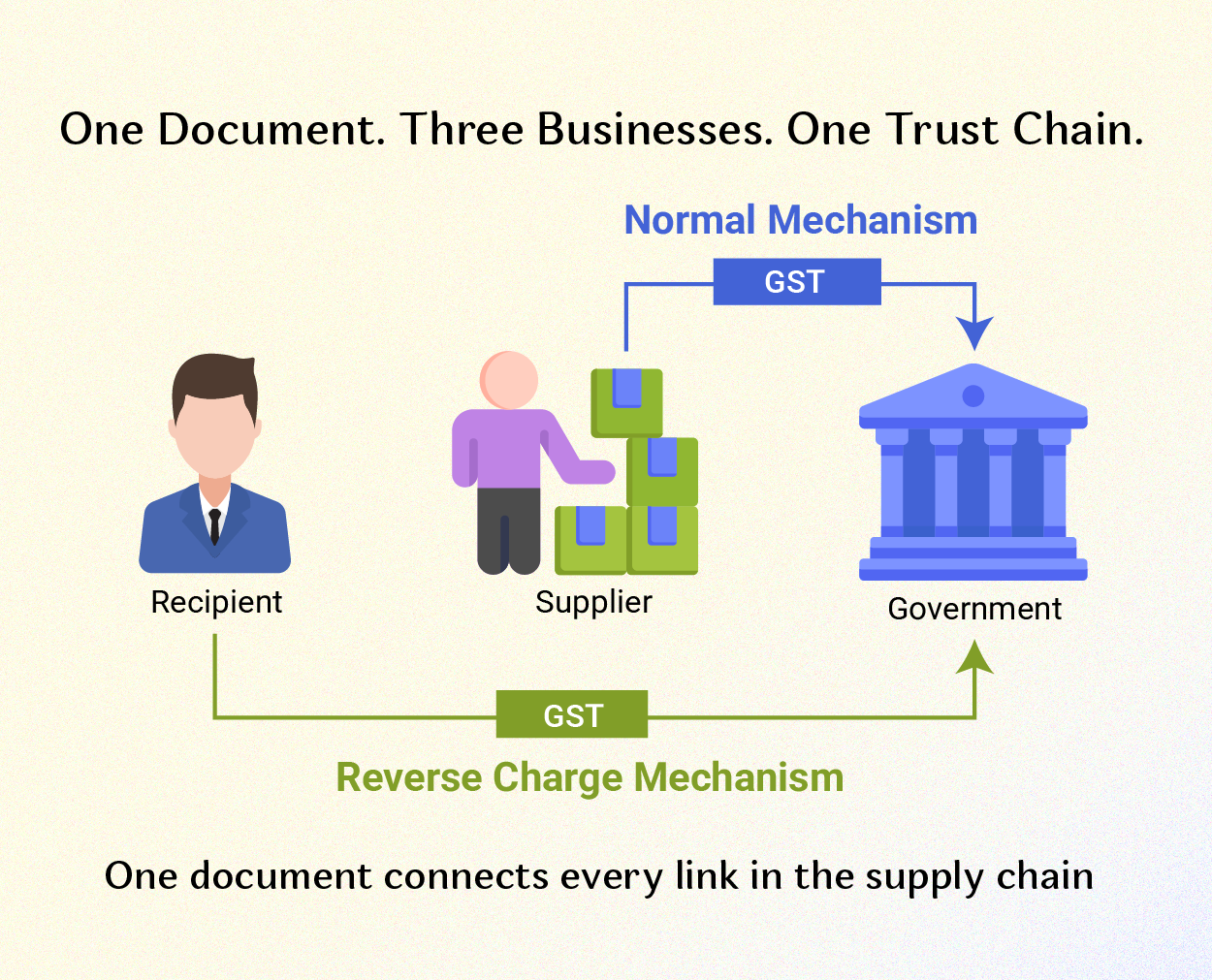
Reverse Charge Mechanism (RCM) under GST is a mechanism under which the recipient of goods or services becomes liable to pay GST to the government instead of the supplier. It is applicable on specified goods and services and procurement of these goods and services from specified category of suppliers under notified circumstances of GST Act. The RCM expands the tax base and ensures proper collection of taxes where tracking of suppliers is challenging.
In this article we will discuss RCM under GST like meaning, features, applicability conditions, notified goods and services, section 9(3) and 9(4) and benefits.
What is Reverse Charge Mechanism (RCM) under GST?
Under the regular GST system, the supplier of goods or services is the one who must collect and deposit the GST with the government. However, in certain situations, the GST law shifts this burden from the supplier to the recipient. This process is known as the Reverse Charge Mechanism (RCM).
RCM is governed by Section 9(3) and Section 9(4) of the Central Goods and Services Tax (CGST) Act, 2017. The key objective of introducing RCM is to ensure tax compliance in sectors where the suppliers are unorganised, difficult to track or where the risks of tax evasion are high.
Characteristics of the Reverse Charge Mechanism
Important features of RCM under GST are as follows:
- Transfer of Tax Liability to Recipient: The recipient of goods or services becomes liable to pay the GST instead of the supplier.
- Only in Notified Cases: RCM does not apply to all transactions. It is applicable only for the transactions, which are specifically notified by the government under GST.
- In certain cases, registration may be required: If you are a person liable to pay tax under the RCM and you meet the stipulated conditions, you may have to register for GST.
- Availability of Input Tax Credit (ITC): GST paid under RCM is normally allowed as Input Tax Credit, subject to eligibility conditions.
- Obligation to self-bill: The recipient may have to issue a self-invoice when the RCM applicable goods or services are received from the unregistered suppliers.
- Responsibility for Compliance: The recipient is required to calculate, pay, and report the tax liability correctly in GST returns.
Related Read: ITC Under GST Explained
Applicability Conditions of RCM
The Reverse Charge Mechanism shall apply if the following conditions are satisfied:
- Government Notified Supply (GNS): The goods or services should be specifically notified under Section 9(3) of CGST Act.
- Recipient is in the Designated Category: Some RCM provisions apply only if the recipient is a member of a specified class of persons.
- Supply of Goods or Services Transaction Amounts: The supply should be taxable under GST and not exempted from tax.
- Receipt of Goods or Services: GST is payable only when the goods or services are received by the recipient.
- Compliance with GST laws: The recipient is liable to pay the GST liability on the supply and report the same in the applicable GST returns.
Examples of Notified Goods and Services under the Act
Some categories of goods and services on which GST is payable under RCM have been notified by the Government.
A. Goods Covered Under RCM:
1.Cashews:
Example: Under RCM, GST is to be paid by the registered person who purchases cashew nuts from the agriculturist.
2.Bidi Wrapper Leaves (Tendu Leaves):
Example: A bidi manufacturer buying tendu leaves from the suppliers covered under the notification is liable to pay GST under RCM.
3.Silk Yarn:
Example: A textile manufacturer purchasing silk yarn from a notified supplier may be liable to pay GST under RCM.
4.Tobacco leaves:
Example: A cigarette manufacturer purchases tobacco leaves from an agriculturist. Since tobacco leaves are notified under RCM, the manufacturer is liable to pay GST under RCM on the purchase of such leaves.
5.Raw Cotton:
Example: A textile mill purchases raw cotton from an agriculturist. Here, the textile mill is required to pay GST under RCM on the purchase of raw cotton.
B. Services notified for RCM:
1.Services of Goods Transport Agency (GTA):
Example: A registered company engages a transporter for GTA services. Here the company pays GST under RCM.
2.Legal Services:
Example: A registered company receiving legal consultation from a law firm. In this scenario the company is subject to paying GST under RCM.
3.Sponsorship Services:
Example: A business entity sponsoring a sports event must pay GST under RCM on sponsorship fees.
4.Services of the Director:
Example: RCM applies to services rendered by a director to a company. The company shall discharge GST under RCM on the paid sitting fee or remuneration.
Section 9(3) and Section 9(4)
Section 9(3) of CGST Act
Section 9(3) empowers the government to notify certain categories of goods and services on which the recipient shall be liable to pay GST under reverse charge.
In this provision:
- The government specifies goods or services by notification.
- The recipient is liable for tax payment.
Examples:
- GTA services
- Legal services
- Sponsorship Services
- Services of Directors
Section 9(4) of the CGST Act
Section 9(4) applies to supplies received from unregistered suppliers by specified categories of registered persons.
Key Difference Between Section 9(3) and Section 9(4)
| Basis | Section 9(3) | Section 9(4) |
|---|---|---|
| Primary Objective | To shift the tax burden on certain goods or services to the recipient for more efficient tax administration. | To provide for tax collection on supplies received from unregistered persons in notified cases. |
| Scope | Restricted to the goods and services notified by the Government. | Only applies to the notified class of registered persons where a registered person purchases goods or services from an unregistered supplier. |
| Supplier Type | The supplier may be registered or unregistered, depending on the notified supply. | Specifically applies when the supplier is unregistered. |
| Frequency of Application | Frequently encountered in day-to-day business transactions. | Applies only in specific notified scenarios, making it comparatively less common. |
Benefits of RCM under GST
- Better Tax Compliance: RCM ensures tax collection from organised recipients, which are easier to monitor and regulate.
- Decrease in Tax Evasion: As the tax liability is transferred to the registered recipients, the likelihood of tax leakage is substantially diminished.
- Better to focus on the unorganised sectors: Many sectors have small or unorganised suppliers who may not maintain correct tax records. RCM helps to bring such transactions within the tax net.
- Increased Revenue Mobilisation: This results in better revenue realisation as the government gets tax from financially stable and compliant entities.
- Input Tax Credit Availability: The Input Tax Credit is available to those paying GST under RCM, which helps in reducing the overall tax liability.
- Promotes Documentation: RCM encourages companies to keep proper invoices, self-invoices, and tax records, making transactions more transparent.
- Improves GST Administration: With RCM, it becomes easier to collect tax in those sectors where it would be difficult to monitor at the supplier level.
Final remarks
The Reverse Charge Mechanism is a vital component of the GST regime in India. It shifts the tax liability from the supplier to the recipient in certain circumstances. Sections 9(3) and 9(4) provide the legal basis of RCM. Applicability of RCM on notified goods, services, and transactions involving some unregistered suppliers. RCM increases the compliance burden on the recipients, but it is important in terms of transparency, accountability, and efficient tax administration. Businesses must identify transactions under RCM and ensure timely payment and reporting of GST to avoid penalties.
Frequently Asked Questions (FAQs)
Question 1: What is the Reverse Charge Mechanism (RCM) under GST?
Answer: The Reverse Charge Mechanism (RCM) is a provision under GST where the recipient of goods or services is responsible for paying GST directly to the government instead of the supplier.
Question 2: When is the Reverse Charge Mechanism applicable under GST?
Answer: RCM applies when goods or services are notified by the government under Section 9(3) of the CGST Act or when specified registered persons procure supplies from certain unregistered suppliers under Section 9(4).
Question 3: Who is liable to pay GST under the Reverse Charge Mechanism?
Answer: Under RCM, the recipient of goods or services is liable to pay GST instead of the supplier. The recipient must calculate, pay, and report the tax liability in the applicable GST returns.
Question 4: What is the difference between Section 9(3) and Section 9(4) of the CGST Act?
Answer: Section 9(3) applies to government-notified goods and services where GST is payable by the recipient, whereas Section 9(4) applies to specified registered persons receiving supplies from certain unregistered suppliers as notified by the government.
Question 5: Can Input Tax Credit (ITC) be claimed on GST paid under RCM?
Answer: Yes, GST paid under the Reverse Charge Mechanism can generally be claimed as Input Tax Credit (ITC), provided the recipient satisfies the eligibility conditions prescribed under the GST law.
Question 6: Which services are commonly covered under the Reverse Charge Mechanism?
Answer: Some commonly notified services under RCM include Goods Transport Agency (GTA) services, legal services provided by advocates, sponsorship services, and services provided by directors to a company.

Nita R
Nita is a content writer specialising in Accounting, Finance, GST, and Taxation. She creates easy-to-understand, research-driven content that simplifies complex financial and tax concepts for learners, professionals, and businesses. Her expertise lies in translating technical accounting and GST topics into practical insights, helping readers stay informed about tax compliance, financial processes, and industry best practices. Through her content, she aims to make accounting and taxation accessible, accurate, and relevant for today's evolving business environment.