

What is QRMP Scheme Under GST? Meaning, Eligibility, IFF, Turnover Limit & Key Features Explained.


30-Second Summary
A simplified GST compliance scheme for small taxpayers is the Quarterly Return Monthly Payment (QRMP) Scheme. It provides an option to the eligible businesses with an aggregate annual turnover up to ₹5 crore to file GSTR-1 and GSTR-3B on a quarterly basis while paying GST monthly. To enable buyers to claim Input Tax Credit (ITC) without waiting for quarterly returns, the government introduced the Invoice Furnishing Facility (IFF) that allows QRMP taxpayers to upload B2B invoices monthly. This scheme eases the compliance burden while ensuring regular tax payment and seamless flow of ITC.
What is the QRMP Scheme?
Running a business comes with many GST compliance duties and filing multiple returns every month can be time-consuming especially for small and medium-sized businesses. To facilitate this process, the Government introduced the Quarterly Return Monthly Payment (QRMP) Scheme under GST.
Under this scheme, eligible taxpayers can file their GST returns quarterly instead of monthly but pay their GST liability every month by submitting only B2B (Business 2 Business) and CDNR (Credit & Debit Note Registered). In simple words, companies are not required to prepare and submit GSTR-1 and GSTR-3B every month. Instead, they file these returns once in a quarter, making GST compliance easier without affecting tax collections.
Related Read: From GSTR-1 to GSTR-3B – Filing Made Effortless with TallyPrime
When was the QRMP Scheme Introduced?
The Government of India has implemented the QRMP Scheme with effect from 1st January 2021.
It was launched as part of the government’s continuous efforts to simplify GST compliance for small taxpayers and improve ease of doing business. Before its introduction, many businesses with relatively low turnover were required to lodge monthly GST returns, which often led to additional compliance costs and administrative effort.
The government sought to balance the reduction of compliance burden for taxpayers with the regular collection of revenue through the introduction of quarterly return filing coupled with monthly tax payment. One of the important objectives behind introduction of QRMP Scheme was to ease the compliance for small businesses under GST.
Key Features of the QRMP Scheme
Some features of QRMP Scheme that make GST compliance easier are:
• Quarterly filing of GSTR-1 and GSTR-3B instead of monthly filing.
• GST liability will be paid on a monthly basis, even if the returns are filed on a quarterly basis.
• Availability of Invoice Furnishing Facility (IFF) to report B2B and CDNR if any, invoices on a monthly basis.
• The scheme is voluntary for eligible taxpayers, and businesses can elect to participate or to continue monthly filing.
• Ability to change from the QRMP to the regular filing system during the prescribed window of 90-day time frame which starts from 1st day of the second month of the preceding quarter and runs until the last day of the first month of the new quarter. Example: To switch the filing systems for the quarters of July to September, the prescribed window is May 1st to July 31st.
What is the Turnover Limit for the QRMP Scheme?
Under the QRMP Scheme, only such taxpayers shall be allowed whose aggregate annual turnover does not exceed ₹5 crore in the immediately preceding financial year.
Aggregate turnover consists of:
• Taxable supplies
• Supplies that are exempt
• Merchandise and services exports
• Inter-state supply under same PAN
Excluding GST and inward supplies on which tax is payable under Reverse Charge Mechanism (RCM). The QRMP Scheme will not be available to a taxpayer if his turnover exceeds ₹5 crore in a financial year, and they must switch to monthly return filing in the next quarter.
Invoice Furnishing Facility (IFF)
The Invoice Furnishing Facility (IFF) is an online service which allows small businesses that file quarterly tax returns to upload their B2B invoices monthly. The problem with quarterly filing is that the recipients would have to wait till the end of the quarter to see the invoices reflected in their GST records and claim Input Tax Credit (ITC). To address this, the government rolled out the Invoice Furnishing Facility (IFF).
The IFF is a voluntary facility and is available only to taxpayers registered under the QRMP Scheme. Businesses can upload details of their B2B and CDNR invoices for the first two months of every quarter without filing GSTR-1.
This ensures that buyers can see these invoices in their GST records and claim eligible ITC without waiting for the quarterly return. IFF is only for reporting invoices. IFF is not a replacement for GSTR-1 which is still filed at the end of every quarter.
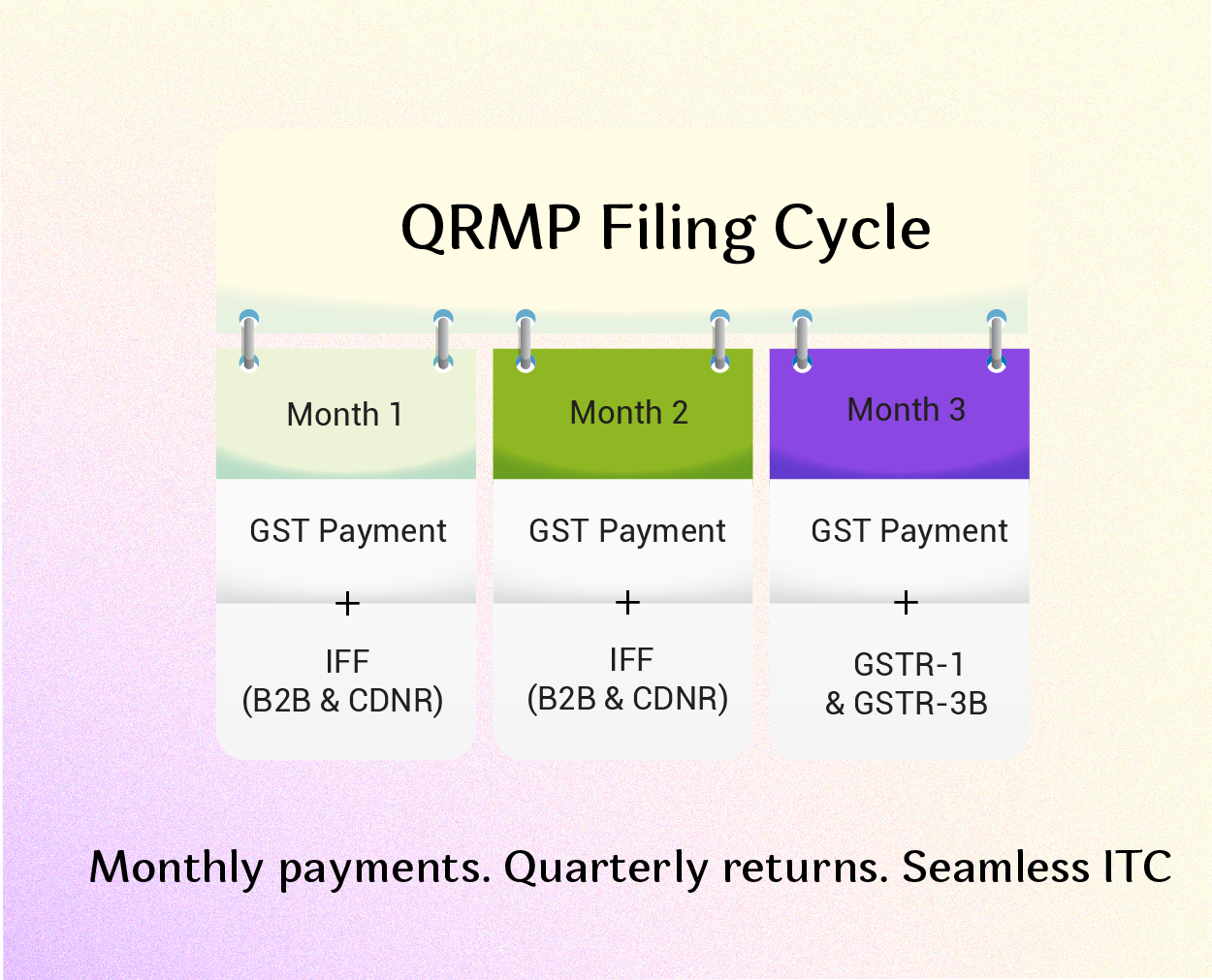
For instance, a taxpayer who has opted for the QRMP Scheme.
• Taxpayer can upload eligible B2B invoices through IFF during the first month of the quarter.
• The taxpayer can upload B2B invoices again through IFF at the second month.
• The taxpayer files GSTR-1 for the full quarter in the third month, except for the invoices already reported through IFF.
Businesses can file B2B bills of up to ₹50 lakh a month with IFF.
Benefits of QRMP Scheme
The QRMP Scheme offers various benefits to eligible taxpayers.
• Reduced frequency of filing of GST return.
• Time saving.
• Cuts GST compliance costs for small businesses.
• Facilitates cash flow planning via regular monthly tax payments.
• Allows buyers to get timely ITC through IFF.
• Less paperwork, while still keeping up with your regular tax compliance.
• Flexibility to change from quarterly filing to monthly filing as per business need.
Conclusion
The QRMP Scheme is one of the most taxpayer-friendly measures introduced under GST for small businesses. It permits returns to be filed quarterly but taxes to be paid monthly, greatly reducing the compliance burden while not relaxing tax discipline.
With the introduction of the Invoice Furnishing Facility (IFF), the scheme is further strengthened by providing a facility for the buyers to claim Input Tax Credit without unnecessary delay. The QRMP Scheme is suitable for businesses with an annual turnover of up to ₹5 crore and those who want to know if it fits their compliance needs and operational requirements. If used effectively, it can make GST compliance easier, reduce administrative effort and help businesses focus more on growth rather than paperwork.
Frequently Asked Questions (FAQs)
Question 1: What is QRMP Scheme in GST?
Under the QRMP Scheme, eligible taxpayers can file GSTR-1 and GSTR-3B on a quarterly basis and pay GST monthly.
Question 2: Who can avail the QRMP Scheme?
Answer: It is open to registered taxpayers whose total annual turnover does not exceed ₹5 crore and who have filed all GST returns due. To better understand the return filing requirements and compliance process, read our guide on GST Return Filing Process in India.
Question 3: Is GST payable monthly under the QRMP Scheme?
Answer: Yes. GST returns are filed quarterly but the tax liability must be paid every month.
Question 4: What is the turnover cap for QRMP?
Answer: The aggregate turnover made during the previous financial year shall not exceed ₹5 crore.
Question 5: Is the Invoice Furnishing Facility (IFF) mandatory?
Answer: No. IFF is an elective facility that enables QRMP taxpayers to upload B2B invoices for the first two months of a quarter.
Question 6: What is the reporting limit of invoices under IFF?
Answer: Businesses can use the Invoice Furnishing Facility to report eligible B2B invoices up to ₹50 lakh per month.
Question 7: Is it possible for a taxpayer to switch from QRMP to monthly filing?
Answer: Yes. Eligible taxpayers can choose to opt in or opt out of the QRMP Scheme within the timeframes prescribed on the GST portal.

Nita R
Nita is a content writer specialising in Accounting, Finance, GST, and Taxation. She creates easy-to-understand, research-driven content that simplifies complex financial and tax concepts for learners, professionals, and businesses. Her expertise lies in translating technical accounting and GST topics into practical insights, helping readers stay informed about tax compliance, financial processes, and industry best practices. Through her content, she aims to make accounting and taxation accessible, accurate, and relevant for today's evolving business environment.